
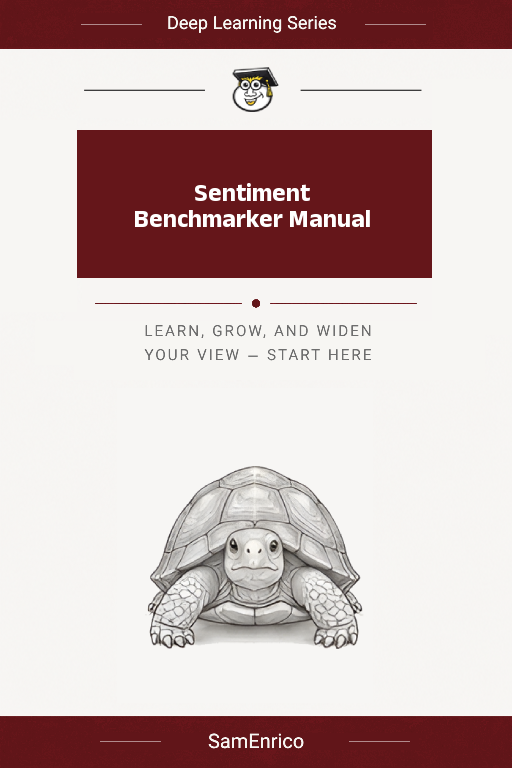
Non-FictionAI OperatorReputation ManagementBenchmark Guide
Sentiment Benchmarker Manual eBook
Compare brand sentiment against competitors using
Compare brand sentiment against competitors using AI-powered cross-brand analysis and industry norms. Includes competitive positioning, gap identification, and strategic recommendation prompts.
Formats
Free sample
Chapter 1: The Vanity Metrics Graveyard–- In 2013, JCPenney had 8.4 million Facebook likes, a Twitter following of 1.2 million, and a You Tube channel generating millions of views. By 2014, their stock had dropped 60 percent, the CEO was fired, and 33 stores had been shuttered. The likes never left. The followers stayed. The views kept coming.
But the customers were gone.This is the great lie of the digital marketing age. For nearly two decades, brands have been told that volume equals velocity—that more likes, more shares, more followers, and more impressions translate directly into more revenue. The social media platforms built billion-dollar businesses on this premise. The marketing technology industry grew into a $500 billion ecosystem selling tools to measure and optimize these metrics. And brand after brand poured fortunes into content calendars, influencer campaigns, and engagement bait, only to discover what JCPenney learned the hard way: you can have all the likes in the world and still go out of business.The problem is not that these metrics are useless.
The problem is that they are lagging indicators of something that happened yesterday, while brand leaders need leading indicators of what will happen tomorrow. A like tells you that someone stopped scrolling for a fraction of a second. A share tells you that someone found your content minimally valuable to their social identity. A follower tells you that someone once, at some point, clicked a button. None of these tell you whether that person will buy from you, recommend you, defend you, or forget you existed by dinner time.What does tell you?
Sentiment. Not the vague, hand-wavy "brand perception" of annual surveys that take six weeks to field and three months to analyze. Real, granular, AI-powered sentiment that tracks how customers feel about your brand in real time—and how those feelings compare to every competitor in your category, including ones you haven't noticed yet.This book is not a theoretical exploration of sentiment analysis. It is a manual. A step-by-step, tool-agnostic, vendor-neutral playbook for building a competitive brand intelligence capability that predicts market share changes before they appear on a spreadsheet.
By the time you finish Chapter 12, you will have a working system for:Collecting and normalizing sentiment data across your brand and up to ten competitors Establishing a statistically valid baseline that separates signal from noise Identifying sentiment gaps that represent either vulnerabilities or opportunities Engineering AI prompts that generate executive-ready strategic recommendations Building governance structures that prevent bad data from driving bad decisions But before we get to any of that, we need to understand why sentiment benchmarking has become not just valuable but existential for brands in the age of generative AI. Because the rules of brand warfare have changed—and most brand leaders don't even know the new game has started.The 2026 Prediction That Should Keep You Awake In late 2024, Gartner published a prediction that rippled through the marketing analytics community but has yet to reach most brand strategy teams: By 2026, 30 percent of brand perception will be shaped by generative AI content. Let me translate that from analyst-speak into business consequences.Thirty percent of what customers think about your brand will not come from your advertising. It will not come from your social media. It will not come from your website, your packaging, your store associates, or your customer service.
It will come from content generated by large language models—Chat GPT, Gemini, Claude, Grok, Perplexity, and whatever new entrants appear in the next twenty-four months.Consider what this means for a typical consumer journey today. A potential customer searches for "best CRM for small business" on Google. But increasingly, they do not click any of the ten blue links. Instead, they read the AI-generated summary at the top of the search results—a paragraph synthesized from dozens of sources, none of which are attributed in a way the user notices. That summary mentions Salesforce, Hub Spot, and Pipedrive.
It does not mention your CRM, even though you have comparable features and a better price. The user never visits your site. You have lost a customer not because of anything you did wrong, but because an algorithm decided you were not worth mentioning.Now multiply that by millions of searches per day across every category you compete in. That is the new reality. And here is the cruel irony: most brands are still measuring their "share of voice" on Twitter and Instagram while becoming invisible on the platforms where customers are actually forming their opinions.This is not a future problem.
This is a present problem that most brands have not yet diagnosed because they are still looking at the wrong dashboard.The Brand Health Stack: Why Sentiment Is the Critical Bridge To understand where sentiment benchmarking fits, we need a shared framework for brand health. I call this the Brand Health Stack, and it consists of four layers that build on one another. You cannot skip layers. You cannot fake progress. And sentiment is the layer that most brands get wrong.Layer 1: Awareness Awareness is the most basic condition of brand health.
It answers the question: "Does the target customer know you exist?" Awareness can be earned through advertising, public relations, word of mouth, or sheer luck. It can be bought through paid media. It can be measured through surveys, search volume, and share of voice metrics.But awareness alone is worthless. Millions of people are aware of brands they will never buy from. I am aware that Greyhound buses exist.
I am not going to take one to a business meeting. Awareness is the price of entry, not the prize.Layer 2: Sentiment Sentiment answers the question: "How does the target customer feel about you?" This is where most brand measurement stops—and where the real work begins. Sentiment is not a binary (good/bad) but a spectrum of emotions ranging from joy and trust to anger and disgust. Sentiment is not static; it shifts with every product launch, customer service interaction, news story, and competitor move.Critically, sentiment is not the same as satisfaction. A customer can be satisfied with your product—it does what it says on the box—while feeling absolutely nothing about your brand.
That neutral sentiment is a hidden churn risk, as we will explore in Chapter 4. A customer who feels nothing is one small inconvenience away from leaving for a competitor who makes them feel something.Layer 3: Trust Trust is what happens when positive sentiment becomes durable. It answers the question: "Does the target customer believe you will do what you say, consistently, over time?" Trust is not built through a single campaign or a single great experience. It is built through hundreds of small confirmations that your brand is reliable, honest, and transparent.Trust is also the most fragile layer. A single breach of trust—a data leak, a deceptive practice, a broken promise—can destroy years of accumulated trust in days.
And because trust is often invisible until it is gone, it requires active monitoring through sentiment data that tracks trust-related keywords like "reliable," "honest," "transparent," and "secure."Layer 4: Advocacy Advocacy is the ultimate expression of brand health. It answers the question: "Does the target customer actively…
This is the end of the free sample. Get the eBook to keep going. Buy now
About this book
Details
- Author
- Moses Rosella
- Publisher
- SamEnrico
- Language
- English
- Genre
- Non-Fiction, AI Operator, Reputation Management, Benchmark Guide
- Released
- 2026-05-30
- Pages (approx.)
- 157
- Available as
- eBook, Audiobook

Read better in the ZLOADR app
Your eBooks on your phone or tablet. Sign in with your SamEnrico account and start reading.
More by Moses Rosella
 Construction Crane Operator High Rise Stress CourseMoses Rosella$11.99
 Fecal Transplant Brain EffectsMoses Rosella$11.99
 Resentment After Organ DonationMoses Rosella$11.99
 The Workaholism Self Assessment ManualMoses Rosella$11.99
 Aum Shinrikyo Escapee StoryMoses Rosella$11.99
 The Last Alchemist of Byzantium: Secrets in the FlamesMoses Rosella$11.99
 Understanding Laurence–moon–bardet–biedl SyndromeMoses Rosella$17.99
 A Beginners Guide to Disc dog (Volume 1)Moses Rosella$11.99
 Retail Omnichannel FulfillmentMoses Rosella$12.99
 CDCA Chemical Dependency Counselor AssistantMoses Rosella$11.99
You may also like
 Hong Kong Handover 1997Dunn Johnnie$11.99
 Zumba For Postnatal Recovery CourseNeal Christian$11.99
 Zumba for BeginnersLadner Nikia$11.99
 YouTube Comment Mining GuideHumes Pandora$12.99
 Worry Box MeditationCarlin Rudy$11.99
 Workplace Stress MeditationNguyen Lynn$11.99
 Workplace Stress and Sleep RepairHawley Ivory$11.99
 Workplace Perfectionism CureDelaney Jeffry$11.99
 Workplace Injustice Anger GuideWallen Isabelle$11.99
 Work Addiction and Burnout LinkGreenwood Ester$11.99
 Women in Yoga and WellnessBeattie Galina$11.99
 Women in Stand Up ComedyChun Evangeline$11.99