
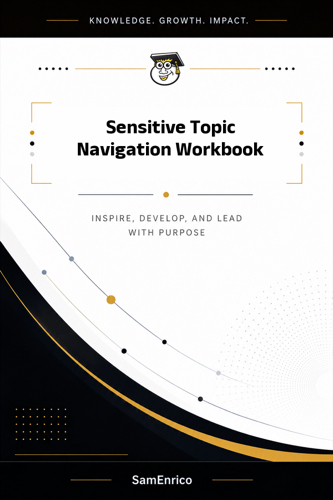
Sensitive Topic Navigation Workbook eBook
Discuss health, money, or politics carefully witho
Discuss health, money, or politics carefully without causing discomfort.
Formats
Free sample
Chapter 1: The Three Danger Zones--Most people go through life believing that certain topics are simply "too personal" to discuss. They learn this rule at dinner tables, in break rooms, and across family gatherings where someone inevitably announces, "Let's not talk about politics," or "Money is private," or "Health decisions are between you and your doctor." On the surface, this sounds like good manners. But beneath that polite surface lies a quiet epidemic of fractured relationships, unspoken resentments, and conversations that should have happened but never did.The truth is that health, money, and politics are not dangerous because they are inherently rude or invasive. They are dangerous because each one threatens a core human need—identity, security, or belonging. And when a core need feels threatened, the brain responds as if it is under physical attack.
The heart rate spikes. The amygdala activates. The nervous system prepares to fight, flee, or freeze. In that state, rational discussion becomes nearly impossible. This is not a character flaw.
It is basic neuroscience.The good news is that understanding why these three topics trigger such strong reactions is the first step toward navigating them skillfully. This chapter will walk you through each danger zone in detail, help you identify your personal "hot buttons," and introduce the single most important question you can ask yourself before any sensitive conversation: What is my real goal here?Why These Three? The Neuroscience of Trigger Topics Before we examine health, money, and politics individually, we need to understand what they share in common. Research in social neuroscience has identified three domains that the human brain treats as survival threats: threats to identity (who I am), threats to scarcity (whether I will have enough), and threats to tribal belonging (whether my people are safe). These map almost perfectly onto health, money, and politics.Health threatens identity.
When someone challenges your health choices—what you eat, whether you vaccinate, how you manage a chronic condition—they are not just offering an opinion. They are implicitly questioning your competence as a caretaker of your own body. For people with chronic illness, health choices become intertwined with daily survival. To criticize a health decision can feel like an attack on the self.Money threatens scarcity. The brain processes financial loss in the same regions that process physical pain.
This is not a metaphor. Neuroimaging studies show that thinking about losing money activates the insula and the anterior cingulate cortex—the same areas that light up when you burn your hand. Money conversations trigger ancient circuits designed to protect you from starvation and exile. That is why a comment about your spending habits can feel like a punch to the gut.Politics threatens tribal belonging. Human beings evolved in tribes where being expelled meant death.
Political identity today functions as a proxy for tribal affiliation. When someone attacks your political views, your brain does not hear a disagreement about policy. It hears: Your people are wrong. You might be cast out. This is why political conversations escalate faster than almost any other topic.Understanding this neurobiology does not excuse bad behavior.
But it does explain why otherwise reasonable people lose their minds over a comment about vaccines, a question about salary, or a remark about an election. You are not weak for having a strong reaction. You are human.Danger Zone One: Health – Identity and Autonomy Let us begin with the most intimate danger zone: health. Health conversations are uniquely volatile because they touch on three deeply personal domains: bodily autonomy, mortality, and personal responsibility.Bodily autonomy is the principle that you have final say over what happens to your body. When someone offers unsolicited advice about your weight, your medication, or your exercise routine, they are implicitly violating that autonomy.
Even if they mean well, the message received is often: You are not capable of managing your own body.Mortality is the elephant in every health conversation. Discussions about vaccines, end-of-life care, or serious diagnoses force both parties to confront the fact that bodies fail. Most people cope with this reality by avoiding it. When you bring up a health topic, you may be triggering their unspoken terror of death.Personal responsibility cuts both ways. In some health conversations, the underlying message is: If you had made better choices, you would not be in this situation.
This is almost never helpful. It is also almost never true in any simple way. But the fear of being judged as irresponsible drives many people to become defensive at the first mention of a health topic.Common Health Flashpoints The following topics generate the most frequent and intense conflicts in the health domain. As you read this list, notice which ones make your chest tighten or your jaw clench.Vaccines. This topic sits at the intersection of personal choice, public health, and trust in institutions.
Arguments about vaccines are rarely about the scientific data alone. They are about whether you trust pharmaceutical companies, government agencies, and medical authorities—and whether you believe individual freedom should outweigh community protection.Weight and body image. Few topics carry more shame than weight. Comments about diet, exercise, or appearance are almost always received as personal criticism, regardless of intent. This is because most people already carry an internal narrative of judgment about their own bodies.Mental health.
Discussions about depression, anxiety, medication, or therapy often trigger fears of being seen as "crazy," "weak," or "dramatic." Even well-meaning suggestions ("Have you tried yoga?") can feel dismissive of genuine suffering.Chronic illness. When someone lives with a condition that has no clear cure, they have often tried dozens of treatments and heard hundreds of opinions. Unsolicited advice about diet changes or alternative medicine can feel exhausting and insulting.End-of-life care. No topic triggers mortality fears more directly than discussions about what happens when someone is dying. Families tear apart over disagreements about feeding tubes, resuscitation orders, and hospice care—not because anyone is evil, but because everyone is afraid.Your Health Hot Button Exercise Take out a notebook or open a new document.
Write down three specific phrases or comments related to health that have made you feel defensive, angry, or shut down in the past. Examples might include:"You should really try this diet.""I can't believe you haven't gotten the vaccine.""Have you considered that your anxiety might be caused by something you're eating?"After each phrase, write down the fear that phrase triggered in you. Be honest. The fear might be: They think I'm irresponsible. They think I'm weak.
They think I'm a bad parent. They think I don't care about other people.Naming your hot buttons in advance is like putting on armor before a battle. You cannot prevent yourself from being triggered. But you can recognize the trigger when it happens and choose your response instead of reacting automatically.Danger Zone Two: Money – Scarcity and Shame If health conversations threaten identity, money conversations threaten something even more primitive: the sense that you will be safe and secure. Money is not just currency.
It is stored time, stored freedom, and stored protection against disaster. To criticize someone's financial choices is to suggest that they are mismanaging…
This is the end of the free sample. Get the eBook to keep going. Buy now
About this book
Details
- Author
- Duran Rayford
- Publisher
- SamEnrico
- Language
- English
- Genre
- Non-Fiction, Self-Help, Difficult Conversations, Tact
- Released
- 2026-06-07
- Pages (approx.)
- 152
- Available as
- eBook, Audiobook

Read better in the ZLOADR app
Your eBooks on your phone or tablet. Sign in with your SamEnrico account and start reading.
More by Duran Rayford
 Workplace Habit CultureDuran Rayford$11.99
 Mindfulness For Impulsive People WorkbookDuran Rayford$11.99
 Walking Meditation for EmpathsDuran Rayford$11.99
 Competitive Matrix TemplateDuran Rayford$11.99
 The Djinn of the Empty Quarter: Whispers in the SandsDuran Rayford$11.99
 Endurance: Shackleton's Impossible Survival in the Frozen WastesDuran Rayford$11.99
 Ship FitterDuran Rayford$11.99
 Payment Dispute Resolution WorkbookDuran Rayford$12.99
 BPO Vendor Selection GuideDuran Rayford$12.99
 Understanding Granulomas, Congenital CerebralDuran Rayford$17.99
 How to Start a Bug Zappers Without Light Business (Beginners Guide)Duran Rayford$11.99