
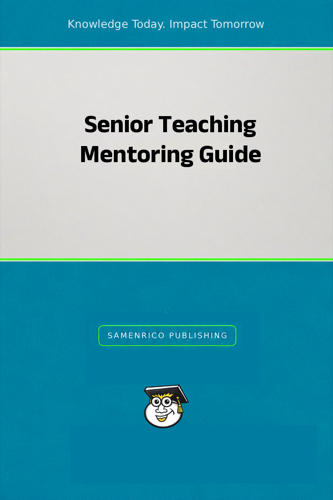
Senior Teaching Mentoring Guide eBook
Share expertise with younger generations for purpo
Share expertise with younger generations for purpose.
Formats
Free sample
Chapter 1: The Wisdom Gap--–- What happens to forty years of hard-won expertise when a senior professional walks out the door for the last time? For most organizations and communities, the answer is devastating and permanent loss. The filing cabinets are emptied, the passwords are handed over, and the institutional memory walks out in a pair of comfortable shoes, never to return. Yet the national conversation about workforce development focuses obsessively on a different problem entirely. Politicians bemoan the "skills gap." Educators redesign curricula to teach "21st century competencies." Corporations pour billions into upskilling their youngest employees.
And all the while, a far larger and more consequential gap yawns unnoticed beneath these efforts—the wisdom gap.This chapter establishes the foundational argument of this entire book: that the most overlooked resource in modern society is not oil, not data, not artificial intelligence, but the lived, tested, failure-scarred wisdom of seniors who have spent decades learning what works and what does not. Drawing on extensive research from the fields of organizational psychology, gerontology, and workforce development, we will explore why the wisdom gap matters more than the skills gap, why traditional retirement models are failing both seniors and society, and why mentoring offers the only scalable solution to both problems simultaneously. By the end of this chapter, you will understand not just why your experience matters, but why it matters urgently—and why waiting even six months to begin mentoring means losing knowledge that can never be recovered.The Myth of the Skills Gap For the past two decades, employers have complained relentlessly about the "skills gap." Young people, they argue, graduate from high schools and colleges without the basic competencies required for entry-level work. They cannot write professional emails. They cannot manage their time without constant supervision.
They cannot think critically about complex problems or communicate solutions to colleagues. The evidence for this gap is mixed—some studies show a genuine deficit, while others suggest that employers have simply raised their expectations—but one thing is clear: focusing exclusively on what young people lack has blinded us to what seniors possess.Patty Alper, author of the seminal work Teach to Work, puts it bluntly: "The United States is abundantly rich in adults with 'know how' who are currently sitting on the sidelines, their expertise untapped." She is describing the approximately forty million Americans over the age of sixty-five who have retired or semi-retired from the workforce. Among these forty million are former engineers who designed bridges that still stand, former nurses who kept patients alive through code blue emergencies, former small business owners who survived three recessions, and former teachers who educated thousands of children. Each of these individuals carries inside their head a lifetime of pattern recognition, troubleshooting heuristics, and hard-won lessons that cannot be found in any textbook or online course.Consider the difference between knowledge and wisdom. Knowledge is information: the capital of South Dakota is Pierre, the Pythagorean theorem calculates the sides of a right triangle, and the standard deduction for a single filer in 2024 is $14,600.
Wisdom is something else entirely. Wisdom is knowing that the capital of South Dakota is frequently misspelled in official documents, so always double-check. Wisdom is knowing that the Pythagorean theorem works perfectly in theory but that construction materials are never perfectly square, so add a quarter-inch margin. Wisdom is knowing that the standard deduction changes every year, so never memorize it—memorize where to look it up instead. Knowledge can be downloaded.
Wisdom must be lived.The skills gap, whatever its true dimensions, can be addressed with training programs, online courses, and on-the-job instruction. The wisdom gap cannot. The only way to acquire wisdom is to watch someone who already has it make decisions, explain their reasoning, admit their mistakes, and then watch again. Wisdom is transmitted through relationship, not through curriculum. And that transmission requires two things that modern society has systematically dismantled: time and proximity between generations.The Quiet Catastrophe of Unshared Wisdom Let us quantify what is at stake.
Every day in the United States, approximately ten thousand people turn sixty-five. Every day, approximately ten thousand people retire or reduce their working hours. And every day, the accumulated wisdom of thousands of careers begins to fade from active use. Some of that wisdom will be written down in manuals or captured in training videos, but the vast majority—the judgment calls, the relational skills, the intuitive "feel" for a machine or a market or a patient—will simply evaporate.This is not hyperbole. Research on organizational knowledge loss suggests that when a senior expert leaves a workplace, it takes between twelve and twenty-four months for their replacement to reach comparable levels of productivity—assuming a replacement is even found.
During that transition period, errors increase, productivity drops, and institutional knowledge is lost forever. Now multiply that loss across every industry, every region, and every year of the coming decade. The cumulative effect is staggering: trillions of dollars in lost economic value, countless hours of duplicated effort, and generations of young people forced to learn lessons that their elders could have taught them in an afternoon.But the catastrophe is not merely economic. It is also cultural and personal. When wisdom goes unshared, societies lose the connective tissue that binds generations together.
Young people grow up without realistic models of what a working life actually looks like. They see only the highlight reels of successful entrepreneurs or the cautionary tales of failed corporations—never the day-to-day grind of problem-solving, the quiet dignity of showing up on time, or the incremental satisfaction of mastering a craft. Seniors, meanwhile, lose the sense of being needed. They withdraw into communities of their own age, speak only to people who already share their assumptions, and slowly lose contact with the world they helped build.This separation is historically unprecedented. For most of human history, elders lived alongside younger generations, sharing meals, stories, and work.
Grandparents taught grandchildren how to plant corn, repair a fence, or navigate a difficult marriage. The industrial revolution began separating generations by sending young people to factories and old people to porches. The information age completed the separation by convincing everyone that wisdom could be found on a screen. It cannot. And the consequences of this delusion are visible in the rising rates of loneliness among seniors, the rising rates of anxiety among young people, and the rising rates of frustration among everyone in between.Reframing Retirement: From Withdrawal to Redeployment If the problem is unshared wisdom, the solution is not to convince seniors to stay in their old jobs indefinitely.
For many, retirement is a well-earned rest from decades of demanding labor. The solution is not to extend working lives, but to redefine what "work" means in the later years. This book proposes a fundamental reframing: retirement should not be withdrawal from contribution, but redeployment to a different battlefield.Consider the language we use around aging. People "retire" from work. They "step down" from leadership.
They "wind down" their careers. Every verb suggests diminishment, slowing, retreat. What if we replaced those verbs with others? What if seniors "redirected" their expertise? What if they "redeployed" their skills?
What if they "transitioned" from doing to teaching? This is not mere semantic play. Language shapes identity, and identity shapes…
This is the end of the free sample. Get the eBook to keep going. Buy now
About this book
Details
- Author
- Moore Gabriel
- Publisher
- SamEnrico
- Language
- English
- Genre
- Non-Fiction, Self-Help, Mentoring
- Released
- 2026-06-09
- Pages (approx.)
- 147
- Available as
- eBook, Audiobook

Read better in the ZLOADR app
Your eBooks on your phone or tablet. Sign in with your SamEnrico account and start reading.
More by Moore Gabriel
 The Focus Reset Routine ManualMoore Gabriel$11.99
 Self Hypnosis for AgilityMoore Gabriel$11.99
 YouTube Shorts Binge GuideMoore Gabriel$11.99
 The Outback Conspiracy: South African Syndicates and the Vanishing of the Kimberley ProspectorsMoore Gabriel$11.99
 Salesforce Marketing Cloud ConsultantMoore Gabriel$11.99
 Remote Worker Safety Protocol ManualMoore Gabriel$12.99
 How to Produce Aerobic StepsMoore Gabriel$11.99
 How to Start a Hobby in ArcheryMoore Gabriel$11.99
You may also like
 Hong Kong Handover 1997Dunn Johnnie$11.99
 Zumba For Postnatal Recovery CourseNeal Christian$11.99
 Zumba for BeginnersLadner Nikia$11.99
 YouTube Comment Mining GuideHumes Pandora$12.99
 Worry Box MeditationCarlin Rudy$11.99
 Workplace Stress MeditationNguyen Lynn$11.99
 Workplace Stress and Sleep RepairHawley Ivory$11.99
 Workplace Perfectionism CureDelaney Jeffry$11.99
 Workplace Injustice Anger GuideWallen Isabelle$11.99
 Work Addiction and Burnout LinkGreenwood Ester$11.99
 Women in Yoga and WellnessBeattie Galina$11.99
 Women in Stand Up ComedyChun Evangeline$11.99