
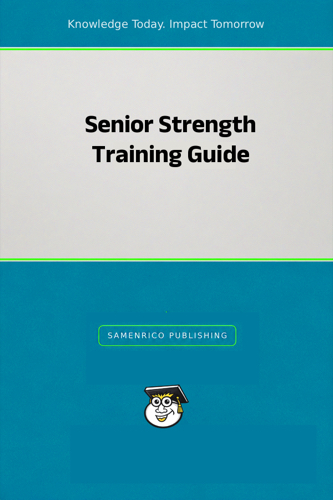
Non-FictionHealth & WellnessSenior Fitness
Senior Strength Training Guide eBook
Build muscle safely in older age to prevent falls
by Zapata Abbie
Build muscle safely in older age to prevent falls and maintain independence.
Formats
Free sample
Chapter 1: The 45-Minute Truth--George was seventy-three years old, a retired carpenter who had spent forty years building things that lasted. He could still recite the measurements for a perfect dovetail joint from memory. He had survived a heart attack at sixty-one and a bout of pneumonia at sixty-eight. He was, by his own definition, a tough old bird.On a Tuesday afternoon in October, he tripped over a garden hose in his own backyard.Not a dramatic fall. Not off a ladder or down a flight of stairs.
Just a slow, awkward stumble that ended with him sitting on the damp grass, surprised more than hurt. He tried to get up. He pushed against the ground with his hands. Nothing happened. He tried again, rocking forward onto his knees.
His quadriceps—the large muscles on the front of his thighs—simply refused to cooperate. They had, over the previous decade, lost nearly forty percent of their strength. He just didn't know it yet.George sat on the grass for forty-five minutes. He called out for his wife, but she was at the grocery store. He tried crawling toward the back door, but his knees hurt too much.
So he waited. When his wife finally found him, she had to call the fire department to lift him off the ground. He wasn't injured from the fall. He was injured from the forty-five minutes of lying still—the cold seeping into his joints, the muscle fibers beginning to break down, the quiet humiliation settling into his bones.Three months later, George moved into an assisted living facility. His doctor said the fall had "broken his confidence." But that wasn't quite right.
The fall had revealed something George had been ignoring for years: his muscle had been quietly disappearing, like sand through an hourglass, and he had run out of time.The Statistic That Should Terrify You Let me tell you a different story. This one is about a woman named Margaret. She was sixty-seven, a retired schoolteacher who had never set foot in a gym. She believed, like many people her age, that "taking it easy" was the path to safety. She avoided stairs.
She asked her husband to carry the heavy grocery bags. She sat down to fold laundry because standing for too long made her legs feel shaky.One morning, she reached for a coffee mug on a high shelf and lost her balance. She didn't fall—she caught herself on the kitchen counter. But the incident scared her badly enough that she called her daughter, who happened to be a physical therapist. Her daughter didn't say "be careful." She said, "Mom, when was the last time you tried to stand on one leg for ten seconds?"Margaret couldn't.
Her leg wobbled and gave way after three seconds.Here is the statistic that separates George's story from Margaret's: after the age of sixty, an untrained adult loses roughly three percent of their muscle strength per year. That is not a typo. Three percent. Every year. By age seventy-five, that adds up to a forty-five percent loss in functional strength.
The medical term for this is sarcopenia, from the Greek words for "poverty of flesh."But I want you to understand what that number actually means in human terms.A forty-five percent loss in strength means that the muscles which once allowed you to rise from a chair without using your hands now require you to push off the armrests. It means the stabilizing muscles around your hips and spine, which once automatically corrected a slight stumble, now react too slowly to prevent a fall. It means that if you do fall—and one in four Americans over sixty-five falls each year—you may not have the strength to get back up.George didn't know he was losing strength. He thought he was just "getting older." Margaret, on the other hand, learned the truth before it was too late. She started strength training at sixty-seven.
By seventy, she could carry both grocery bags from the car to the kitchen without stopping. By seventy-two, she could get off the floor using only one hand.This book is the difference between George and Margaret. It is the difference between a fall that ends your independence and a stumble that becomes nothing more than a brief annoyance.Why "Fall Prevention" Is a Dangerous Lie You have heard the phrase "fall prevention" your entire adult life. Your doctor has probably used it. Your children have used it.
The commercials for medical alert devices use it. The phrase sounds sensible, even wise: prevent the fall, prevent the injury.But here is the problem with "fall prevention" as a strategy: it doesn't work.Falls are not random accidents. They are not acts of God or bad luck. Falls are the predictable, measurable, and—most importantly—preventable result of specific physical deficits. You fall because your reaction time has slowed.
You fall because the small stabilizing muscles around your ankles and hips have weakened. You fall because your brain and your body have lost the high-speed communication network that keeps you upright when the ground beneath you shifts unexpectedly.The "fall prevention" industry has sold you a bill of goods. They want you to install grab bars in your shower. They want you to buy non-slip bathmats. They want you to walk more slowly, take smaller steps, and avoid "dangerous" activities like climbing ladders or walking on uneven ground.None of these things actually prevent falls.
They merely avoid them. And avoidance comes with a terrible hidden cost: the more you avoid movement, the weaker you become. The weaker you become, the more likely you are to fall when the unavoidable stumble finally occurs.I am going to offer you a different framework. It is not "fall prevention." It is fall resilience.Fall resilience means accepting that you will occasionally stumble. That is a fact of human biology, not a moral failing.
Fall resilience means building a body that can handle the stumble—muscles that react quickly, bones that can absorb impact, joints that move through a full range of motion, and a nervous system that coordinates it all in milliseconds.Think of it this way: you cannot prevent every car accident. But you can wear a seatbelt. You cannot prevent every bump to the head. But you can wear a helmet. Fall resilience is building a protective "crash helmet" of muscle around your hips and spine—the parts of your body that hit the ground first in most falls.That is the core metaphor of this book.
Every exercise you will learn, every habit you will build, every meal you will eat is about adding another layer of padding to that crash helmet. By the time you finish this book, you will not be afraid of falling. You will be confident that if you fall, you will get back up.The Self-Audit: Where Are You Right Now?Before we go any further, I need you to take an honest look at where your body currently stands. This is not a test. There is no passing or failing.
This is simply a baseline—a snapshot that will allow you to measure your progress over the next twelve weeks.Find a…
This is the end of the free sample. Get the eBook to keep going. Buy now
About this book
Details
- Author
- Zapata Abbie
- Publisher
- SamEnrico
- Language
- English
- Genre
- Non-Fiction, Health & Wellness, Senior Fitness
- Released
- 2026-06-10
- Pages (approx.)
- 146
- Available as
- eBook, Audiobook

Read better in the ZLOADR app
Your eBooks on your phone or tablet. Sign in with your SamEnrico account and start reading.
More by Zapata Abbie
 AgTech Investment GuideZapata Abbie$11.99
 Post Hospital Sarcopenia PlanZapata Abbie$11.99
 Pesticide Drift Home ProtectionZapata Abbie$11.99
 Enmeshment Trauma TriggersZapata Abbie$11.99
 Parental Anger ManagementZapata Abbie$11.99
 Lactose IBS ManagementZapata Abbie$11.99
 Alcohol Recovery for Older AdultsZapata Abbie$11.99
 Time Blocking Mastery GuideZapata Abbie$11.99
 Silk & Sabotage: The Rise and Fall of the House of WorthZapata Abbie$11.99
 The Tide of Titans: How the Dutch Built a Maritime EmpireZapata Abbie$11.99
 The Last Scribe of Alexandria: Unraveling the Lost Library’s Final GuardianZapata Abbie$11.99
 How to Start a Pork Pie Business (Beginners Guide)Zapata Abbie$11.99
You may also like
 Hong Kong Handover 1997Dunn Johnnie$11.99
 Zumba For Postnatal Recovery CourseNeal Christian$11.99
 Zumba for BeginnersLadner Nikia$11.99
 YouTube Comment Mining GuideHumes Pandora$12.99
 Worry Box MeditationCarlin Rudy$11.99
 Workplace Stress MeditationNguyen Lynn$11.99
 Workplace Stress and Sleep RepairHawley Ivory$11.99
 Workplace Perfectionism CureDelaney Jeffry$11.99
 Workplace Injustice Anger GuideWallen Isabelle$11.99
 Work Addiction and Burnout LinkGreenwood Ester$11.99
 Women in Yoga and WellnessBeattie Galina$11.99
 Women in Stand Up ComedyChun Evangeline$11.99