

Non-FictionHealth & WellnessGeriatric Sleep
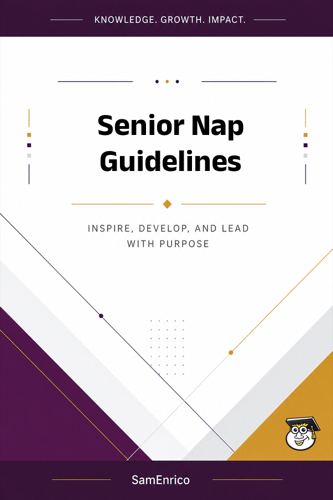
Senior Nap Guidelines eBook
Age-related napping strategies for older adults.
Age-related napping strategies for older adults.
Formats
Free sample
Chapter 1: The 6.6-Hour Lie--–- Margaret, age seventy-two, had spent three years apologizing for her afternoon naps. She hid them like a teenager hiding cigarettes. When her daughter called at 2:00 PM, Margaret would whisper, “I was just resting my eyes.” When the doorbell rang, she would jolt upright, smooth her hair, and pretend she had been organizing the pantry. She told her bridge club that she “didn’t really need naps” while secretly building her entire day around the one hour when she could finally close her eyes without guilt. Margaret is not lazy.
Margaret is not depressed. Margaret is not suffering from a terrible disease. Margaret is a normal seventy-two-year-old whose body has done exactly what human biology predicts: she has shifted from a monophasic sleep pattern (one long sleep at night) to a biphasic pattern (one shorter night sleep plus one daytime nap). And every single day, she fights this biology because a voice inside her head—planted by decades of cultural messaging—whispers that napping is for children, the infirm, and the unmotivated.This book exists to kill that voice.The Great Sleep Myth We have been sold a lie about aging and sleep. The lie has three parts.
First, that older adults need less sleep than younger adults. Second, that waking up at 3:00 AM unable to fall back asleep is a sign of “insomnia” that must be medicated. Third, that daytime napping is a crutch for people who have “let themselves go.” None of these statements are true. None of them are supported by the scientific literature. And yet, these three myths have caused millions of older adults to spend their golden years exhausted, anxious, and secretly napping in parked cars.Let us examine the first myth.
The National Sleep Foundation and the National Institute on Aging have conducted large-scale studies measuring actual sleep duration across the lifespan. The data are unambiguous: older adults do not need less sleep. They need the same seven to nine hours per twenty-four-hour period as younger adults. The difference is that older adults cannot always get those seven to nine hours in a single nocturnal block. The average nighttime sleep duration for adults over sixty-five is 6.6 hours.
That is not a target. That is a deficit. A 6.6-hour night is like a paycheck that covers only two-thirds of your bills. You can survive, but you will accumulate debt. And that debt—sleep debt—manifests as daytime fatigue, brain fog, irritability, weakened immune function, and increased risk of falls.The second myth—that early morning waking is pathological insomnia—requires a deeper dive into circadian biology.
Most older adults experience what sleep scientists call advanced sleep phase syndrome. Your internal clock, located in the suprachiasmatic nucleus of the hypothalamus, shifts forward as you age. This means your body starts releasing melatonin earlier in the evening (making you tired at 7:00 PM instead of 10:00 PM) and stops producing melatonin earlier in the morning (making you wake at 3:00 AM instead of 7:00 AM). This is not a disorder. This is a predictable, biological change.
Calling it “insomnia” and treating it with sedatives is like calling gray hair a “scalp disorder” and treating it with hair dye. You are masking the symptom, not understanding the cause.The third myth—that napping is a sign of decline—is the most pernicious. In cultures that have not been infected by Protestant work ethic and industrial capitalism, the afternoon nap is ritualized. The siesta in Spain. The riposo in Italy.
The qaylulah in Islamic cultures, where the Prophet Muhammad reportedly said, “Take a nap, for the devils do not take naps.” These cultures did not develop napping traditions because they were lazy. They developed them because human physiology is biphasic. Core body temperature drops in the early afternoon, triggering a natural dip in alertness. This is not a design flaw. This is a design feature.
Fighting it with caffeine, willpower, and guilt is fighting your own biology.The Architecture of Aging Sleep To understand why napping is not just acceptable but necessary for many older adults, you must first understand what happens to your sleep architecture as you age. Sleep is not a uniform state. It is composed of distinct stages that cycle throughout the night.Stage 1 is the lightest sleep, the drifting-off stage that lasts only a few minutes. Stage 2 is slightly deeper, accounting for about fifty percent of total sleep in young adults. It is characterized by sleep spindles and K-complexes—brain wave patterns that help with memory consolidation and sensory gating (the ability to ignore background noise).
Stage 3 is slow-wave sleep, also called deep sleep or delta sleep. This is the physically restorative stage. Your body repairs tissue, releases growth hormone, clears metabolic waste from the brain (including beta-amyloid, the protein associated with Alzheimer’s disease), and strengthens your immune system. REM sleep (rapid eye movement) is the stage associated with vivid dreaming, emotional processing, and procedural memory consolidation.Here is what happens with age: Slow-wave sleep declines dramatically. A young adult might spend 20-25% of the night in deep sleep.
By age sixty, that number often drops to 5-10%. By age eighty, many adults have almost no measurable slow-wave sleep. REM sleep also declines, though less steeply. The result is that older adults spend more time in Stage 1 and Stage 2 sleep—lighter, more easily disrupted sleep. This is why you wake up more easily to a creaking floorboard or a distant siren.
This is why you feel like you “didn’t sleep deeply.” You didn’t. Your brain physically cannot generate the same amount of slow-wave activity it did at twenty.But here is the crucial insight that most sleep books miss: The total amount of slow-wave sleep your brain needs has not changed. Your body still requires the physical restoration that deep sleep provides. If you cannot get that restoration at night because your brain has lost the ability to sustain long periods of slow-wave activity, you must get it elsewhere. That elsewhere is napping.
Short naps—particularly those timed to capture the early afternoon circadian dip—can generate Stage 2 sleep and even some slow-wave sleep, depending on duration. They are not a “consolation prize.” They are a legitimate, biologically necessary supplement to a nocturnal sleep architecture that has changed through no fault of your own.The 6.6-Hour Reality Let us return to that 6.6-hour statistic because it is the most misunderstood number in geriatric sleep medicine. When researchers attach actigraphs (wristwatch-like devices that measure movement and light) to older adults and track their sleep for a week, the average total sleep time is 6.6 hours per night. But here is what the headlines do not tell you: Successful agers—older adults who report high levels of energy, cognitive sharpness, and life satisfaction—almost always nap. They do not nap because they are tired from a bad night.
They nap because they have learned to distribute their sleep across a twenty-four-hour cycle. They sleep 6 hours at night and 1 hour during the day. Total sleep: 7 hours. Right in the recommended range.The unsuccessful agers—those who report fatigue, depression, and cognitive complaints—fall into two groups. The first group sleeps 6.6 hours at night, refuses to…
This is the end of the free sample. Get the eBook to keep going. Buy now
About this book
Details
- Author
- Quezada Jillian
- Publisher
- SamEnrico
- Language
- English
- Genre
- Non-Fiction, Health & Wellness, Geriatric Sleep
- Released
- 2026-06-07
- Pages (approx.)
- 152
- Available as
- eBook, Audiobook

Read better in the ZLOADR app
Your eBooks on your phone or tablet. Sign in with your SamEnrico account and start reading.
More by Quezada Jillian
 Reverse Mortgage for Downsizing AnalysisQuezada Jillian$11.99
 Stimulant Craving ManagementQuezada Jillian$11.99
 Name Memorization ScienceQuezada Jillian$11.99
 Mentoring Self Esteem GuideQuezada Jillian$11.99
 Half Sibling ReconciliationQuezada Jillian$11.99
 Compulsive Spender's Financial AuditQuezada Jillian$11.99
 OKRs for Engineering TeamsQuezada Jillian$11.99
 The Poisoner of Montreal: The Deadly Vendetta of Thérèse DéryQuezada Jillian$11.99
 The Lion’s Den: South Africa’s Greatest Prison BreakQuezada Jillian$11.99
 A Collector's Handbook to the Lamborghini IiQuezada Jillian$11.99
 API Reporting and Reconciliation HandbookQuezada Jillian$12.99
 Open Account Export TermsQuezada Jillian$12.99
You may also like
 Hong Kong Handover 1997Dunn Johnnie$11.99
 Zumba For Postnatal Recovery CourseNeal Christian$11.99
 Zumba for BeginnersLadner Nikia$11.99
 YouTube Comment Mining GuideHumes Pandora$12.99
 Worry Box MeditationCarlin Rudy$11.99
 Workplace Stress MeditationNguyen Lynn$11.99
 Workplace Stress and Sleep RepairHawley Ivory$11.99
 Workplace Perfectionism CureDelaney Jeffry$11.99
 Workplace Injustice Anger GuideWallen Isabelle$11.99
 Work Addiction and Burnout LinkGreenwood Ester$11.99
 Women in Yoga and WellnessBeattie Galina$11.99
 Women in Stand Up ComedyChun Evangeline$11.99