

Non-FictionSelf-HelpMentoringTeaching
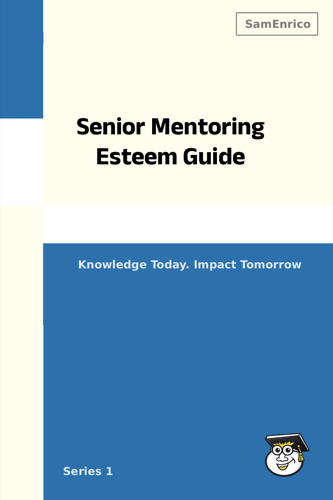
Senior Mentoring Esteem Guide eBook
Boost self worth by sharing skills and wisdom with
Boost self worth by sharing skills and wisdom with younger generations.
Formats
Free sample
Chapter 1: The Obsolescence Myth--–- The first time Carol realized she had become invisible, she was standing in line at a grocery store, holding a bag of cat food and a loaf of bread. The young cashier looked through her—not around her, not past her, but through her—as if Carol had already become a photograph rather than a person. When Carol smiled and asked about the cashier’s day, the response was a grunt. When she fumbled for exact change, there was a sigh. Walking to her car, Carol thought: I used to run a department of forty people.
I negotiated contracts worth millions. And now I cannot get a teenager to look me in the eye.That night, alone in her two-bedroom condo, Carol did what millions of seniors do every evening: she scrolled through her phone, watched a home renovation show she didn’t care about, and went to bed at 8:45. Not because she was tired. Because there was no reason to stay awake.Carol is not real. But Carol is every senior who has ever whispered to a friend, “I feel like I’m already gone, and nobody’s bothered to hold a funeral.”This book exists because of Carol.
And because of the hundreds of thousands of real men and women over sixty who have been told, explicitly or implicitly, that their time is over. That their skills are obsolete. That their knowledge belongs to a world that no longer exists. That the only appropriate posture for their remaining years is quiet consumption: cruises, golf, gardening, and waiting.That narrative is a lie. And in this chapter, we are going to dismantle it brick by brick.The Great Disappearing Act The lie begins early.
In the workplace, it arrives as a “voluntary” early retirement package, wrapped in cheerful language about “new chapters” and “well-deserved rest.” In families, it manifests as adult children who say, “Mom, just relax, you’ve earned it,” while quietly taking over the checkbook and the decision-making. In culture, it bombards seniors through advertising that portrays older adults as either frail and confused (the life-alert commercial falling down the stairs) or comically out of touch (the grandpa who doesn’t understand emojis).There is a word for this process: social obsolescence. It is the systematic devaluation of human beings based on age, disguised as concern. And it is one of the most destructive forces in modern life—not because it makes seniors sad (though it does), but because it robs younger generations of precisely what they need most.What do young people need? They need perspective in a world that rewards speed over wisdom.
They need problem-solving skills in an economy that punishes mistakes. They need emotional regulation in a culture that confuses self-expression with self-destruction. They need someone who has failed and survived to tell them that failure is not the end.In other words, they need Carol. They need you.But first, you have to stop believing the lie.The Two Knowledges: Ephemeral vs. Durable Let us draw a distinction that will serve as the backbone of this entire book.
There are two kinds of knowledge in the world. One is celebrated. The other is ignored. The one that is celebrated is not the one that matters most.Ephemeral knowledge is knowledge that has a short shelf life. It changes rapidly.
It is tied to specific technologies, trends, or cultural moments. Examples include: knowing how to use the latest social media app, understanding current slang, memorizing the most popular Netflix show, or being up-to-date on celebrity gossip. Ephemeral knowledge is valuable—it helps people connect, it signals belonging, and it oils the gears of social interaction. But ephemeral knowledge is also cheap. A teenager can acquire it in an afternoon.
An algorithm can generate it instantly.Durable knowledge is knowledge that ages like whiskey, not like milk. It solves problems that have existed for thousands of years and will exist for thousands more. Examples include: knowing how to calm a person in the middle of a panic attack, understanding how to negotiate a raise without burning a bridge, being able to repair a leaking pipe, knowing how to apologize in a way that actually heals a relationship, recognizing the early signs of a stroke, understanding how to budget during a financial crisis, and knowing when to speak and when to stay silent.Here is the truth that the culture of obsolescence hides from you: seniors are not poor in ephemeral knowledge; they are rich in durable knowledge. And durable knowledge is what actually saves lives, builds careers, mends families, and steers communities through chaos.The young cashier who looked through Carol had ephemeral knowledge in spades. She knew how to operate the register, how to scan items quickly, how to process a credit card.
But Carol—the woman who had negotiated million-dollar contracts and managed dozens of employees—possessed durable knowledge that the cashier could not even name, let alone deploy. Carol knew how to handle an angry customer without becoming angry herself. Carol knew how to prioritize when ten things were on fire at once. Carol knew how to admit a mistake without collapsing into shame.That knowledge does not expire. It does not become obsolete.
It only becomes invisible when we stop believing it has value.The Preservation Paradox In a culture obsessed with disruption, we have forgotten the value of preservation. Disruption means tearing things down to build something new. Preservation means keeping what works while adding what is missing. Disruption is loud, fast, and exciting. Preservation is quiet, slow, and boring.
But preservation is also what keeps airplanes from falling out of the sky, what keeps hospitals from descending into chaos, and what keeps families from fracturing beyond repair.Seniors are the world’s foremost experts in preservation. Not because they hate change, but because they have lived through enough change to know which parts of the old world are worth carrying forward.Consider the retired engineer who saved a local factory from collapse. The factory had new machines, new software, and young managers full of disruptive ideas. But no one knew how to maintain the ancient HVAC system that kept the production line at the right temperature. No one remembered where the original blueprints were filed.
No one had a relationship with the city inspector who had signed off on the building forty years ago. The engineer, who had been dismissed as “out of touch,” spent three weeks documenting the undocumented, calling the unreturned calls, and fixing the unfixed. The factory stayed open. Two hundred people kept their jobs.That is preservation. That is durable knowledge.
That is the value that does not show up on a resume but shows up in the difference between thriving and shuttering.The Cost of Believing You Are Obsolete Believing the obsolescence myth is not a neutral act. It has real, measurable consequences for seniors’ health, relationships, and life expectancy.Research consistently shows that seniors who believe they are a burden to others have significantly higher rates of depression, cognitive decline, and early mortality. Conversely, seniors who report feeling “useful” or “needed” live longer, stay sharper, and report higher life…
This is the end of the free sample. Get the eBook to keep going. Buy now
About this book
Details
- Author
- Beane Stefanie
- Publisher
- SamEnrico
- Language
- English
- Genre
- Non-Fiction, Self-Help, Mentoring, Teaching
- Released
- 2026-06-09
- Pages (approx.)
- 136
- Available as
- eBook, Audiobook

Read better in the ZLOADR app
Your eBooks on your phone or tablet. Sign in with your SamEnrico account and start reading.
More by Beane Stefanie
 Assertive Military LeadershipBeane Stefanie$11.99
 Immigrant Poverty StoryBeane Stefanie$11.99
 Gratitude for the Unlived LifeBeane Stefanie$11.99
 The Morning Coffee Mindfulness GuideBeane Stefanie$11.99
 The Phantom Printers: The Supernatural Secrets of the Counterfeit UndergroundBeane Stefanie$11.99
 Chainsaw Operation (Safety)Beane Stefanie$11.99
 Zoom SWOT Analysis GuideBeane Stefanie$12.99
 Accounting Formulas for Financial ModelingBeane Stefanie$12.99
 Understanding Myopathy Ophthalmoplegia Hypoacousia AreflexiaBeane Stefanie$17.99
 How to Become a Dog BatherBeane Stefanie$11.99
You may also like
 Hong Kong Handover 1997Dunn Johnnie$11.99
 Zumba For Postnatal Recovery CourseNeal Christian$11.99
 Zumba for BeginnersLadner Nikia$11.99
 YouTube Comment Mining GuideHumes Pandora$12.99
 Worry Box MeditationCarlin Rudy$11.99
 Workplace Stress MeditationNguyen Lynn$11.99
 Workplace Stress and Sleep RepairHawley Ivory$11.99
 Workplace Perfectionism CureDelaney Jeffry$11.99
 Workplace Injustice Anger GuideWallen Isabelle$11.99
 Work Addiction and Burnout LinkGreenwood Ester$11.99
 Women in Yoga and WellnessBeattie Galina$11.99
 Women in Stand Up ComedyChun Evangeline$11.99