
Non-FictionBusiness BriefDevelopment
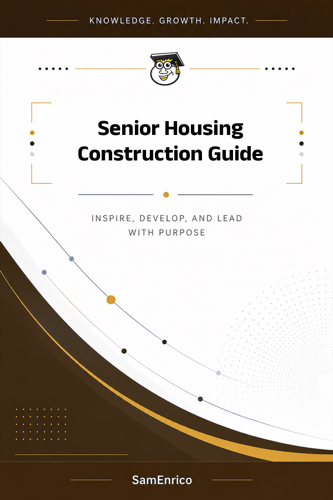
Senior Housing Construction Guide
Calculates build costs and development margins for
Calculates build costs and development margins for new facilities.
Formats
About this book
Free sample
Chapter 1: Beyond Drywall...--–- The first time I watched a senior housing developer lose $2 million, it wasn't because of bad luck. It was because he thought he was building apartments for old people. That mistake cost him his retirement fund, his marriage, and nearly his sanity. His building was beautiful. His margins were a disaster.
And he never saw it coming because every number on his proforma was built on the wrong assumption: that senior housing is real estate. It is not. Senior housing is healthcare delivery wrapped in hospitality, disguised as real estate. Confuse the three, and you will lose money. Master the distinction, and you will build wealth while solving one of the most urgent demographic crises of our time.This chapter establishes the foundational truth that runs through every page of this book: senior housing is neither standard residential construction nor acute-care hospital building.
It is a hybrid asset class requiring specialized financial and operational logic. Get this wrong at the outset, and no amount of value engineering, creative financing, or lease-up heroics will save your project. Get it right, and you will understand why the next decade presents the single greatest opportunity in commercial real estate development.The Four Product Types: Know What You Are Actually Building Before discussing costs, margins, or construction schedules, you must understand what you are building for whom. The senior housing industry divides into four primary product types, each with distinct construction costs, regulatory burdens, staffing requirements, and margin profiles.Independent Living (IL)Independent living communities are the closest to conventional multifamily housing. Residents are typically ages 75 to 85, fully ambulatory, and require no daily assistance with activities of daily living (ADLs)—bathing, dressing, eating, toileting, transferring, and continence.
The value proposition is lifestyle: maintenance-free living, social programming, meals, and security.From a construction perspective, IL resembles upscale apartment buildings with two critical differences. First, accessibility features are more robust: wider doorways (36 inches minimum), roll-in showers with benches, lever-style door handles, and non-slip flooring throughout. Second, common areas are larger and more numerous because residents spend more time on-site than conventional…
This is the end of the free sample. Get the eBook to keep going. Buy now
Contents
- Chapter 1
- Chapter 2
- Chapter 3
- Chapter 4
- Chapter 5
- Chapter 6
- Chapter 7
- Chapter 8
- Chapter 9
- Chapter 10
- Chapter 11
- Chapter 12
Details
- Author
- Hefner Wynell
- Publisher
- SamEnrico
- Language
- English
- Genre
- Non-Fiction, Business Brief, Development
- Released
- 2026-06-06
- Pages (approx.)
- 137
- Available as
- eBook, Audiobook

Read better in the ZLOADR app
Your eBooks on your phone or tablet. Sign in with your SamEnrico account and start reading.
More by Hefner Wynell
 Double Depression ExplainedHefner Wynell$11.99
 Gambling Addiction For WomenHefner Wynell$11.99
 Design Challenge FramingHefner Wynell$11.99
 Emotional Validation GuideHefner Wynell$11.99
 Alcoholism and Spirituality in RecoveryHefner Wynell$11.99
 Gastroparesis and FoodHefner Wynell$11.99
 Annual Financial Close For FoundersHefner Wynell$11.99
 The Forgotten Flame: Africa’s First Olympic Spark in the 19th CenturyHefner Wynell$11.99
 London 2012: The Games That United a NationHefner Wynell$11.99
 A Collector's Handbook to the Delage DrHefner Wynell$11.99
 UAE VAT Banking and Insurance GuideHefner Wynell$12.99
 ASC Certification AquacultureHefner Wynell$12.99
You may also like
 Hong Kong Handover 1997Dunn Johnnie$11.99
 Zumba For Postnatal Recovery CourseNeal Christian$11.99
 Zumba for BeginnersLadner Nikia$11.99
 YouTube Comment Mining GuideHumes Pandora$12.99
 Worry Box MeditationCarlin Rudy$11.99
 Workplace Stress MeditationNguyen Lynn$11.99
 Workplace Stress and Sleep RepairHawley Ivory$11.99
 Workplace Perfectionism CureDelaney Jeffry$11.99
 Workplace Injustice Anger GuideWallen Isabelle$11.99
 Work Addiction and Burnout LinkGreenwood Ester$11.99
 Women in Yoga and WellnessBeattie Galina$11.99
 Women in Stand Up ComedyChun Evangeline$11.99