
Non-FictionHealth & WellnessStretching
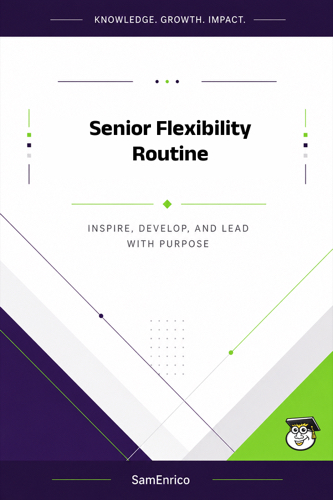
Senior Flexibility Routine eBook
Teaches full range of motion stretches for shoulde
Teaches full range of motion stretches for shoulders, hips, and spine to maintain independence.
Formats
Free sample
Chapter 1: The Stiffness Lie--–- On a rainy Tuesday morning in Cleveland, a 73-year-old retired schoolteacher named Eleanor sat on the edge of her bed, staring at her socks. They were lying on the floor, exactly where she had dropped them the night before. She had been able to put on her own socks just six months ago. Now, every morning brought the same humiliating ritual: thirty seconds of grunting, twisting, and finally giving up, calling her husband to bend down and do what her own body no longer would. Eleanor was not lazy.
She was not weak-willed. She was, by every medical measure, in decent health. But her doctor had told her, "You're just getting older. Stiffness happens." Eleanor believed him. She was wrong.The Epidemic Nobody Is Talking About Welcome to the most widespread, most accepted, and most preventable epidemic of our time.
It is not heart disease, though it makes exercise dangerous. It is not diabetes, though it makes weight management impossible. It is not Alzheimer's, though it steals independence just as cruelly. It is the slow, silent stiffening of the human body that begins, on average, at age forty-five and accelerates mercilessly after sixty-five. By age seventy, the average person has lost thirty-five percent of their spinal mobility, forty percent of their hip rotation, and nearly fifty percent of their shoulder range of motion.
These are not normal. They are not inevitable. They are, almost entirely, reversible.This book exists because of a simple, radical idea: stiffness is not aging. Stiffness is disuse. And disuse can be reversed at any age, by any person, regardless of how long they have been inactive.Let me tell you about James.
James is an eighty-two-year-old former construction worker who, when he first came to my attention, could not lift his arms above his shoulders. He had not hugged his grandchildren properly in five years. He had given up driving because he could not turn his head to check his blind spot. His doctor told him, "You have arthritis. It's degenerative." But James did not have significant joint damage.
He had spent forty years sitting in trucks, sitting on couches, sitting in waiting rooms. His muscles had shortened. His fascia had glued itself together. His nervous system had learned to guard every movement. After twelve weeks of the routine you are about to learn, James lifted a suitcase into an overhead bin on an airplane.
He cried. His daughter cried. The flight attendant cried. And not one of them knew that James had simply remembered something his body had never forgotten: how to move.Why Every Other Book Got It Wrong If you have picked up this book, you have probably encountered other flexibility guides. They are everywhere.
Most of them share three fatal flaws.The first flaw: they treat a seventy-year-old body exactly like a twenty-year-old body. They show photographs of lithe, double-jointed models folding themselves into pretzels, with captions like "Breathe into the stretch." These books are not just unhelpful. They are dangerous. A senior attempting a young person's stretch without modified positioning, support, and safety protocols is a senior who will end up in physical therapy, not on a yoga mat.The second flaw: they focus exclusively on muscles. They talk about lengthening, relaxing, and releasing, as if the body were nothing more than a collection of rubber bands.
This is a profound misunderstanding. Your flexibility is determined by at least four systems: muscles (the engines), fascia (the web that connects everything), joints (the hinges), and the nervous system (the boss that decides when to allow movement). If you stretch only the muscle while ignoring the nerve that is screaming "stop," you will make no progress. Worse, you may trigger a protective spasm that leaves you stiffer than before.The third flaw: they assume motivation is the problem. "Just stretch every day," they say, as if the person reading the book had simply not thought of that.
The truth is that motivation is rarely the issue. The issue is that most seniors have no idea what productive stretching actually feels like. They do not know the difference between the burn of a healthy stretch and the sharp signal of an impending tear. They do not know that holding their breath during a stretch spikes their blood pressure. They do not know that stretching a cold muscle in the morning is like trying to bend a frozen twig.
These are not character flaws. They are knowledge gaps. And knowledge gaps can be filled.The Science of "Use It or Lose It"Let us talk about what actually happens to an unused body. When you stop moving a joint through its full range of motion, a cascade of changes begins. First, the synovial fluid that lubricates your joints begins to thicken.
Think of it as oil in an engine that sits idle. It becomes sludge. Second, the collagen fibers in your connective tissue start to form cross-links, like a net tightening around your muscles. Third, your fascia—that silvery web that wraps every muscle fiber—begins to glue itself to adjacent structures. Fourth, and most insidiously, your nervous system learns a new default: "This joint is fragile.
Do not let it move far." That last change is the most important. Your brain is trying to protect you. But it is protecting you from a danger that no longer exists. The result is a body that has been "turned down" by its own owner.This process has a name: mechanotransduction failure. Mechanotransduction is the ability of your cells to sense mechanical load (movement, pressure, stretch) and respond by building stronger, more flexible tissue.
When you stop loading your tissues, they stop rebuilding. The opposite is also true. When you apply gentle, consistent, progressive load to your tissues, they remodel. They lengthen. They lubricate.
They strengthen. This happens at any age. The science is unequivocal. A ninety-year-old who begins a gentle stretching routine will show measurable changes in tissue elasticity within three weeks. A ninety-year-old.Let me pause here and address the voice that might be whispering in your ear right now.
It says: "But I have arthritis. I have bone spurs. I had a hip replacement. This doesn't apply to me." I want to be very clear. This book is not for people who have never been injured.
It is for people who have been injured, who have been told to "slow down," who have been prescribed pills for pain that stretching could have prevented. Every exercise in this book has been tested on people with osteoarthritis, with labral tears, with rotator cuff pathology, with spinal stenosis. We do not stretch through pain. We stretch around it. We stretch differently.
We stretch smarter. But we do not stop.Real Independence: What Are You Actually Trying to Do?Let me ask you a question that will sound simple but is actually profound: why do you want to be more flexible?Do not answer "to be healthy" or "to live longer." Those are abstractions. The real answer is much more specific. You want to be able to look over your shoulder when you back out of a driveway. You want to get out of a…
This is the end of the free sample. Get the eBook to keep going. Buy now
About this book
Details
- Author
- Mullen Armida
- Publisher
- SamEnrico
- Language
- English
- Genre
- Non-Fiction, Health & Wellness, Stretching
- Released
- 2026-06-06
- Pages (approx.)
- 123
- Available as
- eBook, Audiobook

Read better in the ZLOADR app
Your eBooks on your phone or tablet. Sign in with your SamEnrico account and start reading.
More by Mullen Armida
 Codependency and Drug UseMullen Armida$11.99
 Morning Of Speech Ritual ManualMullen Armida$11.99
 Body Language First ImpressionsMullen Armida$11.99
 The Iron King: Gunpowder and the Birth of Modern WarfareMullen Armida$11.99
 Laundry Wash AttendantMullen Armida$11.99
 Geographic Pricing for Inflation VarianceMullen Armida$12.99
 How to Produce Canopy and Gazebo Enclosure KitsMullen Armida$11.99
 10 Ways to Use Amchoor Powder (Recipe Book)Mullen Armida$11.99
You may also like
 Hong Kong Handover 1997Dunn Johnnie$11.99
 Zumba For Postnatal Recovery CourseNeal Christian$11.99
 Zumba for BeginnersLadner Nikia$11.99
 YouTube Comment Mining GuideHumes Pandora$12.99
 Worry Box MeditationCarlin Rudy$11.99
 Workplace Stress MeditationNguyen Lynn$11.99
 Workplace Stress and Sleep RepairHawley Ivory$11.99
 Workplace Perfectionism CureDelaney Jeffry$11.99
 Workplace Injustice Anger GuideWallen Isabelle$11.99
 Work Addiction and Burnout LinkGreenwood Ester$11.99
 Women in Yoga and WellnessBeattie Galina$11.99
 Women in Stand Up ComedyChun Evangeline$11.99