
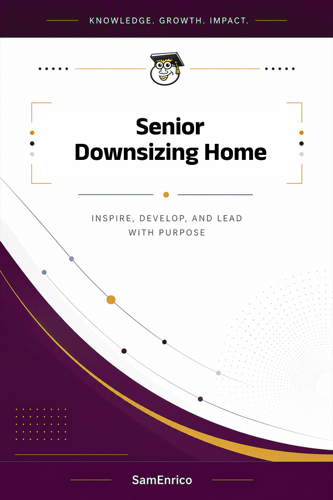
Senior Downsizing Home eBook
Moves to smaller space with dignity.
Moves to smaller space with dignity.
Formats
Free sample
Chapter 1: The Rightsizing Revelation--For most of your adult life, you were told that bigger was better. A larger house meant success. More square footage meant security. An extra bedroom meant you had arrived. But somewhere between the last child leaving for college and the third knee surgery you never scheduled because you were too busy cleaning rooms nobody uses, that equation flipped.
Suddenly, the house that once felt like a trophy now feels like a tyrant. The stairs you climbed without thinking now require a strategic pause. The basement full of holiday decorations and forgotten exercise equipment has shifted from storage to burden. And the guest room—the one you kept pristine for visitors who come twice a year—has become a museum of someone else's potential.You are not alone. This chapter dismantles the most toxic myth in senior living: that moving to a smaller space is a step down, a demotion, a white flag waved at the inevitable decline of aging.
That myth has kept millions of seniors trapped in homes that no longer serve them, spending their golden years dusting empty rooms and paying property taxes on square footage that brings them zero joy. But what if the opposite were true? What if moving to a smaller space was not a loss but a liberation? What if rightsizing—matching your home precisely to your current energy, mobility, and social needs—was the single most empowering decision you could make for your next chapter?This chapter will walk you through the psychology of why we cling to space we no longer need, introduce the transformative concept of rightsizing, and give you a concrete tool—the Decade Audit—to prove that your current home is likely full of rooms you have not truly lived in for years. By the end of this chapter, you will no longer see downsizing as something done to you.
You will see it as something you choose for yourself.The Psychology of Square Footage: Why We Cling to Empty Rooms Let us begin with a hard truth. Human beings are wired to fear loss more than we crave gain. This is not a character flaw; it is a neurological fact. Psychologists Daniel Kahneman and Amos Tversky won a Nobel Prize for demonstrating what they called loss aversion: the simple, brutal reality that the pain of losing something is approximately twice as powerful as the pleasure of gaining something of equal value. In practical terms, this means that the anxiety you feel about leaving your three-bedroom house is about twice as intense as the relief you would feel moving into a beautiful, well-designed one-bedroom apartment—even if that apartment objectively improves your daily life.This is why downsizing feels so hard.
Your brain is lying to you. It is amplifying the threat of loss while muting the promise of gain. And the real estate industry, the moving industry, and even well-meaning family members have spent decades reinforcing this lie. "Are you sure you want to sell?" they ask. "What about the grandkids?
Where will they sleep? You might need that extra space someday."But here is the question nobody asks: what about you? What about the space you need right now, today, for the life you are actually living?Consider the concept of the "ghost square foot." This is space in your home that you maintain, heat, cool, clean, insure, and pay property taxes on, but that you do not meaningfully use. The formal dining room where you eat twice a year. The second guest bedroom that has become a storage unit for out-of-season clothing.
The finished basement that nobody has sat in since 2017. Each of these ghost square feet costs you money, time, and energy. According to data from the American Housing Survey, the average American homeowner uses only about 40 to 60 percent of their home's square footage on a weekly basis. The rest is maintained out of habit, guilt, or the vague anxiety that "someday" you might need it.But here is the liberating truth: someday never comes. The extra bedroom does not fill itself with grateful grandchildren.
The dining room table does not suddenly host weekly dinner parties. The basement gym equipment does not magically start being used. These spaces remain empty, waiting for a version of you that no longer exists—a version with more energy, more time, more social obligation, and more desire to host than you have today.The Decade Audit: A Tool for Radical Honesty It is time to replace vague anxiety with concrete data. The Decade Audit is a simple, one-hour exercise that will forever change how you see your home. You will need a notebook, a pen, and the willingness to be honest with yourself.Begin by drawing a line down the center of a page.
On the left side, list every room in your current home. On the right side, answer three questions for each room:First, how many times did you use this room for its intended purpose in the last twelve months? "Use" means active, intentional occupation—eating a meal in the dining room, sleeping in the guest bed, exercising in the basement. Passive use like walking through the room to get somewhere else does not count.Second, how many hours per week do you spend cleaning, maintaining, or organizing this room? Be honest.
Add up dusting, vacuuming, tidying, and the mental load of "I really should reorganize that closet someday."Third, if this room disappeared tomorrow, what would you genuinely miss? Not what you think you should miss. What would you actually notice the absence of in your daily life?Now do the same exercise again, but this time for the decades of your life. Ask yourself: what did you use in your fifties? Your sixties?
Your seventies? The answers will likely shift dramatically. The formal living room that hosted book club meetings in your fifties may have gone unused since 2015. The craft room that brought you joy in your sixties may now hold untouched supplies gathering dust. The home office where you managed your finances for thirty years may now be where you pay bills at the kitchen table because the office is too cold in winter.Here is what the Decade Audit almost always reveals: most people are living in a museum of their former selves.
The rooms, the furniture, the layouts—they all reflect who you were, not who you are. And that is not sentimentality. That is inertia. You have simply not gotten around to admitting that your life has changed.Case Study: The Harrisons and the Four Empty Bedrooms Let me tell you about Richard and Diane Harrison. They were in their late seventies when I first met them, living in a four-bedroom colonial in a quiet suburb.
The house was beautiful. It was also slowly killing their quality of life. Richard had two replaced hips and a heart condition. Diane had arthritis in both hands. They had a live-in aide who slept in what used to be their son's bedroom.
The other three bedrooms were used for storage: one held holiday decorations, one held boxes of tax returns going back to 1987, and one held furniture from…
This is the end of the free sample. Get the eBook to keep going. Buy now
About this book
Details
- Author
- Wooden Luciana
- Publisher
- SamEnrico
- Language
- English
- Genre
- Non-Fiction, Self-Help, Senior Moving
- Released
- 2026-06-06
- Pages (approx.)
- 145
- Available as
- eBook, Audiobook

Read better in the ZLOADR app
Your eBooks on your phone or tablet. Sign in with your SamEnrico account and start reading.
More by Wooden Luciana
 Active Recall Study GuideWooden Luciana$11.99
 TM for Memory EnhancementWooden Luciana$11.99
 Real Estate Agent Deadline StressWooden Luciana$11.99
 Anger Management BreathingWooden Luciana$11.99
 The Inheritance ThiefWooden Luciana$11.99
 CPR for Obese PatientsWooden Luciana$11.99
 Action Planning for CreativesWooden Luciana$11.99
 The Iron Admiral: Zheng He's Seven Voyages and the Rise of Ming Naval PowerWooden Luciana$11.99
 The Poisoned Inheritance: Lebanon’s Deadly Family Betrayal (1960s)Wooden Luciana$11.99
 The Essential Guide to Alternative RockWooden Luciana$11.99
 How to Produce E-book Reader BatteriesWooden Luciana$11.99
 Manioc: Cassava RootWooden Luciana$11.99