
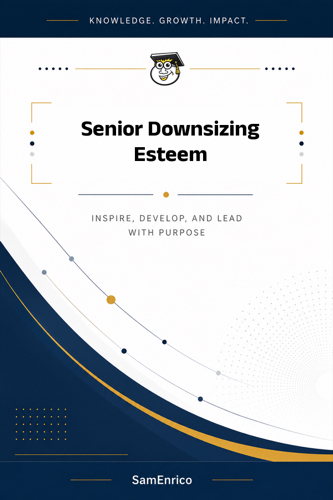
Non-FictionSelf-HelpDownsizing
Senior Downsizing Esteem eBook
Releases attachment to possessions without shame.
Releases attachment to possessions without shame.
Formats
Free sample
Chapter 1: The Material Convoy–- The first time Margaret cried over a lampshade, she was seventy-two years old, alone in her living room, and utterly convinced that something had gone wrong with her brain.It was not an expensive lampshade. It was not a family heirloom. It was, by any objective measure, a perfectly ordinary beige fabric shade that had sat on a floor lamp in her den for nineteen years. She had never loved it. She had never even liked it.
But when her daughter suggested, gently, that the lamp might not fit in the new apartment, Margaret felt a surge of panic so sharp and sudden that her eyes filled with tears before she could stop them.“I can’t,” she whispered. And then, because she was a rational woman who had raised three children and managed a hospital pharmacy for thirty-four years, she added: “What is wrong with me?”This is the question that haunts the downsizing process for millions of older adults. Not “where will I put the china?” or “how do I find a mover?” but something far more personal and far more painful: What is wrong with me? Why can’t I just let things go?The answer, which this entire book is built upon, is both simple and liberating: Nothing is wrong with you.You are not broken. You are not lazy.
You are not a hoarder in denial. You are not ungrateful for the life you have lived or the possessions you have accumulated. You are, in fact, entirely normal. And the sooner you understand why you feel the way you feel, the sooner you can release yourself from the shame that has been silently sabotaging every attempt to downsize.This chapter is about that shame. It is about naming it, understanding where it comes from, and—most importantly—discovering that you have been carrying a burden that was never yours to carry.The Shame That No One Talks About Let us begin with a definition.
Shame, in the context of downsizing, is not the same as guilt. Guilt says, “I did something bad.” Shame says, “I am bad.” Guilt is about behavior; shame is about identity. And identity-based shame is the single greatest predictor of failed downsizing attempts, according to research by sociologist David Ekerdt and his colleagues at the University of Kansas.Here is what shame sounds like in the downsizing process:“I should have dealt with this years ago. Now it’s too late.”“My children are going to be so annoyed when they have to clean this up after I’m gone.”“I spent good money on this. Throwing it away is irresponsible.”“Other people can do this.
Why can’t I?”“I’m just lazy. I’ve always been lazy about clutter.”Notice the pattern. Every single one of these statements is a judgment about the person, not the stuff. The stuff is neutral. The stuff is fabric and wood and paper and glass.
The shame is what turns neutral objects into emotional landmines.This book operates from a single, non-negotiable premise: Shame is not a motivational tool. Shame is a paralysis agent. It does not help you make decisions. It makes you avoid decisions. It does not clarify what matters.
It makes everything feel equally important and therefore impossible to sort.If you have ever stood in a cluttered room, felt overwhelmed, and then walked away to do literally anything else—watch television, make tea, take a nap—you were not being lazy. You were experiencing a normal neurological response to shame. Your brain was protecting you from a perceived threat. The threat was not the clutter. The threat was the voice inside your head telling you that you should have been a different person.So let us say this clearly, at the very beginning of this book, before we do anything else:You are exactly the right person to be doing this at exactly the right time.
Not earlier. Not later. Now. And the fact that you are reading this sentence means you have already taken the first and hardest step: you have decided that the shame does not get to win.The Material Convoy: A Better Way to Understand Your Stuff In 2004, sociologist David Ekerdt published a paper that changed how researchers think about accumulation in later life. He called it the “Material Convoy” model, borrowing from the concept of the “social convoy”—the network of relationships that travels with us throughout our lives.Here is the idea in plain language: You have been accumulating possessions your entire life, not because you are a bad person, but because you are a human person.
Every life stage brings new things. Your twenties brought cheap furniture and your first set of cookware. Your thirties brought children’s toys and school projects. Your forties brought hobby equipment and vacation souvenirs. Your fifties brought heirlooms from aging parents.
Your sixties and seventies brought… more. The convoy grows because life happens.The Material Convoy is not a pathology. It is a description of normal human behavior across cultures and socioeconomic groups. Rich people have larger convoys. Poor people have smaller convoys.
But everyone has a convoy. The only people who do not have a Material Convoy are people who have never lived—infants, amnesiacs, and people who have lost everything in a disaster.Understanding this changes everything. Because if accumulation is normal, then downsizing is not a moral failure that requires atonement. Downsizing is simply rerouting the convoy. You are not abandoning your history.
You are not throwing away your life. You are deciding, consciously and intentionally, which parts of the convoy will continue with you into your next chapter and which parts will be released to serve other people, other homes, other lives.This reframe is not a trick. It is not toxic positivity. It is a more accurate description of reality than the shame-based story you have been telling yourself. The shame-based story says: “I have too much because I am a failure.” The Material Convoy story says: “I have a full convoy because I have lived a full life.
Now I am going to edit it.”Which story serves you better? Which story gives you energy instead of draining it?Healthy Attachment vs. Entrapment: The Critical Distinction One of the most common fears expressed by seniors contemplating downsizing is that they will be forced to get rid of everything they love. This fear is often driven by well-meaning but poorly delivered advice from family members who say things like “You can’t take it with you” or “Do you really need all this?”These comments, however well-intentioned, miss a crucial distinction. There is a world of difference between healthy attachment and entrapment.
Learning to tell them apart is the single most important skill you will develop in this book.Healthy attachment looks like this:You own items that bring you genuine joy, comfort, or utility.You can explain, in a sentence or two, why an item matters to you.You use the item, display the item, or actively enjoy the item on a regular basis.You would be sad to lose the item, but you could imagine life without it.You have…
This is the end of the free sample. Get the eBook to keep going. Buy now
About this book
Details
- Author
- Calhoun Abbey
- Publisher
- SamEnrico
- Language
- English
- Genre
- Non-Fiction, Self-Help, Downsizing
- Released
- 2026-06-06
- Pages (approx.)
- 140
- Available as
- eBook, Audiobook

Read better in the ZLOADR app
Your eBooks on your phone or tablet. Sign in with your SamEnrico account and start reading.
More by Calhoun Abbey
 The Safety Stock Review CycleCalhoun Abbey$11.99
 Anger Rehearsal Technique GuideCalhoun Abbey$11.99
 SMART Goals Action WorkbookCalhoun Abbey$11.99
 Police Officer Anger ControlCalhoun Abbey$11.99
 FSB Criminal CollaborationCalhoun Abbey$11.99
 TM for Better SleepCalhoun Abbey$11.99
 The Persona Archetype in DreamsCalhoun Abbey$11.99
 Thunder on the Halfpipe: The Global Rise of Skateboarding's Golden AgeCalhoun Abbey$11.99
 The Eastern Front's Forgotten Hell: The Brusilov Offensive (1916)Calhoun Abbey$11.99
 How to Produce DVD RecordersCalhoun Abbey$11.99
 Free Trial Length Optimization StudyCalhoun Abbey$12.99
 Debt Collection AlternativesCalhoun Abbey$12.99
You may also like
 Hong Kong Handover 1997Dunn Johnnie$11.99
 Zumba For Postnatal Recovery CourseNeal Christian$11.99
 Zumba for BeginnersLadner Nikia$11.99
 YouTube Comment Mining GuideHumes Pandora$12.99
 Worry Box MeditationCarlin Rudy$11.99
 Workplace Stress MeditationNguyen Lynn$11.99
 Workplace Stress and Sleep RepairHawley Ivory$11.99
 Workplace Perfectionism CureDelaney Jeffry$11.99
 Workplace Injustice Anger GuideWallen Isabelle$11.99
 Work Addiction and Burnout LinkGreenwood Ester$11.99
 Women in Yoga and WellnessBeattie Galina$11.99
 Women in Stand Up ComedyChun Evangeline$11.99