
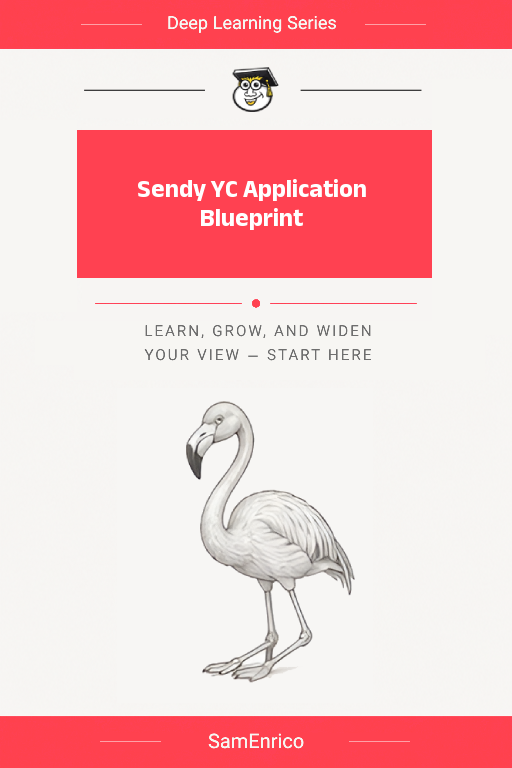
Non-FictionStartup GuideAccelerator PrepLogistics
Sendy YC Application Blueprint eBook
Apply Sendy Y Combinator logistics platform lesson
by Ahern Jimmie
Apply Sendy Y Combinator logistics platform lessons to craft your African startup application narrative.
Formats
Free sample
Chapter 1: The Diaspora Lie--Let me tell you something no one in the Lagos tech scene will admit over Tiger beer. You have been trained to be ashamed. Not of your country, not of your infrastructure, not of your government — but of the raw, ugly, glorious texture of how business actually gets done here.I have watched thirty-seven African founders pitch to international investors. Thirty-three of them did the same thing within the first ninety seconds. They softened their accents.
They swapped "Naira" for "local currency." They turned "I have to pay a dash at the port" into "there are informal transaction costs." They replaced "my driver knows which police checkpoint to avoid at 6 PM" with "our route optimization algorithm addresses regulatory friction."One founder — a young woman building last-mile delivery in Accra — actually removed the word "market" from her deck and replaced it with "distributed commerce nodes."I wanted to scream.She was hiding the very thing that made her business defensible: the fact that she had personally negotiated access to the only loading bay in the biggest market in West Africa. That access was not a bug. It was a moat. But she had been taught — by Linked In gurus, by MBA case studies, by the silent pressure of wanting to seem "professional" — that her reality was embarrassing.This chapter is an intervention.We are going to strip away the performance. We are going to look at what actually happened at Sendy, Kobo360, Topship, and a dozen other African logistics startups that caught the attention of Y Combinator.
And we are going to discover a counterintuitive truth: the parts of your business that feel most unpolished, most informal, most "African" are probably the parts a US investor cannot copy.But first, we have to talk about why you've been hiding them.The Performance of Polish Let me describe a scene I have witnessed in twelve different co-working spaces from Nairobi to Lagos to Cape Town.A founder is preparing a pitch deck for a US accelerator. It is 2 AM. They have been revising the same slide for three hours. The problem? They cannot decide whether to include a photo of the market where their first hundred customers come from.The market is chaotic.
There are women selling tomatoes from plastic buckets. There are teenagers pushing handcarts through mud. There is a man repairing a motorcycle with a wrench and a prayer. It is real. It is also, by the standards of a Silicon Valley pitch deck, ugly.The founder's mentor — another African founder who "made it" — advises: "Make it look cleaner.
Use stock photos if you have to."So they do. They replace the market with a generic image of smiling people with laptops. They change "market trader" to "small business owner." They change "handcart" to "last-mile logistics vehicle."The lie is small. But it is a lie.And here is what happens when that founder gets on the call with a US investor. The investor has seen five hundred decks this month.
They have a finely calibrated sense for when a founder is performing. They may not know Lagos. They may not know the difference between Oshodi and Ikeja. But they know — in their gut — when someone is telling them a story they do not quite believe themselves.Trust is the only thing that scales across continents. And you cannot build trust on a foundation of small lies.The Sendy Story: What Actually Happened Sendy did not become a Y Combinator company because they had the best technology.
They did not have the most funding. They did not have the slickest website.Sendy got into YC because they told the truth about market women.In 2016, when Sendy was just an idea, the founders went to the major markets in Lagos — Idumota, Alaba, Trade Fair. They watched. They listened. They saw something that every other logistics company had missed.The "Social Sellers" — women who sold textiles, electronics, and food from small stalls — were already running sophisticated logistics networks.
They just did it with Whats App, with handwritten ledgers, with young men on motorcycles they paid by the trip. These women knew exactly how much to charge for delivery based on traffic, time of day, and whether it was raining. They had built trust networks that allowed them to send goods worth thousands of dollars with a driver they had never met, based on a single introduction from a cousin.Sendy did not try to replace this system. They tried to augment it.Their first product was not an app. It was a shared Google Spreadsheet that one of the founders manually updated with delivery statuses.
They would sit in the market, take orders on paper, and at the end of the day, type the updates into a sheet that the traders could check on their phones. It was ugly. It was slow. It required a human being to do work that software should have done.But it worked. And because it worked, the traders trusted Sendy enough to try the app when it finally launched.Here is what most case studies will not tell you: Sendy later struggled.
In 2022 and beyond, the company faced layoffs, margin compression, and a difficult pivot. The market dynamics that made them successful — rapid growth, cheap capital, a flood of e-commerce demand — shifted. Fuel prices spiked. The Naira devalued. Investors stopped writing checks for "growth at all costs."Does that mean the Sendy lesson is invalid?
Absolutely not.The lesson is not "copy Sendy." The lesson is: Sendy succeeded at the application stage because they were honest about their beachhead. They did not pretend to be solving logistics for all of Africa. They solved it for one market. They did not pretend to have an algorithm that defied physics. They admitted they started with a spreadsheet and a notebook.Their later struggles teach a different lesson — one we will return to in Chapter 13 about the difference between getting into YC and building a company that survives.
But for the purpose of this chapter, the takeaway is clear: authenticity got them in the door. Performance would have locked it.The Three Masks African Founders Wear Over years of studying YC applications from African startups, I have identified three common "masks" that founders put on when they think no one is watching. Each mask is an attempt to solve a real problem — the problem of being misunderstood by a foreign investor. But each mask backfires.Mask 1: The Accent Chameleon This is the founder who sounds like they grew up in Connecticut when they are on a Zoom call with a US investor, but sounds like they grew up in Lagos when they are talking to their drivers.I understand why this happens. There is a well-documented phenomenon — call it "linguistic code-switching" — where people adjust their speech to be understood and accepted by a dominant culture.
It is not malicious. It is survival.But here is what US investors hear when you switch your accent: "I am not confident that my real voice will be respected."And if you are not confident in your real voice, why should they be?The fix: Speak the way you speak when you are…
This is the end of the free sample. Get the eBook to keep going. Buy now
About this book
Details
- Author
- Ahern Jimmie
- Publisher
- SamEnrico
- Language
- English
- Genre
- Non-Fiction, Startup Guide, Accelerator Prep, Logistics
- Released
- 2026-05-30
- Pages (approx.)
- 147
- Available as
- eBook, Audiobook

Read better in the ZLOADR app
Your eBooks on your phone or tablet. Sign in with your SamEnrico account and start reading.
More by Ahern Jimmie
 TM Complete Beginners GuideAhern Jimmie$11.99
 The Mayor's Secret DealAhern Jimmie$11.99
 Remote Presentation SkillsAhern Jimmie$11.99
 Small Talk for Social MediaAhern Jimmie$11.99
 IBS Antibiotic Treatment GuideAhern Jimmie$11.99
 The Great Emoji Heist: How a Single Symbol Took Over the WorldAhern Jimmie$11.99
 Understanding Cleft Palate Stapes Fixation OligodontiaAhern Jimmie$17.99
 Supervision ManagerAhern Jimmie$11.99
 Production Schedule RiskAhern Jimmie$12.99
 How to Start a Prepared Culture Media for Micro-organisms Business (Beginners Guide)Ahern Jimmie$11.99
You may also like
 Hong Kong Handover 1997Dunn Johnnie$11.99
 Zumba For Postnatal Recovery CourseNeal Christian$11.99
 Zumba for BeginnersLadner Nikia$11.99
 YouTube Comment Mining GuideHumes Pandora$12.99
 Worry Box MeditationCarlin Rudy$11.99
 Workplace Stress MeditationNguyen Lynn$11.99
 Workplace Stress and Sleep RepairHawley Ivory$11.99
 Workplace Perfectionism CureDelaney Jeffry$11.99
 Workplace Injustice Anger GuideWallen Isabelle$11.99
 Work Addiction and Burnout LinkGreenwood Ester$11.99
 Women in Yoga and WellnessBeattie Galina$11.99
 Women in Stand Up ComedyChun Evangeline$11.99