
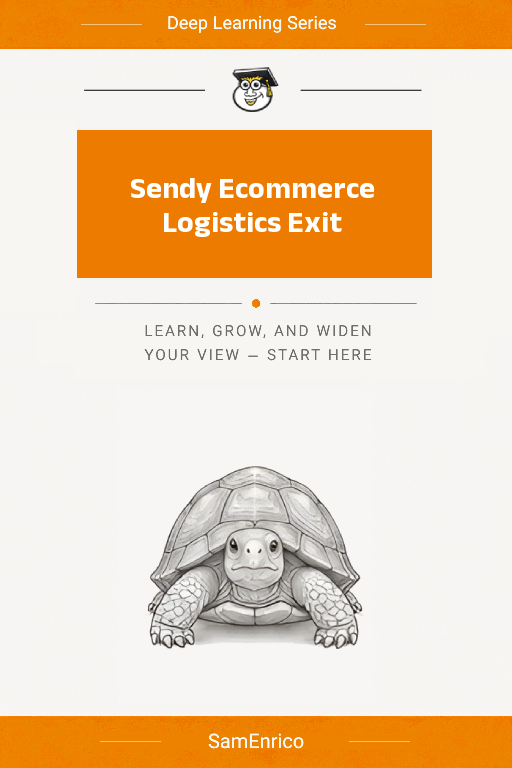
Sendy Ecommerce Logistics Exit eBook
Sell African last-mile delivery startups following
by Hawley Ara
Sell African last-mile delivery startups following Sendy's acquisition, understanding fulfillment network valuation for ecommerce enablers.
Formats
Free sample
Chapter 1: The Two-Front War--–- On a humid morning in September 2023, a court-appointed administrator walked into Sendy's Nairobi headquarters and changed the trajectory of African e-commerce forever. The administrator's job was not to save the company. It was to dismantle it. Within weeks, assets that had taken nearly a decade to build—warehouses in three countries, contracts with multinational FMCG giants, a fleet management system that had once dazzled Toyota Tsusho—would be sold for pennies on the dollar. Employees who had built their careers around the promise of an African logistics unicorn received termination letters with no severance.
Merchants who had trusted Sendy with their inventory found themselves locked out of dashboards, unable to retrieve stock or reconcile payments.–- The bankruptcy of Sendy was not a sudden collapse. It was a slow, predictable, and entirely avoidable death by a thousand cuts—each cut representing a strategic error that founders across Africa continue to make today. But here is what the headlines missed: Sendy did not fail because African logistics is impossible. It did not fail because investors lost interest in the continent. It failed because its leadership fought a two-front war against two fundamentally different enemies simultaneously—and lost both battles.–- This chapter provides the definitive post-mortem of Sendy, integrating what business school case studies have treated as separate failures into a single, unified analysis.
The first front of Sendy's war was commercial: an over-concentration on a small number of large B2B FMCG clients whose extended payment cycles slowly strangled the company's working capital. The second front was operational: an asset-heavy expansion into Nigeria, where Sendy attempted to own trucks and warehouses in a fragmented, informal market that rewarded flexibility over ownership. These two failures did not occur in isolation. They fed each other. The B2B concentration created cash flow volatility, while the asset-heavy Nigeria expansion consumed the very capital needed to weather that volatility.
When the attempted $100 million Series D round failed to close, there was no Plan B. There was no pivot. There was only an administrator with a key to the office door.The Rise: A Unicorn in the Making–- To understand the collapse, we must first understand the ambition. Sendy was founded in 2014 by Meshack Alloys, Don Okoth, and Evanson Biwott—three Kenyan entrepreneurs who saw what Silicon Valley saw: that e-commerce would transform Africa, but only if the logistics underpinning it worked. At the time, moving a package from Nairobi to Mombasa was a gamble.
Fragmented couriers, no real-time tracking, cash payments that disappeared, and delivery times measured in weeks rather than days. Sendy promised to change that with a platform that connected merchants to a network of vetted drivers, provided real-time tracking, and digitized what could be digitized.–- The value proposition was compelling. A merchant could log into Sendy's dashboard, input delivery details, receive an instant quote, and have a driver dispatched within minutes. For the first time, an African logistics company offered something resembling the Uber experience—but for cargo. Sendy raised a seed round, then a Series A, then a Series B.
The investors were not fringe players. Toyota Tsusho, the trading arm of the Toyota Group, came in with significant capital. MOL PLUS, the venture arm of Mitsui O.S.K. Lines—one of the largest shipping companies in the world—followed. By 2020, Sendy had raised a total of 26.5millionandwasvaluedatover26.5 million and was valued at over 26.5millionandwasvaluedatover80 million.
It operated in Kenya, Uganda, and Nigeria. It employed hundreds of people. It was, by any reasonable measure, a unicorn in the making.–- The company's pitch to investors was elegant in its simplicity. Africa's e-commerce market was growing at 25 to 30 percent annually. Jumia had already gone public.
New players like Kasha, Copia, and Wasoko were raising massive rounds. But none of these companies owned their logistics. They relied on third-party couriers—fragmented, unreliable, expensive. Sendy would become the logistics backbone for African e-commerce, the company that every marketplace and every direct-to-consumer brand would use to move goods from warehouse to customer. The total addressable market was in the billions.
The path to profitability was through scale.–- That path never materialized.The First Front: B2B Concentration and the Working Capital Trap–- Sendy's revenue model was built on two pillars: business-to-business contracts with large fast-moving consumer goods companies and business-to-consumer deliveries for e-commerce marketplaces. In theory, this diversification was wise. In practice, the B2B contracts came to dominate both revenue and management attention. Companies like Unilever, Procter & Gamble, and local manufacturers of consumer goods signed on as Sendy clients. These were blue-chip names, the kind that investors love to see on a client list.
They promised volume—thousands of deliveries per week from distribution centers to retail shops across Nairobi, Kampala, and Lagos.–- The problem was payment terms. Standard practice in African FMCG is net-90 to net-120 days. A manufacturer delivers goods to a retailer, and the retailer pays 90 to 120 days later. When Sendy signed on as a logistics provider to these FMCG giants, it inherited the same payment cycles. Sendy would deliver goods to a retailer on behalf of Unilever.
Unilever would invoice the retailer. The retailer would pay Unilever 90 days later. Then Unilever would pay Sendy. Meanwhile, Sendy had to pay its drivers, its warehouse staff, its fuel suppliers, and its technology vendors in cash—immediately.–- This created a working capital gap that grew with every new B2B contract. The more successful Sendy became at winning large FMCG clients, the more cash it needed to bridge the 90 to 120 day gap between paying drivers and receiving payment from clients.
The company attempted to finance this gap through a combination of venture debt and equity raises. But venture debt is expensive in Africa, typically carrying interest rates of 15 to 20 percent. And equity raises required Sendy to show growth metrics that looked attractive to Silicon Valley-style venture capitalists.–- That led to the second dynamic of the first front: the growth imperative. To raise the next round, Sendy needed to show accelerating revenue growth. The easiest way to grow revenue quickly was to sign more B2B contracts, because each contract represented a large, predictable revenue stream.
But each new contract also widened the working capital gap. Sendy was effectively selling a dollar for ninety cents—generating revenue that looked impressive on a profit and loss statement but destroyed cash flow in reality. By 2022, the company had over-leveraged on B2B clients, with the top five customers accounting for nearly 60 percent of revenue. This concentration created an existential risk. If any one of those clients delayed payment further—and in the post-COVID supply chain chaos, many did—Sendy's cash position would crater.–- The diversification that Sendy had originally envisioned—serving small and medium enterprises, marketplaces, and direct-to-consumer brands—never materialized at scale because those customers required more hand-holding, generated lower average order values, and demanded features like cash-on-delivery reconciliation that Sendy had deprioritized in favor of B2B features.
The company had built its platform for large FMCG clients, and in doing so, had made itself unattractive to the very customers that would have provided payment diversity and healthier working…
This is the end of the free sample. Get the eBook to keep going. Buy now
About this book
Details
- Author
- Hawley Ara
- Publisher
- SamEnrico
- Language
- English
- Genre
- Non-Fiction, Business Brief
- Released
- 2026-06-01
- Pages (approx.)
- 152
- Available as
- eBook, Audiobook

Read better in the ZLOADR app
Your eBooks on your phone or tablet. Sign in with your SamEnrico account and start reading.
More by Hawley Ara
 Mindfulness Meditation for Athletes GuideHawley Ara$11.99
 EQ For Police And First RespondersHawley Ara$11.99
 The Homesick Student GuideHawley Ara$11.99
 Drug Dependency FAQHawley Ara$11.99
 The Compact Loci MethodHawley Ara$11.99
 Child Nightmare Processing GuideHawley Ara$11.99
 Self Worth And Suicidal ThoughtsHawley Ara$11.99
 Palace for Names FacesHawley Ara$11.99
 Loving Kindness For FailureHawley Ara$11.99
 The Velvet Rebellion: How a Secret Society of Designers Toppled the Fashion EliteHawley Ara$11.99
 The Twitter Files: Secrets, Power, and the Battle for TruthHawley Ara$11.99
 The Art of the Steal: How a Billion-Dollar Heist Exposed the Dark Side of Fine ArtHawley Ara$11.99
You may also like
 Hong Kong Handover 1997Dunn Johnnie$11.99
 Zumba For Postnatal Recovery CourseNeal Christian$11.99
 Zumba for BeginnersLadner Nikia$11.99
 YouTube Comment Mining GuideHumes Pandora$12.99
 Worry Box MeditationCarlin Rudy$11.99
 Workplace Stress MeditationNguyen Lynn$11.99
 Workplace Stress and Sleep RepairHawley Ivory$11.99
 Workplace Perfectionism CureDelaney Jeffry$11.99
 Workplace Injustice Anger GuideWallen Isabelle$11.99
 Work Addiction and Burnout LinkGreenwood Ester$11.99
 Women in Yoga and WellnessBeattie Galina$11.99
 Women in Stand Up ComedyChun Evangeline$11.99