
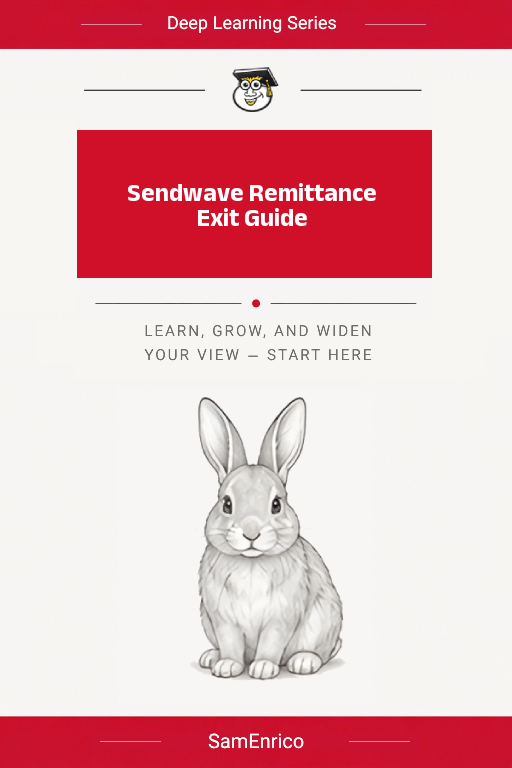
Non-FictionBusiness BriefRemittance Exits
Sendwave Remittance Exit Guide eBook
Exit remittance startup via global player using Se
by Robb Ardis
Exit remittance startup via global player using Sendwave's acquisition by Zepz for diaspora money flows.
Formats
Free sample
Chapter 1: The $500 Million Question--–- On a humid November morning in 2020, the fintech world received a notification that would reshape the diaspora money movement forever. The headline was deceptively simple: "World Remit acquires Sendwave for $500 million." For most observers, it was just another consolidation in a crowded remittance market. But for those who understood what had actually happened, the news landed like a thunderclap. A five-year-old startup, founded by two Harvard classmates with no prior experience in remittances, had just sold itself to its biggest competitor for half a billion dollars. And the real story wasn't the price tag — it was what that price tag revealed about the future of cross-border finance.The Valuation That Defied Convention The 500millionfiguredemandsscrutinynotbecauseitwasunusuallyhighforafintechacquisition—inthefrothymarketof2020−2021,largerdealswereannouncedweekly—butbecauseofwhat Sendwavehadachievedtoreachthatnumber.Atthetimeofacquisition,Sendwavewasprocessingapproximately500 million figure demands scrutiny not because it was unusually high for a fintech acquisition — in the frothy market of 2020-2021, larger deals were announced weekly — but because of what Sendwave had achieved to reach that number.
At the time of acquisition, Sendwave was processing approximately 500millionfiguredemandsscrutinynotbecauseitwasunusuallyhighforafintechacquisition—inthefrothymarketof2020−2021,largerdealswereannouncedweekly—butbecauseofwhat Sendwavehadachievedtoreachthatnumber.Atthetimeofacquisition,Sendwavewasprocessingapproximately2 billion in annualized transaction volume. Using standard fintech valuation metrics, that implied a valuation multiple of roughly 0.25x transaction volume. However, the more telling metric was revenue. Sendwave had perfected a pricing model that generated between 1.5% and 3% net revenue on each transaction, depending on the corridor. That placed its annualized revenue in the range of 40millionto40 million to 40millionto60 million at the time of the deal.A 500millionacquisitionpriceagainst500 million acquisition price against 500millionacquisitionpriceagainst50 million in revenue yields a 10x revenue multiple.
In the context of 2020 fintech M&A, that was respectable but not extraordinary. What made the Sendwave deal remarkable was not the multiple but the strategic premium embedded within it. Financial acquirers — private equity firms looking for cash flow — typically pay 2x to 4x revenue. Strategic acquirers, buying capabilities they cannot replicate internally, pay 5x to 15x revenue. The Sendwave deal sat firmly in the strategic category because Zepz (then operating as World Remit) was not buying Sendwave's revenue stream.
It was buying Sendwave's density.Breaking Down the Premium Let us parse the valuation with precision. A financial buyer looking at Sendwave would have seen a profitable, growing business with strong unit economics. Customer acquisition cost was remarkably low — Sendwave had achieved viral growth through referral programs and word-of-mouth within diaspora communities. Lifetime value per customer, driven by monthly recurring remittance flows, was healthy. A pure financial buyer might have paid 150millionto150 million to 150millionto200 million for such an asset.
Zepz paid more than double that range. The difference is the strategic premium, and that premium was paid for three specific, quantifiable assets:First, the US-to-Africa corridor infrastructure. Zepz had spent years trying to break into the United States sending market. They had hired US-based teams, signed partnerships with American banks, and marketed aggressively to the African diaspora living in New York, Texas, and California. Despite these efforts, their US-to-Africa volumes remained a fraction of their Europe-to-Africa business.
Sendwave, by contrast, had cracked the code. Their US corridor was not just operational — it was dominant, particularly to Ghana, Kenya, and Nigeria.Second, the mobile money integration layer. Sendwave had built proprietary API connections to every major mobile money provider in Africa: M-Pesa in Kenya, MTN Mobile Money in Ghana and Uganda, Airtel Money across multiple markets. These integrations were not simple API calls. They involved real-time reconciliation, handling partial failures, managing currency conversion, and complying with each country's specific regulations.
Rebuilding these integrations from scratch would have cost Zepz years and millions of dollars.Third, the compliance engine. By 2020, Sendwave had built an automated anti-money laundering system that could screen transactions, flag suspicious patterns, and file regulatory reports with minimal human intervention. This system had already been approved by US Fin CEN, the UK FCA, and multiple African central banks. For Zepz, buying this pre-approved compliance infrastructure meant they could expand into new corridors without undergoing lengthy regulatory reviews.The Strategic Rationale: Why Zepz Needed Sendwave To understand why Zepz paid $500 million, we must understand what was at stake for the acquirer. In 2020, Zepz was positioning itself for an initial public offering.
The company had raised hundreds of millions of dollars from investors including TCV, Accel, and Leapfrog. The narrative they needed to sell to public market investors was compelling: Zepz was not just a remittance company but a global financial super-app for migrants.That narrative had one glaring hole: the United States.The US is the largest source of remittances in the world. In 2020, migrants in the United States sent over 150billiontotheirhomecountries.Africareceivedapproximately150 billion to their home countries. Africa received approximately 150billiontotheirhomecountries.Africareceivedapproximately15 billion of that total, with the largest flows going to Nigeria, Ghana, Kenya, and Senegal. Zepz, despite its strong position in Europe, had failed to capture a meaningful share of this market.
Their brand was well-known in London, Paris, and Brussels but virtually unknown in New York, Houston, or Minneapolis. Sendwave had exactly the opposite problem: they were strong in the US but weak everywhere else.From a corporate development perspective, Zepz faced a classic build-versus-buy decision. Could they build US-to-Africa capabilities internally? Theoretically, yes. But doing so would require:Hiring a US-based compliance team and obtaining money transmitter licenses in all 50 states Establishing banking relationships with US correspondent banks willing to serve an African-focused fintech Building the mobile money integrations that Sendwave had already perfected Marketing to the US African diaspora from scratch, competing against an entrenched Sendwave The timeline for such an effort would be 18 to 36 months, assuming everything went perfectly.
Zepz's IPO timeline did not allow for that delay. Buying Sendwave compressed that timeline to 90 days — the typical period for regulatory approval and integration planning.The Corridor Gap Concept This chapter introduces a concept that will recur throughout this book: the corridor gap. Every global remittance company has strong corridors and weak corridors. Western Union dominates US-to-Mexico. Wise (formerly Transfer Wise) dominates Europe-to-UK corridors for professionals.
Remitly has built a strong position in US-to-Philippines. Zepz's corridor gap was North America to Africa.Sendwave's value, from Zepz's perspective, was that it perfectly filled that gap. The acquisition converted Zepz from a regional player (strong in Europe, weak in the Americas) into a truly global competitor overnight.This is the core lesson for founders: your startup's exit value is not determined by your revenue alone. It is determined by how perfectly you fill a specific gap in your acquirer's strategic roadmap. Sendwave was not the largest remittance company in the world.
It was not the fastest-growing. It was not the most technologically sophisticated. But it was the only independent player that had solved the US-to-Africa puzzle. That scarcity created the strategic premium.The Timing: Why 2020-2021 Was the Peak The Sendwave deal did not happen in a vacuum. The period of 2020 through 2021 was a golden age for fintech M&A, driven by three converging forces that every founder must understand.Force One: The COVID Acceleration The pandemic forced millions of migrants to shift from in-person remittance (Western Union agents, grocery store counters) to digital alternatives.
A Nigerian nurse in the Bronx who had always walked to a local agent to send money home suddenly needed a mobile…
This is the end of the free sample. Get the eBook to keep going. Buy now
About this book
Details
- Author
- Robb Ardis
- Publisher
- SamEnrico
- Language
- English
- Genre
- Non-Fiction, Business Brief, Remittance Exits
- Released
- 2026-05-30
- Pages (approx.)
- 140
- Available as
- eBook, Audiobook

Read better in the ZLOADR app
Your eBooks on your phone or tablet. Sign in with your SamEnrico account and start reading.
More by Robb Ardis
 Cave Retreat VisualizationRobb Ardis$11.99
 Scramble Sahara Desert BordersRobb Ardis$11.99
 Hydroxyzine AnxietyRobb Ardis$11.99
 GAD And Time ManagementRobb Ardis$11.99
 Neurodivergent ResilienceRobb Ardis$11.99
 Small Talk for Doctors VisitsRobb Ardis$11.99
 Parent Anger and AnxietyRobb Ardis$11.99
 Disaster Loss Tax Strategies WorkbookRobb Ardis$11.99
 The Surgeon's Heart: Love and Discovery in Renaissance FlorenceRobb Ardis$11.99
 The Storm Over Malacca: Portugal’s Fight for the Spice Kingdoms (1511)Robb Ardis$11.99
 How to Produce Heat Insulation MaterialsRobb Ardis$11.99
 Vendor Code of Conduct TemplateRobb Ardis$12.99
You may also like
 Hong Kong Handover 1997Dunn Johnnie$11.99
 Zumba For Postnatal Recovery CourseNeal Christian$11.99
 Zumba for BeginnersLadner Nikia$11.99
 YouTube Comment Mining GuideHumes Pandora$12.99
 Worry Box MeditationCarlin Rudy$11.99
 Workplace Stress MeditationNguyen Lynn$11.99
 Workplace Stress and Sleep RepairHawley Ivory$11.99
 Workplace Perfectionism CureDelaney Jeffry$11.99
 Workplace Injustice Anger GuideWallen Isabelle$11.99
 Work Addiction and Burnout LinkGreenwood Ester$11.99
 Women in Yoga and WellnessBeattie Galina$11.99
 Women in Stand Up ComedyChun Evangeline$11.99