
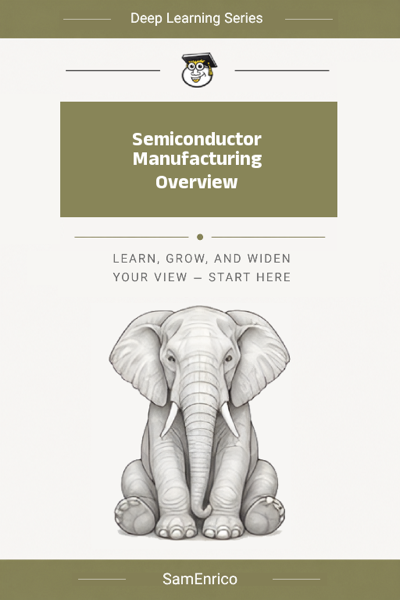
Non-FictionInformativeEducational
Semiconductor Manufacturing Overview eBook
A Coursebook on Semiconductor Manufacturing Overvi
by Pond Carmon
A Coursebook on Semiconductor Manufacturing Overview
Formats
Free sample
Chapter 1: The Silicon Gambit–- On a humid July morning in 1947, three men in fedoras walked into a vacant building in Murray Hill, New Jersey. They carried no blueprints, no government contracts, and no certainty of success. What they carried instead was a question that had haunted physicists for two decades: could you control the flow of electricity through a solid piece of material with no moving parts, no vacuum tubes, and no mechanical switches that would inevitably wear out and fail? The answer to that question would, within a single generation, transform humanity from a species that communicated by burning dead trees and shouting into metal cans to one that carries the sum total of human knowledge in a device smaller than a postage stamp. This is the story of how that transformation happened—not as a gentle evolution, but as a series of desperate bets, spectacular failures, and moments of accidental brilliance that together created the most complex manufacturing process ever conceived by the human mind.The answer, as the world would learn on December 23, 1947, was yes.
On that day, Walter Brattain and John Bardeen, working under the direction of William Shockley at Bell Labs, successfully demonstrated the first point-contact transistor. It was a crude device—a sliver of germanium with two gold foil contacts pressed against it, suspended in a plastic triangle, all submerged in water to prevent oxidation. When they applied a small current to one contact, the current flowing through the other contact increased by a factor of fifty. A whisper could now control a scream. The era of solid-state electronics had begun, though almost no one recognized it at the time.
The New York Times buried the announcement on page forty-six.The Accidental Revolution What those three men could not have foreseen was that their invention would eventually require manufacturing facilities costing more than twenty billion dollars each—factories so expensive that they have been called the largest single capital investment in human history outside of nuclear aircraft carriers and particle accelerators. They could not have imagined cleanrooms where the air is filtered so aggressively that a single dust particle landing on a wafer is the equivalent of a boulder crashing through a highway. And they certainly could not have imagined that the device they built on that December afternoon would, seventy-five years later, be replicated more than one hundred quadrillion times—more than the number of grains of sand on every beach on Earth.But the transistor of 1947 was not a product. It was a curiosity. It was unreliable, difficult to manufacture, and far more expensive than the vacuum tubes it promised to replace.
The real breakthrough—the one that transformed a scientific curiosity into an economic engine—came a decade later, and it came from a man who was, by his own admission, trying to solve a wiring problem.The Great Leap: Kilby and Noyce In the summer of 1958, a newly hired engineer named Jack Kilby was working at Texas Instruments in Dallas. Because he had just joined the company, he had not yet accrued enough seniority to take a vacation during the company-wide summer shutdown. Left alone in the nearly empty laboratory, Kilby began thinking about a problem that had frustrated the entire electronics industry: the "tyranny of numbers." As engineers added more and more components to electronic systems, the number of interconnections between those components grew exponentially. The wires themselves became the limiting factor—they took up space, they broke, they introduced stray capacitance, and they cost money to attach. The conventional wisdom was that the solution was better assembly techniques, more reliable soldering, and automated wire-bonding machines.Kilby saw it differently.
What if, he thought, you could manufacture all the components—transistors, resistors, capacitors—out of a single piece of semiconductor material, and then connect them without wires by simply depositing metal lines directly onto the same piece of material? On July 24, 1958, he wrote in his laboratory notebook: "The following circuit elements could be made on a single slice: resistors, capacitors, distributed capacitors, transistors." He built a demonstration device on a germanium wafer, attached it to a glass slide with wax, and showed it to his superiors. It worked. The integrated circuit had been born.Unbeknownst to Kilby, a physicist named Robert Noyce was having the same idea three thousand miles away at Fairchild Semiconductor in California. But Noyce's version had a critical advantage: instead of connecting components with fragile gold wires, he proposed depositing a layer of aluminum on top of an insulating oxide layer, then etching away the unwanted aluminum to leave only the desired connections.
This "planar process," which had been invented by Noyce's colleague Jean Hoerni only months earlier, made integrated circuits manufacturable. While Kilby had proven the concept, Noyce had invented the manufacturing method that would scale.The two companies spent the next decade fighting patent battles, but history would eventually credit both men as co-inventors of the integrated circuit. Kilby would receive the Nobel Prize in Physics in 2000. Noyce would not live to see that day—he died in 1990—but his name would become synonymous with Silicon Valley, the region that grew up around Fairchild and its many spin-offs, including a little company he co-founded in 1968 called Intel.Moore's Law: The Engine That Wouldn't Quit In 1965, three years after co-founding Fairchild Semiconductor and five years before co-founding Intel, Gordon Moore was asked to write an article for Electronics Magazine about the future of integrated circuits. The assignment was simple: predict what would happen to chip manufacturing over the next ten years.
Moore sat down with a ruler and a sheet of graph paper, plotted the number of transistors on commercially available chips from 1959 to 1965, and drew a straight line through the points. The line showed that the number of transistors per chip had doubled approximately every year. He then extended the line forward to 1975, predicting that chips would contain 65,000 transistors by that year—an astonishing number, given that the most advanced chip in 1965 contained only about fifty.Moore later called the prediction "a wild extrapolation." The article, titled "Cramming More Components onto Integrated Circuits," contained no equations, no citations, and no rigorous methodology. It was an educated guess. But when the prediction turned out to be remarkably accurate in 1975—the most advanced chip that year contained 65,536 transistors, almost exactly what Moore had predicted—the industry took notice.
A decade after that, with the doubling period having slowed to approximately every two years, Moore's observation became known as "Moore's Law." It was not a law of physics, like gravity or thermodynamics. It was an observation about economics and human ambition. But it became something far more powerful than a law: it became a self-fulfilling prophecy.The semiconductor industry organized itself around Moore's Law. Roadmaps were created. Research and development budgets were allocated.
Equipment manufacturers built machines capable of ever-finer precision, knowing that customers would buy them only if they enabled the next generation of chips. And perhaps most importantly, the industry developed a shared understanding that if you fell behind Moore's Law, you would never catch up. The company that missed one generation of technology would miss the next, and the next, until it…
This is the end of the free sample. Get the eBook to keep going. Buy now
About this book
Details
- Author
- Pond Carmon
- Publisher
- SamEnrico
- Language
- English
- Genre
- Non-Fiction, Informative, Educational
- Released
- 2026-06-02
- Pages (approx.)
- 143
- Available as
- eBook, Audiobook

Read better in the ZLOADR app
Your eBooks on your phone or tablet. Sign in with your SamEnrico account and start reading.
More by Pond Carmon
 The Small Wins Financial Confidence GuidePond Carmon$11.99
 Parental Self Compassion WorkbookPond Carmon$11.99
 The Governor's Legislative BreakfastsPond Carmon$11.99
 Sleep After Exam GuidePond Carmon$11.99
 Thyroid and FertilityPond Carmon$11.99
 Sprint Retrospective MetricsPond Carmon$11.99
 Medium Follower TrapPond Carmon$11.99
 Founder Crisis Survival GuidePond Carmon$11.99
 White Bronco: The Untold Cocaine ConnectionPond Carmon$11.99
 The Lost Legion: Rome’s Forgotten War in the East (53 BC)Pond Carmon$11.99
 Kublai Khan's Failed Conquest: The Divine Winds of JapanPond Carmon$11.99
 Growing GardeniaPond Carmon$11.99
You may also like
 Hong Kong Handover 1997Dunn Johnnie$11.99
 Zumba For Postnatal Recovery CourseNeal Christian$11.99
 Zumba for BeginnersLadner Nikia$11.99
 YouTube Comment Mining GuideHumes Pandora$12.99
 Worry Box MeditationCarlin Rudy$11.99
 Workplace Stress MeditationNguyen Lynn$11.99
 Workplace Stress and Sleep RepairHawley Ivory$11.99
 Workplace Perfectionism CureDelaney Jeffry$11.99
 Workplace Injustice Anger GuideWallen Isabelle$11.99
 Work Addiction and Burnout LinkGreenwood Ester$11.99
 Women in Yoga and WellnessBeattie Galina$11.99
 Women in Stand Up ComedyChun Evangeline$11.99