
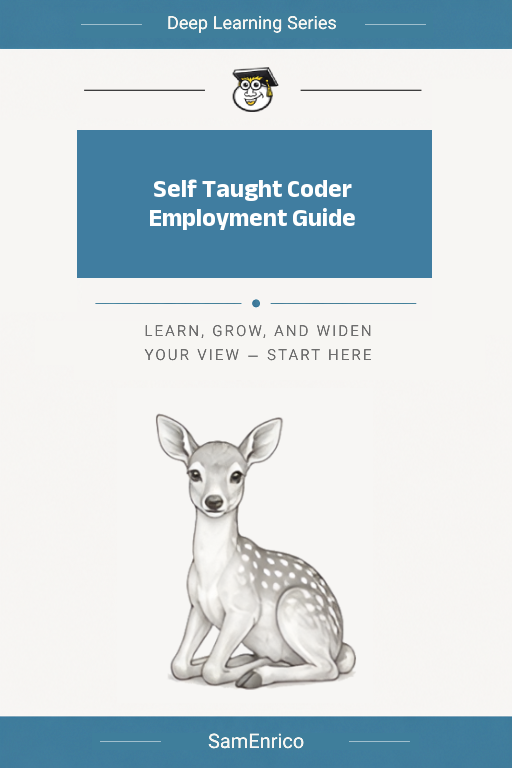
Non-FictionStudent's ShortcutEmployment GuideSkills Roadmap
Self Taught Coder Employment Guide eBook
Compare hiring outcomes for bootcamp grads, degree
by Paz Brenton
Compare hiring outcomes for bootcamp grads, degree holders, and self-taught developers across six continents. Includes portfolio strategies and interview prep for each path.
Formats
Free sample
Chapter 1: The $320,000 Mistake--–- In 2022, a 19-year-old named Priya from a village in Tamil Nadu, India, had no computer science degree, no bootcamp certificate, and no internet connection at home. She learned to code on a borrowed smartphone during the two hours of daily free village Wi-Fi. Eighteen months later, she was earning $85,000 per year as a remote frontend engineer for a San Francisco-based startup.–- At the same time, a Stanford University computer science graduate with three FAANG internships under his belt spent nine months unemployed, submitting over 400 applications before accepting a role paying $72,000—less than Priya, who had never written a line of code until after he had already completed Data Structures 101.–- These two stories are not anomalies. They are the new normal.–- The old rules of becoming a software developer have shattered. The linear path—high school, college degree, internship, job—is no longer the only path, and increasingly, it is not even the best path for many people.
Yet the advice industry has not caught up. Career forums still echo with the same three refrains: "Just get a CS degree." "Just build 10 projects." "Just network harder."–- This book exists because those three pieces of advice, offered separately and without context, are failing thousands of aspiring developers every year.–- The problem is not that the advice is wrong. The problem is that the advice assumes a universal job market that no longer exists. A CS degree is invaluable in Munich, where Germany's Blue Card visa system heavily favors degree holders. That same degree is less valuable in a remote-first US startup that prioritizes portfolios over diplomas.
Building 10 projects is essential in San Francisco, where portfolio bias dominates. Those same 10 projects might not even get you past the HR filter in Bangalore, where degree inflation means recruiters see thousands of applicants with identical credentials.–- The single most important word in your job search is not "Java Script," "Python," or "React." It is "where."The Geography of Opportunity–- Let us begin with a simple question that most career books never ask: Where do you want to work?–- If you answered "remotely for a US company," your strategy will look completely different from someone who answers "in-person at a bank in London." If you answered "anywhere that will sponsor my visa," your constraints are different from someone with citizenship in their target country. If you answered "in my home country in Southeast Asia," your competition is different from someone in Latin America.–- The global software development market is not one market. It is dozens of distinct markets, each with its own biases, salary expectations, and hiring filters. Understanding your target market is more important than understanding any programming language.–- Consider the following data points, drawn from a synthesis of industry reports, hiring platform data, and employment surveys across six continents:–- In North America, the entry-level market is saturated.
Bootcamp placement rates average 79 percent but range from 40 percent to 95 percent depending on the program. Self-taught candidates face an uphill battle, but those with exceptional portfolios can bypass degree requirements entirely. The median entry-level salary for software developers is approximately 85,000,butthatnumberhidesenormousvariation:abootcampgradinrural Ohiomightearn85,000, but that number hides enormous variation: a bootcamp grad in rural Ohio might earn 85,000,butthatnumberhidesenormousvariation:abootcampgradinrural Ohiomightearn55,000 while a self-taught developer in San Francisco earns $120,000.–- In Europe, the degree still reigns supreme—but only for visa sponsorship. Germany's Blue Card program requires a recognized degree or five years of specialized experience. The UK's points-based immigration system awards points for degrees and salary, not bootcamps.
However, a 2025 survey of UK employers found that 72 percent now accept bootcamp certificates for specific roles, up from 48 percent in 2022. The shift is real, but it is slow.–- In India and Southeast Asia, degree inflation has created a nightmare for job seekers. Over 1.5 million engineering graduates compete for approximately 300,000 entry-level tech positions annually. The result: degree holders accept roles paying as little as $5,000 per year, and self-taught candidates without degrees are often filtered out before a human ever sees their resume. The only escape is remote work for US or European companies, where location-based arbitrage allows talented developers to earn 10 to 20 times the local rate.–- In Latin America, the story is different.
US companies desperate for developers during their waking hours have turned to Mexico, Brazil, Argentina, and Colombia as talent sources. Bootcamps are highly valued in this context because they produce developers who are "hands-on ready"—they can ship code on day one. A bootcamp grad in São Paulo earning $45,000 for a remote US role is making more than most local senior engineers.–- In Africa, particularly Nigeria, Kenya, and South Africa, the remote work boom has created unprecedented opportunity. However, infrastructure challenges—unreliable power, expensive internet, time zone differences—mean that async communication skills are more valuable than technical prowess.–- In the Middle East, oil-rich nations are investing heavily in technology hubs, but visa requirements still heavily favor degree holders. A self-taught developer without a degree will struggle to get a work visa for Dubai or Riyadh, regardless of skill level.The Hidden Biases That Determine Your Fate–- The data reveals three hidden biases that determine whether your resume gets read, your portfolio gets viewed, or your application gets ignored.–- Degree bias is strongest in Europe and Asia.
It is not rational—a degree does not predict on-the-job performance better than a portfolio—but it is real. HR systems in Germany, India, and the Middle East often automatically filter out applicants without a Bachelor's degree. This bias applies primarily to the first five years of a career and to visa-requiring roles. After ten years of experience, degree bias largely disappears—even in Germany and India. But for entry-level candidates without degrees in these markets, the path is brutally difficult.–- Portfolio bias is strongest in US startups and remote-first global companies.
These organizations care less about where you learned and more about what you have built. A deployed application with real users is worth more than a degree from a prestigious university. A merged open source pull request is worth more than a bootcamp certificate. This bias favors self-taught and bootcamp candidates who invest time in building original projects.–- Credential arbitrage is the third hidden factor, and it is the most underappreciated. This is the ability to earn a US or European salary while living in a lower-cost region.
A developer in Brazil earning 60,000foraremote USrolehasthesamepurchasingpowerasadeveloperin San Franciscoearning60,000 for a remote US role has the same purchasing power as a developer in San Francisco earning 60,000foraremote USrolehasthesamepurchasingpowerasadeveloperin San Franciscoearning180,000. Credential arbitrage flips the traditional hierarchy: a bootcamp grad in LATAM can out-earn a CS degree holder in India, not because of skill, but because of location.–- Understanding which bias you face, and how to exploit it, is the single most important determinant of your job search success.The Global Career Trinity–- Throughout this book, we will return to a single framework: The Global Career Trinity.–- Hireability = (Geography × Education Path × Portfolio Strength)–- These three factors multiply each other. A weak portfolio in a portfolio-biased market (US startups) is devastating. A weak degree in a…
This is the end of the free sample. Get the eBook to keep going. Buy now
About this book
Details
- Author
- Paz Brenton
- Publisher
- SamEnrico
- Language
- English
- Genre
- Non-Fiction, Student's Shortcut, Employment Guide, Skills Roadmap
- Released
- 2026-05-28
- Pages (approx.)
- 146
- Available as
- eBook, Audiobook

Read better in the ZLOADR app
Your eBooks on your phone or tablet. Sign in with your SamEnrico account and start reading.
More by Paz Brenton
 GAD Evidence Based ResourcesPaz Brenton$11.99
 Dreams After Medical Trauma GuidePaz Brenton$11.99
 Menstrual Cycle Phase Meal PlanPaz Brenton$11.99
 Accident Survivor Dream ProcessingPaz Brenton$11.99
 The Titan’s Gambit: How Guglielmo Marconi Conquered the Atlantic with Wireless WavesPaz Brenton$11.99
 Orpheus and Eurydice: A Love That Defied the UnderworldPaz Brenton$11.99
 How to Start a CDs and Disks Rental Business (Beginners Guide)Paz Brenton$11.99
 Artificial Intelligence Sports OutlookPaz Brenton$12.99
 Understanding Hashimoto–pritzker SyndromePaz Brenton$17.99
 Balloon Arch BuilderPaz Brenton$11.99
You may also like
 Hong Kong Handover 1997Dunn Johnnie$11.99
 Zumba For Postnatal Recovery CourseNeal Christian$11.99
 Zumba for BeginnersLadner Nikia$11.99
 YouTube Comment Mining GuideHumes Pandora$12.99
 Worry Box MeditationCarlin Rudy$11.99
 Workplace Stress MeditationNguyen Lynn$11.99
 Workplace Stress and Sleep RepairHawley Ivory$11.99
 Workplace Perfectionism CureDelaney Jeffry$11.99
 Workplace Injustice Anger GuideWallen Isabelle$11.99
 Work Addiction and Burnout LinkGreenwood Ester$11.99
 Women in Yoga and WellnessBeattie Galina$11.99
 Women in Stand Up ComedyChun Evangeline$11.99