
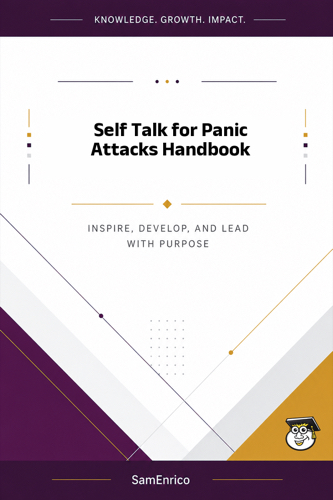
Non-FictionSelf-HelpPanic DisorderCrisis
Self Talk for Panic Attacks Handbook eBook
Use grounding phrases during acute anxiety episode
Use grounding phrases during acute anxiety episodes.
Formats
Free sample
Chapter 1: The Hijack Alarm--–- You are standing in line at the grocery store. The woman in front of you is writing a check—slowly, painfully, as if she has all the time in the world. You shift your weight from one foot to the other. Your chest feels tight. You tell yourself it's nothing.
Then your heart slams against your ribs like a fist on a door. The fluorescent lights seem too bright. The exit sign at the front of the store looks like a life raft on a sinking ship. Your mind screams: Get out. Get out now.
You're going to pass out. You're going to make a scene. Everyone can see you. You whisper to yourself, "Just calm down." It doesn't work. It never works.
And now you are certain: something is terribly wrong with you.If you have lived this moment—or any of its thousand variations—you have also been told, repeatedly, to "just calm down." By friends. By family. By well-meaning internet articles. By your own desperate inner voice. This chapter exists to deliver a piece of news that will either infuriate you or liberate you, and possibly both: "Just calm down" is not merely unhelpful advice.
It is biologically backward instructions for a brain that has already left the building.You have not failed because you cannot calm down. You have failed only because you were given the wrong map for the territory you are in. This chapter will teach you what is actually happening inside your skull during those terrifying seconds, why your rational brain goes offline like a computer in a lightning storm, and why the very phrase "calm down" acts as an accelerant rather than an extinguisher. By the end, you will have a new name for the experience—The Hijack—and a single, simple grounding phrase that will become your first tool for talking back.The Grocery Store Problem: Why Willpower Is Useless Here Let us begin with a confession that most self-help books hide behind academic language: willpower is a terrible panic intervention. In fact, willpower makes panic worse.
This is not a character assessment. It is neurology.When you are calm, your brain operates like a well-organized office. The prefrontal cortex—located right behind your forehead—serves as the CEO. It makes plans, evaluates risks, suppresses inappropriate impulses, and tells your body when to feel safe. The amygdala, two small almond-shaped clusters deep in the brain, acts as a security guard.
Its job is to scan for threats. When the security guard sees something suspicious, it sounds an alarm. The CEO then investigates: Is that a real threat or a shadow? If it is a shadow, the CEO tells the security guard to stand down. This handshake between the amygdala and the prefrontal cortex happens thousands of times per day without you ever noticing.During a panic attack, that handshake breaks.
Something—a trigger as small as a skipped heartbeat or as large as a traumatic memory—causes the amygdala to sound the alarm at full volume. But instead of waiting for the CEO to investigate, the amygdala now overrides the CEO. It sends an emergency signal directly to your brainstem, which activates your sympathetic nervous system. Within milliseconds, your body floods with adrenaline and cortisol. Your heart rate doubles.
Your breathing becomes shallow and rapid. Blood rushes away from your digestive system and toward your large muscles. Your pupils dilate. Your hearing sharpens. Your body is now in full fight-or-flight mode, prepared to fight a saber-toothed tiger or run from a bear.Here is the cruel irony: the prefrontal cortex—the part of your brain that could say "there is no tiger, this is a grocery store"—is now offline.
Blood flow to the prefrontal cortex decreases during a panic attack because your body is diverting resources to survival systems. The CEO has been locked in the broom closet while the security guard screams "FIRE!" at the top of its lungs. And you, the conscious self, are left standing in the cereal aisle with a pounding heart and absolutely no rational access to the very circuits that could tell you that you are safe.This is The Hijack.The Neurobiology of The Hijack: Your Brain on Panic Let us go deeper into the machinery, because understanding what is happening is the first step toward not fearing it. The amygdala does not actually "see" threats. It detects patterns.
It has stored memories of every frightening or painful experience you have ever had, not as stories but as sensory templates. A rapid heartbeat. A feeling of suffocation. A sense of unreality. When your current physical state matches one of those templates—even partially—the amygdala sounds the alarm before your conscious brain has time to evaluate whether the match is accurate.This is why panic attacks often feel like they come "out of nowhere." Your conscious mind cannot find the threat because there is no external threat.
The threat is an internal pattern match. Your heart rate increased slightly because you stood up too quickly, or you took a shallow breath without realizing it, and your amygdala said, "That pattern matches a past moment of terror. Sound the alarm."Once the alarm sounds, a cascade of events unfolds with terrifying speed:The amygdala activates the hypothalamus, which activates the pituitary gland, which activates the adrenal glands. This is the HPA axis, and it floods your bloodstream with cortisol.The amygdala also sends a direct signal to the locus coeruleus in your brainstem, which releases norepinephrine throughout your brain. Norepinephrine is the neurotransmitter of arousal and vigilance.
It makes you hyperaware—which sounds good until you realize that hyperawareness of a racing heart makes the heart race even faster.Your breathing shifts from diaphragmatic (belly breathing) to thoracic (chest breathing) . This is controlled by the phrenic nerve and the intercostal muscles. Thoracic breathing is less efficient, which can create a sensation of air hunger—the feeling that you cannot get enough oxygen even though your blood oxygen levels are normal.Your heart rate increases because your sympathetic nervous system has released epinephrine (adrenaline) directly onto your cardiac muscle. This is not imagination. Your heart can go from 70 beats per minute to 140 beats per minute in under ten seconds.Blood flow changes.
Your body constricts blood vessels in non-essential areas (fingers, toes, digestive system) and dilates vessels in large muscle groups. This can cause cold hands and feet, nausea, and a feeling of internal trembling.Your prefrontal cortex activity decreases because norepinephrine follows an inverted-U curve. A little norepinephrine improves focus. Too much norepinephrine—the amount released during a panic attack—impairs prefrontal function. You literally cannot think clearly.By the time you notice the first symptom, the entire cascade is already underway.
You are not causing the panic. You are experiencing the panic. And the worst part is that your brain now has a new sensory template: this moment of panic. The next time your heart rate increases for any reason, your amygdala will match that pattern and sound the alarm even faster. This is how panic becomes a feedback loop.
This is how a single attack can lead to panic disorder.Why "Just Calm Down" Is Like Yelling at a Tsunami…
This is the end of the free sample. Get the eBook to keep going. Buy now
About this book
Details
- Author
- Earls Donnette
- Publisher
- SamEnrico
- Language
- English
- Genre
- Non-Fiction, Self-Help, Panic Disorder, Crisis
- Released
- 2026-06-08
- Pages (approx.)
- 109
- Available as
- eBook, Audiobook

Read better in the ZLOADR app
Your eBooks on your phone or tablet. Sign in with your SamEnrico account and start reading.
More by Earls Donnette
 Stolen Idea Anger RecoveryEarls Donnette$11.99
 The Perfectionism Shame LinkEarls Donnette$11.99
 Spin Class Secrets HandbookEarls Donnette$11.99
 Veterans Substance GuideEarls Donnette$11.99
 William Morris: The Craftsman Who Built a Sustainable RevolutionEarls Donnette$11.99
 Understanding Upington DiseaseEarls Donnette$17.99
 Financial Services Relationship ManagerEarls Donnette$11.99
 Pre Seed Fundraising ChecklistEarls Donnette$12.99
 Chemical Compliance CertificationsEarls Donnette$12.99
 How to Start a Petroleum Geologist Business (Beginners Guide)Earls Donnette$11.99
You may also like
 Hong Kong Handover 1997Dunn Johnnie$11.99
 Zumba For Postnatal Recovery CourseNeal Christian$11.99
 Zumba for BeginnersLadner Nikia$11.99
 YouTube Comment Mining GuideHumes Pandora$12.99
 Worry Box MeditationCarlin Rudy$11.99
 Workplace Stress MeditationNguyen Lynn$11.99
 Workplace Stress and Sleep RepairHawley Ivory$11.99
 Workplace Perfectionism CureDelaney Jeffry$11.99
 Workplace Injustice Anger GuideWallen Isabelle$11.99
 Work Addiction and Burnout LinkGreenwood Ester$11.99
 Women in Yoga and WellnessBeattie Galina$11.99
 Women in Stand Up ComedyChun Evangeline$11.99