
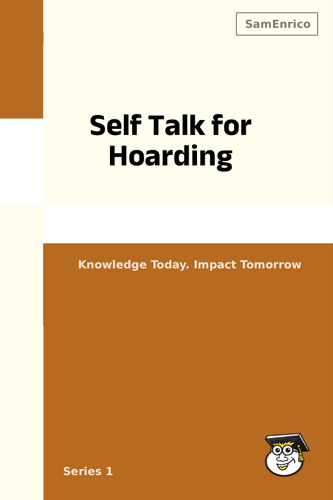
Self Talk for Hoarding eBook
Replace attachment narratives with safety and rele
Replace attachment narratives with safety and release statements.
Formats
Free sample
Chapter 1: The Two Voices--–- The first time Margaret tried to clean her living room, she sat on the floor for three hours holding a single receipt. It was from a grocery store, dated seven years earlier, for a cake she had bought for a birthday party that no one attended. She could not throw it away. Not because she thought the receipt was valuable, and not because she was lazy. She could not throw it away because the receipt whispered to her.
It said, “That party mattered. That cake mattered. You mattered that day.” Then another voice, quieter but sharper, said, “You are pathetic. You can’t even throw away trash.” Margaret threw the receipt into the keep pile. Then she cried.If you have ever held an object that you knew, intellectually, had no practical use—a broken toaster, a ticket stub, a shirt that no longer fits—and felt your chest tighten at the thought of releasing it, you already understand Margaret’s predicament.
You already know that hoarding is not about laziness, disorganization, or a lack of willpower. Hoarding is about a specific kind of conversation that happens inside your head, often below the level of conscious awareness. It is a conversation between two very different voices, and until you learn to recognize both of them, no organizing strategy, no decluttering checklist, and no amount of shame will change your behavior.This book is not about cleaning. It is about changing the language you use when you decide whether to keep or release. And that work begins with a single, counterintuitive distinction: the voice that drives you to acquire and save objects is not the voice that criticizes you for doing so.
In fact, those two voices are enemies. One speaks in whispers of love, memory, and potential. The other speaks in shouts of disgust, failure, and shame. The first voice is the engine of hoarding. The second voice is the paralysis.
Most people try to fight the first voice with the second voice, and that is why nothing ever changes.The Myth of the Lazy Hoarder Before we can rewire your self-talk, we must dismantle a myth that has caused more harm than almost any other misconception about hoarding. The myth is this: people hoard because they are lazy, messy, or morally deficient. Every television show about hoarding reinforces this myth by showing extreme cases, bringing in cleaning crews, and framing the solution as a single weekend of hard work followed by a tearful confession. That narrative sells advertisements, but it does not heal anyone.The research tells a different story. Decades of clinical studies by pioneers like Dr.
Randy Frost and Dr. Gail Steketee have demonstrated that hoarding disorder is neurologically and psychologically distinct from simple messiness. People who hoard show different patterns of brain activity when faced with decisions about their possessions. Specifically, the anterior cingulate cortex and the insula—regions associated with emotional attachment and physical pain—light up when a hoarder considers discarding an item. In other words, letting go of an object does not feel inconvenient.
It feels like injury.This is not a metaphor. Functional MRI studies have shown that the same brain regions activated by physical pain are activated when a person with hoarding disorder attempts to discard a possession. Your brain is not being dramatic. It is genuinely interpreting the act of release as a threat to your safety, your identity, or your emotional survival. And when the brain perceives a threat, it does not respond to logic, shame, or pressure.
It responds by narrowing your options, increasing your anxiety, and driving you back toward the familiar—in this case, keeping the object.So if you have ever beaten yourself up for being unable to throw something away, stop. That self-punishment is not a solution; it is a symptom. And it is the wrong voice entirely.The Two Voices of Hoarding Let us name the two voices that live inside the hoarding brain. You will recognize both of them.The first voice is the Attachment Voice. It is warm, hopeful, and future-oriented.
It speaks softly, often in the second person, and it sounds like a friend trying to comfort you. When you pick up an old magazine, the Attachment Voice says, “There’s an article in here you meant to read.” When you find a childhood toy, it says, “You’ll regret losing this memory.” When you see a free item on the side of the road, it says, “Someone could use this. Maybe you.” The Attachment Voice is从来不 mean. It does not yell or insult. It persuades.
It reminds you of good intentions, lost possibilities, and the person you hoped to become. And because it speaks in the language of love, memory, and potential, it feels almost impossible to argue with. Who wants to be the person who throws away love, memory, or potential?The second voice is the Critical Voice. Unlike the Attachment Voice, the Critical Voice is harsh, past-oriented, and shaming. It speaks after the Attachment Voice has done its work, when the clutter has accumulated and you are surrounded by the consequences of your saving.
The Critical Voice says, “Look at this mess. You are disgusting. Normal people don’t live like this. You’ll never change.” It sounds like every disappointed parent, every judgmental peer, every internalized message you have ever received about your worth being tied to your tidiness. The Critical Voice is loud, and it feels urgent, but it is surprisingly ineffective at changing behavior.
In fact, research on shame and behavior change shows that shame activates the amygdala and the hypothalamic-pituitary-adrenal (HPA) axis, flooding your system with cortisol. That cortisol narrows your cognitive flexibility, making you more rigid and less capable of creative problem-solving. Shame does not motivate release. It motivates avoidance, hiding, and further accumulation as a coping mechanism.Here is the critical insight that changes everything: The Attachment Voice drives acquisition and saving. The Critical Voice never drives anything except paralysis and shame.
And most people try to fight the Attachment Voice with the Critical Voice, which is like trying to put out a fire with gasoline.Think back to Margaret with the receipt. The Attachment Voice said, “That party mattered. You mattered that day.” That is a genuine emotional need—the need to feel remembered, valued, and connected. The Critical Voice responded, “You are pathetic.” That is not a solution. That is an attack.
And what did Margaret do? She kept the receipt. Not because the Critical Voice convinced her, but because the Attachment Voice offered her something the Critical Voice took away: a sense of worth. In the battle between these two voices, the warm one will always win over the cold one. That is not a weakness.
That is how the human brain is wired.Why the Critical Voice Feels Like Progress You might be thinking, “But when I criticize myself, at least I’m trying to change. Isn’t that better than doing nothing?” This is a common and understandable misunderstanding. The Critical Voice feels like accountability. It feels like the voice of responsibility, adulthood, and moral seriousness. When you look at a cluttered room and…
This is the end of the free sample. Get the eBook to keep going. Buy now
About this book
Details
- Author
- Mcknight Alejandrina
- Publisher
- SamEnrico
- Language
- English
- Genre
- Non-Fiction, Self-Help, Hoarding
- Released
- 2026-06-06
- Pages (approx.)
- 135
- Available as
- eBook, Audiobook

Read better in the ZLOADR app
Your eBooks on your phone or tablet. Sign in with your SamEnrico account and start reading.
More by Mcknight Alejandrina
 Gratitude Persuasion GuideMcknight Alejandrina$11.99
 Time Blocking for WritersMcknight Alejandrina$11.99
 Reddit Relationship Advice ComparisonMcknight Alejandrina$11.99
 Perimenopause and Eczema Flare GuideMcknight Alejandrina$11.99
 The Exile of Valmiki: The Sage Who Became a DemonMcknight Alejandrina$11.99
 Project Cost ControllerMcknight Alejandrina$11.99
 Understanding Kallmann Syndrome, Type 3, RecessiveMcknight Alejandrina$17.99
 How to Become a Lag ScrewerMcknight Alejandrina$11.99
 Racial Trauma Recovery HandbookMcknight Alejandrina$12.99
 Defense Tech Investment GuideMcknight Alejandrina$12.99Defense Tech Investment GuideMcknight Alejandrina$12.99
You may also like
 Hong Kong Handover 1997Dunn Johnnie$11.99
 Zumba For Postnatal Recovery CourseNeal Christian$11.99
 Zumba for BeginnersLadner Nikia$11.99
 YouTube Comment Mining GuideHumes Pandora$12.99
 Worry Box MeditationCarlin Rudy$11.99
 Workplace Stress MeditationNguyen Lynn$11.99
 Workplace Stress and Sleep RepairHawley Ivory$11.99
 Workplace Perfectionism CureDelaney Jeffry$11.99
 Workplace Injustice Anger GuideWallen Isabelle$11.99
 Work Addiction and Burnout LinkGreenwood Ester$11.99
 Women in Yoga and WellnessBeattie Galina$11.99
 Women in Stand Up ComedyChun Evangeline$11.99