
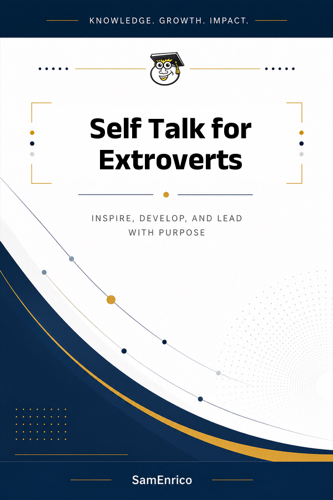
Non-FictionSelf-Help / Extroversion
Self Talk for Extroverts eBook
Rewires validation-seeking inner speech into self-
Rewires validation-seeking inner speech into self-sourced confidence.
Formats
Free sample
Chapter 1: The Loud Echo--–- You are standing in a crowded room. The music is loud enough to feel in your chest, and you are holding a drink you do not want because it gives your hands something to do. You are telling a story—one you have told before, one that usually lands. You hit the punchline. The person across from you smiles, but the smile does not reach their eyes.
Someone else checks their phone. A third person turns away to greet someone who just walked in.For a split second, you feel it: the drop. The tiny, terrible plummet in your stomach that says, They didn't like it. They didn't like me. Your inner voice, which moments ago was soaring with anticipation, now pivots into damage control.
Say something funnier. Ask them a question. Laugh at your own joke so they know it was supposed to be funny. Do something. Fix this.And so you do.
You talk faster. You gesture more. You pivot to a different story, then a different topic, then a compliment about their shoes. You are working. You are performing.
And somewhere beneath the chatter, you are exhausted.This is not a failure of personality. It is not a sign that you are shallow or needy or too much. It is the predictable result of a specific wiring—one that has been rewarded, trained, and reinforced for your entire life. You are an extrovert. And you have been taught, by accident and by design, that your value lives in the space between your words and their reactions.This chapter is not about making you less extroverted.
It is not about teaching you to be quiet, small, or self-contained in the way that introverts naturally are. It is about answering a single question that most self-talk books have never thought to ask: What happens when the person who seeks external validation doesn't lack a voice, but lacks an internal anchor?Let us begin.The Misdiagnosis of the Talkative Personality Most self-help literature on self-talk was written by and for people whose primary struggle is getting themselves to speak up. The classic inner critic for an introverted or anxious person sounds something like this: "You will mess up. You don't know enough. They will see that you are a fraud.
Stay quiet and safe." The solution, in those books, is amplification: learn to quiet the critic, learn to speak your truth, learn to take up space.If you are an extrovert reading this, you have likely tried those techniques and found them confusing. You do not struggle to take up space. You struggle to know why you are taking it up. You do not have a quiet inner voice that needs to be amplified; you have a loud inner voice that needs to be redirected.The misdiagnosis happens when well-meaning advice assumes that all self-doubt looks the same. For you, the inner critic does not say "You will mess up." It says something far more specific and far more destabilizing: "They won't like you."Let us sit with that difference for a moment."You will mess up" is a fear of performance failure.
It is about competence. The solution is preparation, practice, and self-compassion for mistakes."They won't like you" is a fear of social rejection. It is about worth. The solution cannot be more preparation or more practice, because no amount of skill guarantees that everyone will like you.This distinction is the fault line upon which extroverted self-talk cracks open. You do not need to learn how to speak.
You need to learn how to stop needing their response in order to feel real.Healthy Extroversion vs. Addicted Extroversion Let us be precise about a distinction that most books blur entirely. There is a difference between healthy extroversion and addicted extroversion, and the difference is not in how often you talk or how much you enjoy company. It is in what happens to your sense of self when the company leaves.Healthy extroversion means you gain energy from social interaction. You feel alive in the presence of others.
You think out loud, you process externally, you bounce ideas off people because that is how your brain works best. After a good conversation, you feel expansive, connected, and often more clear-headed than when you started. Crucially, when you go home afterward, you are tired in the way an athlete is tired after a good game—satisfied, not depleted. Your sense of self remains intact. You were you at the party, and you are still you on the couch.Addicted extroversion looks similar from the outside.
You also gain energy from social interaction. You also talk, laugh, and engage. But the driver is different. You are not socializing because you are full and want to share; you are socializing because you feel empty and need them to fill you. Your inner speech before an event sounds less like "I can't wait to see everyone" and more like "I hope they like me.
I hope I'm funny enough. I hope I don't say something stupid." Afterward, instead of satisfaction, you feel a hollow crash. You replay every moment, scanning for evidence of rejection. You cannot tell if the night was good or bad because your sense of it depends entirely on how you imagine they experienced it.If this second description lands uncomfortably close to home, you are not broken. You have simply been running on a fuel source that was never meant to be your primary tank: external approval.The Extrovert Ideal: How Society Trained You to Mistake Attention for Connection Susan Cain, in her seminal book Quiet, introduced the concept of the "Extrovert Ideal"—the widespread cultural belief that the ideal self is gregarious, assertive, comfortable in the spotlight, and socially dominant.
From kindergarten ("participation points") to corporate America ("leadership presence") to dating apps ("good conversationalist"), we reward extroverted behavior relentlessly. The person who speaks first, laughs loudest, and fills the silence is judged as more confident, more competent, and more likable.If you are an extrovert, you have benefited from this bias your entire life. Teachers gave you higher participation grades. Bosses noticed you in meetings. Strangers at parties gravitated toward your energy.
These are real rewards, and they feel good.But there is a hidden cost to being rewarded for your social performance: you begin to believe that the performance is you.The Extrovert Ideal does not just reward extroversion; it conditions extroverts to depend on external feedback for their sense of self. Because you received praise for talking, you learned to talk more. Because you received laughs for jokes, you learned to perform humor. Because you received nods of agreement for your opinions, you learned to offer opinions quickly and confidently. None of this is bad in isolation.
But over time, without an internal anchor, you become a mirror that reflects whatever applause the room offers—and shatters when the room goes quiet.Here is the painful truth the Extrovert Ideal hides from you: attention is not connection.Attention is fleeting, external, and dopamine-driven. It asks: "Are they looking at me?" It feels good in the moment, but it leaves you hungry again within…
This is the end of the free sample. Get the eBook to keep going. Buy now
About this book
Details
- Author
- Broderick Dee
- Publisher
- SamEnrico
- Language
- English
- Genre
- Non-Fiction, Self-Help / Extroversion
- Released
- 2026-06-07
- Pages (approx.)
- 129
- Available as
- eBook, Audiobook

Read better in the ZLOADR app
Your eBooks on your phone or tablet. Sign in with your SamEnrico account and start reading.
More by Broderick Dee
 Rainbow Bridge Calm GuideBroderick Dee$11.99
 Mango Tree NapBroderick Dee$11.99
 Flow Journal PromptsBroderick Dee$11.99
 Stress Cold Sores GuideBroderick Dee$11.99
 The Focus and Exercise LinkBroderick Dee$11.99
 Eisenhower Matrix for ExecutivesBroderick Dee$11.99
 Powerlifting Hypnosis GuideBroderick Dee$11.99
 The Twilight Zone: Rod Serling's Vision That Defied the Cold WarBroderick Dee$11.99
 The Bloody Field of Marston Moor: Cromwell's Gambit and the Birth of a RepublicBroderick Dee$11.99
 Problem Solution SnapshotBroderick Dee$12.99
 Chinese Supplier Alternative Sourcing PlaybookBroderick Dee$12.99
 Woodlice: Pill BugBroderick Dee$11.99
You may also like
 Hong Kong Handover 1997Dunn Johnnie$11.99
 Zumba For Postnatal Recovery CourseNeal Christian$11.99
 Zumba for BeginnersLadner Nikia$11.99
 YouTube Comment Mining GuideHumes Pandora$12.99
 Worry Box MeditationCarlin Rudy$11.99
 Workplace Stress MeditationNguyen Lynn$11.99
 Workplace Stress and Sleep RepairHawley Ivory$11.99
 Workplace Perfectionism CureDelaney Jeffry$11.99
 Workplace Injustice Anger GuideWallen Isabelle$11.99
 Work Addiction and Burnout LinkGreenwood Ester$11.99
 Women in Yoga and WellnessBeattie Galina$11.99
 Women in Stand Up ComedyChun Evangeline$11.99