
Non-FictionSelf-Help / Empty Nest
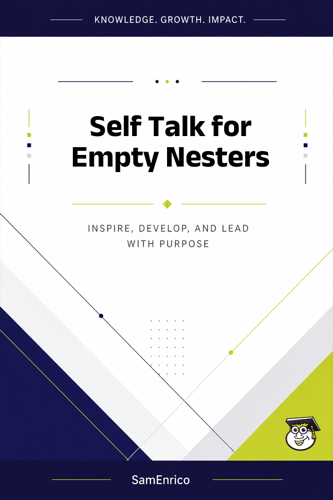
Self Talk for Empty Nesters eBook
Rewires loss self-talk into new chapter inner dial
by Kyle Cary
Rewires loss self-talk into new chapter inner dialogue.
Formats
Free sample
Chapter 1: The Loudest Silence--The last box is taped shut. The car is packed. Your child hugs you—a real hug, not the quick, distracted ones of the past few months—and then they are walking away. The car door closes. The engine starts.
They wave through the window, and you wave back, and then the car turns the corner and disappears.You stand in the driveway for a long moment. The air feels different. The house behind you is suddenly quiet in a way it has never been quiet before. Not the quiet of naptime, when you tiptoed and held your breath. Not the quiet of a school day, when you knew they would return by 3:15.
This is a different quiet. This is the quiet of absence.You walk inside. The hallway feels longer. The kitchen counter where they left their keys every afternoon is empty. Their bedroom door is closed.
You do not open it. Not yet. Maybe not today. Maybe not for a week. Because that door, once opened, will reveal a room that is half-empty or half-full depending on how you look at it, but either way, it will be a room without them in it.And then you hear it.
Not a sound from outside. Not the refrigerator humming or the furnace kicking on. You hear a voice. It is your own voice, but it does not sound like you. It sounds like a version of you that you have not heard in years—maybe decades.
It says things like:"You just lost your purpose.""You should have been a better parent.""They are never coming back the way they were.""You are alone now."This is the loudest silence you have ever experienced. And this chapter is about understanding where that voice comes from, why it speaks so loudly in an empty house, and how to simply hear it—without fighting it, without believing it, and without letting it write the rest of your story.The Inner Voice You Never Had Time to Hear For eighteen years—or twenty, or twenty-five, depending on how many children you raised and how far apart they were spaced—your inner voice was a background hum. It was there, certainly. It whispered doubts when you made parenting decisions. It cheered quietly when your child succeeded.
It panicked when they were late coming home. But you rarely had time to listen to it closely, because the external noise of parenting was overwhelming.Think back. When was the last time you sat in complete silence for more than ten minutes? Not silence while scrolling your phone. Not silence while exhausted and half-asleep.
Real silence, with no demands, no schedules, no questions, no arguments, no doorbells, no carpools, no homework help, no bedtime negotiations. For most parents, that moment does not exist in memory. You have been in survival mode for nearly two decades. Your brain learned to filter out the background hum of your inner voice because there was always something louder demanding attention.Now, suddenly, the noise is gone. And the inner voice that was once a whisper in a crowded room is now a soloist in an empty concert hall.This phenomenon is not weakness.
It is not a sign that you are failing at the empty nest. It is simple neurobiology combined with the physics of attention. When external stimuli decrease, internal stimuli increase. Your brain, starved of the familiar chaos, turns inward. And what it finds there is not always kind.Why Silence Feels Like Danger Let us talk about what is happening in your brain right now.
Because understanding the biology of this moment is the first step toward not being controlled by it.The human brain evolved over hundreds of thousands of years to prioritize one thing above all others: survival. Your brain is not designed for happiness. It is not designed for fulfillment. It is designed to detect threats and keep you alive long enough to reproduce and protect your offspring. Every single neural pathway in your brain is, at its most fundamental level, a threat-detection system.During your parenting years, your brain learned a very specific pattern: noise equals purpose, and purpose equals safety.
When your children were young, noise meant they were alive. A crying baby was a breathing baby. A toddler throwing a tantrum was a toddler with enough energy to be angry. A teenager arguing about curfew was a teenager who was home and accounted for. Your brain came to associate the chaos of parenting with the absence of catastrophe.This is why you could sleep through a thunderstorm but wake up instantly when your child coughed from down the hall.
Your brain had calibrated itself to treat parental noise as the signal for safety.Now, the noise has stopped. And your brain, which has spent nearly two decades interpreting noise as safety, does not know what to do with silence. It does not feel relief. It does not feel peace. It feels the absence of the safety signal, and it misinterprets that absence as a threat.This is not a metaphor.
This is biochemistry. When your brain perceives a threat—even a false one—it activates the hypothalamic-pituitary-adrenal axis. Cortisol is released. Your heart rate increases. Your muscles tense.
You feel restless, irritable, and unable to settle. You may find yourself pacing from room to room, opening and closing drawers, starting tasks and abandoning them. This is not anxiety disorder. This is not depression. This is your brain doing exactly what it evolved to do: looking for danger in the absence of the familiar.The problem is that the danger is not there.
The silence is not a predator. The empty room is not a threat. But your brain does not know that yet. It has to learn. And learning takes time, repetition, and the right kind of practice.The Two Voices: Reminiscing vs.
Rumination Before we go further, we need to make a critical distinction. Not all inner voice activity is the same. There are two very different ways your mind can engage with the past, and they produce completely different emotional outcomes.Reminiscing is a voluntary, warm, memory-based activity that ends in gratitude. When you reminisce, you choose to look at a photo album. You choose to tell a story about the time your child said something hilarious at age four.
You choose to remember a family vacation. Reminiscing is controlled. You can start it and stop it. It leaves you feeling connected to your past without being trapped in it. The emotion at the end of reminiscing is often a bittersweet but genuine gratitude: "I am so lucky to have had those moments."Rumination is an involuntary, cold, guilt-based loop that ends in despair.
When you ruminate, you do not choose it. It chooses you. You are washing dishes and suddenly you are reliving the time you yelled at your child for no good reason. You are lying in bed and suddenly you are cataloging every parenting mistake you ever made. Rumination is not under your control.
It repeats the same painful memories on a loop, getting louder each time. The emotion at the end of rumination…
This is the end of the free sample. Get the eBook to keep going. Buy now
About this book
Details
- Author
- Kyle Cary
- Publisher
- SamEnrico
- Language
- English
- Genre
- Non-Fiction, Self-Help / Empty Nest
- Released
- 2026-06-10
- Pages (approx.)
- 136
- Available as
- eBook, Audiobook

Read better in the ZLOADR app
Your eBooks on your phone or tablet. Sign in with your SamEnrico account and start reading.
More by Kyle Cary
 Frozen Lake SkateKyle Cary$11.99
 Flow Failure RecoveryKyle Cary$11.99
 The Deep Work Coach GuideKyle Cary$11.99
 Stress Tinnitus Ringing EarsKyle Cary$11.99
 Squash Player's Self HypnosisKyle Cary$11.99
 Ferris Wheel RelaxationKyle Cary$11.99
 ABCDE for Social WorkersKyle Cary$11.99
 The Trial of the Century That Wasn't: The Case of Georgi MarkovKyle Cary$11.99
 The Tournament of the Black Eagle: How a Renaissance Joust Became a Political BattlegroundKyle Cary$11.99
 How to Produce DinnerwareKyle Cary$11.99
 A Collector's Handbook to the Wolseley Series Ii 12Kyle Cary$11.99
 Wrasses: Reef FishKyle Cary$11.99
You may also like
 Hong Kong Handover 1997Dunn Johnnie$11.99
 Zumba For Postnatal Recovery CourseNeal Christian$11.99
 Zumba for BeginnersLadner Nikia$11.99
 YouTube Comment Mining GuideHumes Pandora$12.99
 Worry Box MeditationCarlin Rudy$11.99
 Workplace Stress MeditationNguyen Lynn$11.99
 Workplace Stress and Sleep RepairHawley Ivory$11.99
 Workplace Perfectionism CureDelaney Jeffry$11.99
 Workplace Injustice Anger GuideWallen Isabelle$11.99
 Work Addiction and Burnout LinkGreenwood Ester$11.99
 Women in Yoga and WellnessBeattie Galina$11.99
 Women in Stand Up ComedyChun Evangeline$11.99