
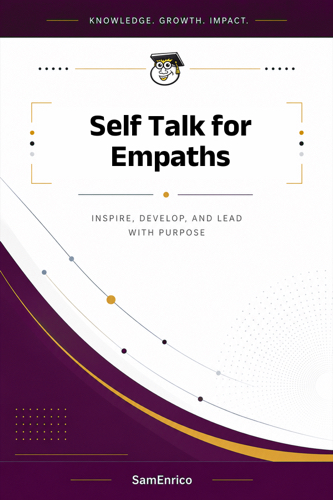
Non-FictionSelf-Help / Empathy
Self Talk for Empaths eBook
Protects sensitive individuals from absorbing othe
Protects sensitive individuals from absorbing others' negative self-talk.
Formats
Free sample
Chapter 1: The Sponge's Burden--–- The panic attack came in the freezer aisle of a Whole Foods. I was fine one second—reaching for almond milk, making a mundane decision about breakfast—and the next, my chest caved in as if someone had dropped a concrete block on it. My vision tunneled to a narrow pinhole. A voice that was not mine screamed inside my skull: You're failing. Everyone can see it.
You don't belong here. You never have. I abandoned my cart, left it sitting there with the dairy case door still open, and walked—then jogged—then ran to my car. I sat in the driver's seat with the engine off for twenty minutes, shaking, before I could breathe normally again.Later that evening, I learned something that changed my understanding of that moment forever. A woman two aisles over from me in the grocery store had received a phone call while I was standing there.
Her mother was dying. She had collapsed against the frozen vegetables, sobbing, and whispered to the person on the phone: "I can't do this. I'm losing her. I'm not strong enough." I did not see her. I did not hear her.
And yet, her terror, her grief, and most critically, her negative self-talk—the script of inadequacy and powerlessness she was directing at herself—had traveled through the air between us and lodged itself inside my nervous system as if it were my own.That was the day I stopped calling myself "sensitive" and started understanding myself as a sponge. And not just any sponge—one that soaks up not only the emotions of others but their internal monologues. Their self-criticisms. Their shame. Their "I'm not good enough" looping in my head for days after a single conversation.If you are reading this book, you already know exactly what I am describing.
You have walked into a room and felt the mood before anyone spoke. You have left a coffee date exhausted despite having done nothing physically strenuous. You have heard a friend say "I'm so stupid" and then spent the next three hours hearing yourself think "I'm so stupid" for no reason you could trace. You have wondered, in your quieter moments, whether you even have an authentic self anymore—or whether you are just a collage of everyone else's fears, anxieties, and insecurities, pasted together and called a personality.Here is the truth that no one told you: You are not broken. You are not too sensitive.
You are not crazy. You are an empath—one of the 15 to 20 percent of the population born with a nervous system that is wired to process the world more deeply than others. And the reason you feel like you are drowning is not because you are weak. It is because you have been absorbing the negative self-talk of everyone around you your entire life, and no one ever taught you how to wring yourself out.This chapter is the beginning of that teaching.The Difference Between Feeling and Absorbing Let us start with a distinction that will save your sanity. Most people—including most therapists, coaches, and well-meaning friends—use the word "empathy" to describe what you experience.
They say you are "highly empathetic" or "emotionally intelligent" or "just a caring person." But those words miss something crucial.Empathy is the ability to feel with someone while maintaining your own emotional center. You see a friend crying, and you feel sadness in your chest—but you know it is their sadness, and you can choose how to respond. Empathy is a bridge, not a flood.Absorption is different. Absorption is when someone else's internal state overwrites your own. You do not just feel with them; you feel as them.
Their fear becomes your fear. Their shame becomes your shame. Their self-talk—the critical, repetitive, often cruel things they say to themselves inside their own heads—becomes a voice inside your head, speaking in the first person as if it were you.Here is an example that may sound familiar.A coworker mutters under his breath during a meeting: "I'm failing at this project. I'm going to get fired. I'm such an idiot." You hear him, but you do not think much of it.
An hour later, alone at your desk, you find yourself thinking: "I'm failing. I'm such an idiot." You look around. Nothing has changed in your work. Your performance reviews are fine. But the thought is there, solid as furniture, repeating like a song stuck on loop.That is absorption.
Not empathy. Not compassion. Absorption.Or consider a partner who comes home anxious about a financial decision. She says, "I'm so stupid with money. We're going to lose everything." You reassure her.
You look at the numbers together. Everything is fine. But that night, lying in bed, you feel a knot in your stomach and hear: "We're going to lose everything. You're stupid with money." The "we" and "you" have become tangled. Her self-talk has become yours.This is the hidden cost of being an empath that no one talks about.
We assume empaths just feel more. But the real damage—the exhaustion, the confusion, the loss of self—comes from absorbing narratives. You are not just carrying other people's emotions. You are carrying their interpretations of reality. Their worst fears about themselves.
Their shame spirals. Their hopelessness. And you are replaying those narratives in your own mind, in your own voice, as if you authored them.The Sponge Metaphor (And Why It Matters)Let me invite you to hold a clear image in your mind for the rest of this book.Imagine a brand-new sponge. It is clean, dry, and light. This is you at birth—open, receptive, capable of absorbing, but not yet full of anything.Now imagine that sponge sitting on a kitchen counter.
Someone spills red wine. The sponge soaks it up. Someone else spills coffee. The sponge soaks that up too. Someone cries over the sponge, and saltwater drips into it.
Someone yells in frustration, and the sponge absorbs the invisible mist of their anger. Over time, the sponge becomes heavy, dark, and unrecognizable. It is not that the sponge is broken. It is that it has been absorbing everything in its environment without any way to wring itself out.Most empaths are living as that sponge. You have absorbed:The self-criticism of your perfectionist parent ("You never do anything right")The anxiety of your catastrophizing coworker ("Something terrible is coming")The martyrdom of your codependent friend ("I give and give and no one cares")The gaslighting of a former partner ("You're too sensitive, you're crazy, that didn't happen")The helplessness of people who have given up ("Nothing ever works out, why bother")And because you are an empath—because your nervous system is literally wired to take in more information from your environment than the average person's—you did not have a choice about absorbing these things.
Your brain's mirror neurons fire more intensely. Your sensory processing sensitivity means you notice subtleties others miss. Your open emotional system, which allows you to feel such deep compassion, also allows you to be invaded by the inner…
This is the end of the free sample. Get the eBook to keep going. Buy now
About this book
Details
- Author
- Huggins Cliff
- Publisher
- SamEnrico
- Language
- English
- Genre
- Non-Fiction, Self-Help / Empathy
- Released
- 2026-06-10
- Pages (approx.)
- 147
- Available as
- eBook, Audiobook

Read better in the ZLOADR app
Your eBooks on your phone or tablet. Sign in with your SamEnrico account and start reading.
More by Huggins Cliff
 Figure Skater's Self HypnosisHuggins Cliff$11.99
 The Focus JournalHuggins Cliff$11.99
 Flow in GardeningHuggins Cliff$11.99
 Stress Breathing ProblemsHuggins Cliff$11.99
 Seashell Listening SpotHuggins Cliff$11.99
 Horseback Trail GuideHuggins Cliff$11.99
 Eisenhower Matrix for Remote WorkHuggins Cliff$11.99
 The Last Stand of the Miracle on Ice: The Untold 1980 Olympic AftermathHuggins Cliff$11.99
 The Alchemists of Meroë: Unveiling the Lost Science of KushHuggins Cliff$11.99
 How to Produce a DigiboxHuggins Cliff$11.99
 How to Become a Counter CutterHuggins Cliff$11.99
 A Collector's Handbook to the Wolseley EighteenHuggins Cliff$11.99
You may also like
 Hong Kong Handover 1997Dunn Johnnie$11.99
 Zumba For Postnatal Recovery CourseNeal Christian$11.99
 Zumba for BeginnersLadner Nikia$11.99
 YouTube Comment Mining GuideHumes Pandora$12.99
 Worry Box MeditationCarlin Rudy$11.99
 Workplace Stress MeditationNguyen Lynn$11.99
 Workplace Stress and Sleep RepairHawley Ivory$11.99
 Workplace Perfectionism CureDelaney Jeffry$11.99
 Workplace Injustice Anger GuideWallen Isabelle$11.99
 Work Addiction and Burnout LinkGreenwood Ester$11.99
 Women in Yoga and WellnessBeattie Galina$11.99
 Women in Stand Up ComedyChun Evangeline$11.99