
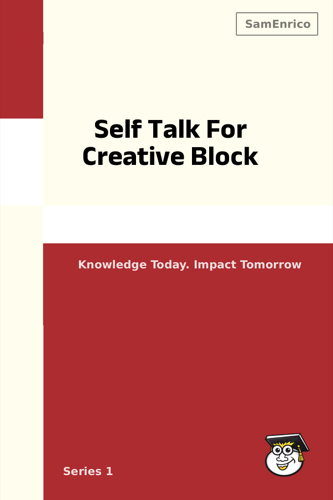
Self Talk For Creative Block eBook
Replace I have no ideas with I am open and ideas w
Replace I have no ideas with I am open and ideas will come.
Formats
Free sample
Chapter 1: The Sentence That Locks You...--You are not out of ideas. You have been hypnotized by a sentence.Let me say that again, because it sounds like a gimmick and it is not. You are not out of ideas. You have been repeating a specific sequence of words—usually without noticing—that tells your brain to stop looking. That sentence is “I have no ideas.” And every time you say it, think it, or sigh it under your breath, your brain obediently closes the door.
It does not close the door because you are untalented. It closes the door because you gave it a command.This is the single most important thing to understand about creative block: your brain is not your enemy. It is a remarkably obedient servant. It does exactly what your language tells it to do. When you say “I have no ideas,” your brain does not think, “Well, that’s an exaggeration—let me find the three ideas hiding in the corner.” No.
Your brain thinks, “Command received. Shutting down idea-generating functions. Let me know when the command changes.” This is not a metaphor. This is the neuropsychology of self-directed language, and it is the difference between a thirty-minute block and a three-year block.I have worked with hundreds of creative professionals—novelists stuck on page ninety, designers who cannot open their software, musicians who have not touched their instrument in eighteen months, entrepreneurs who stare at a blank slide deck for six hours. And in every single case, the block was not located in their skill set, their talent, their education, or their work ethic.
It was located in a handful of sentences they had stopped noticing. The sentences had become wallpaper. And wallpaper, as it turns out, can be a prison.This chapter is not about fixing your block. This chapter is about seeing the sentences that created it. Because you cannot change a command you do not know you are giving.
And right now, you are giving commands all day long.The Difference Between Description and Prescription Let me teach you a distinction that will matter for the rest of this book. It is the difference between descriptive language and prescriptive language.Descriptive language reports on reality as it is right now, in this moment, without exaggeration or permanence. Prescriptive language announces a permanent state of being as if it were a law of nature. Here is the same fact expressed both ways:Descriptive: “I do not have an idea at this exact second.”Prescriptive: “I have no ideas.”Do you feel the difference? The first sentence is a tiny, manageable report about a single moment.
It contains a time stamp (“at this exact second”). It does not claim anything about the next second, or the second after that. The second sentence is a verdict. It is a life sentence. It contains no time stamp, no qualification, no escape hatch.
It is a pronouncement from on high.Here is another example. You are cooking and you burn the onions.Descriptive: “I burned these onions just now.”Prescriptive: “I can’t cook.”One is about a pan. The other is about your identity. One is fixable in thirty seconds by turning down the heat. The other feels like a permanent stain on your soul.
And here is the cruel irony: the prescriptive sentence feels more true in the moment. When you burn the onions, “I can’t cook” has the ring of devastating insight. It feels like you have finally told yourself the painful truth. But it is not the truth. It is a grammatical trap.
Your brain has taken a single burned onion and generalized it into a permanent identity because that is what prescriptive language does.Creative block is almost entirely composed of prescriptive language disguised as self-knowledge. “I have no ideas” is not self-knowledge. It is a bad poem your brain recites out of habit. “I’m not creative” is not a fact. It is a label you glued onto a temporary condition.
“This always happens to me” is not a pattern. It is a generalization that erases every single time it did not happen.The entire first part of this book is about learning to hear the difference between description and prescription. Because once you can hear it, you cannot unhear it. And once you cannot unhear it, the block starts to dissolve not because you tried harder but because you stopped lying to yourself in a specific grammatical form.The Three Families of Block Language After analyzing hundreds of creative blocks, I have found that almost all blocking self-talk falls into one of three families. Each family has a different grammatical structure, but they all do the same thing: they take a temporary, local, small problem and blow it up into a permanent, global, identity-sized catastrophe.Family One: Temporal Absolutes Temporal absolutes are words that claim something is true for all time.
The most common offenders are: never, always, every time, constantly, forever, no matter what. Here is how they show up in creative blocks:“I never have good ideas.”“I always freeze up when I sit down to work.”“Every time I try to write, nothing happens.”“I constantly get stuck halfway through.”Notice what these sentences do. They take a handful of experiences—perhaps the last three writing sessions were difficult—and they stretch them backward and forward across your entire life. “I never have good ideas” claims that you have never had a good idea in the past, do not have one now, and will never have one in the future. That is an extraordinary claim.
It requires evidence across your entire timeline. And yet you accept it in a split second because it feels true in your exhausted body.The absurdity becomes clear when you apply the same grammar to something physical. Imagine burning your hand on a stove and saying, “I will never touch anything safely again.” That would be ridiculous. You would say, “I burned my hand just now. I will be careful with that stove for a while.” But with creativity, we do the opposite.
We take one difficult session and turn it into a life sentence.Family Two: Identity Labels Identity labels are sentences that contain the verb “to be” followed by a noun or adjective that describes your whole self. The most common offenders are: I am a fraud, I am lazy, I am not a real creator, I am blocked, I am stuck, I am uninspired.Here is the problem with “I am” statements: they have no off switch. If you say “I am a fraud,” you are not describing a behavior (“I pretended to know something I did not know in that meeting”). You are describing a soul. And souls, in this grammar, do not change.
You cannot be a fraud in the morning and a real creator in the afternoon. The sentence has declared a permanent condition.The most dangerous identity label for creative people is “I am blocked.” This sentence has destroyed more careers than bad talent ever did. Because “I am blocked” sounds like a diagnosis. It sounds like a medical condition. It sounds like…
This is the end of the free sample. Get the eBook to keep going. Buy now
About this book
Details
- Author
- Wilde Celestine
- Publisher
- SamEnrico
- Language
- English
- Genre
- Non-Fiction, Self-Help
- Released
- 2026-06-07
- Pages (approx.)
- 158
- Available as
- eBook, Audiobook

Read better in the ZLOADR app
Your eBooks on your phone or tablet. Sign in with your SamEnrico account and start reading.
More by Wilde Celestine
 Contract Abstraction Prompt Testing GuideWilde Celestine$11.99
 Imposter Depression ConnectionWilde Celestine$11.99
 Nonforfeiture Benefit LTC GuideWilde Celestine$11.99
 Energizing Breath Awareness PracticeWilde Celestine$11.99
 Russia FCPA Enforcement LogWilde Celestine$11.99
 Memory Keeping for ParentsWilde Celestine$11.99
 Indigenous Spiritual Mentoring CourseWilde Celestine$11.99
 Bosnian Ethnic CleansingWilde Celestine$11.99
 The Outback Telescope: Australia’s Quest for the StarsWilde Celestine$11.99
 The Manchurian Algorithm: How AI Almost Triggered a Cold War AI Arms RaceWilde Celestine$11.99
 The Lost Tomb of the Red Sea: Unlocking Ancient DNA in the Indian OceanWilde Celestine$11.99
 Growing Platycodon (Balloon Flower)Wilde Celestine$11.99
You may also like
 Workplace Stress MeditationNguyen Lynn$11.99
 Volcano Monitoring ScientistCox Alexis$11.99
 The Tech Professional NetAguiar Nevada$11.99
 The Morning Metta RitualCanales Anya$11.99
 The Chunking Memory TechniqueClanton Hyacinth$11.99
 The Beginner Mistake FixAmmons Cassondra$11.99
 Surrendering to What IsGrimm Reatha$11.99
 Self Hypnosis for Fear of FireBillups Eli$11.99
 Road Rage for Professional DriversBrackett Janise$11.99
 Psychiatric Ward Nurse StressDunning Wyatt$11.99
 Observation vs Evaluation NVCTimmons Alda$11.99
 Networking for Nonprofit ProfessionalsPoole Jesse$11.99