
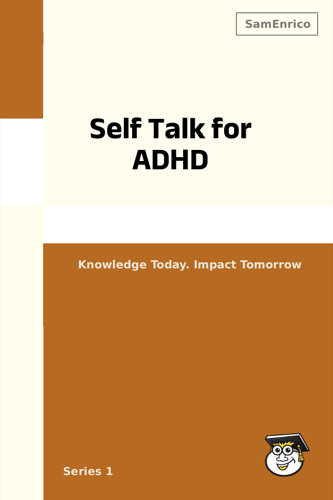
Self Talk for ADHD eBook
Rewires shame-based inner speech into compassionat
Rewires shame-based inner speech into compassionate, executive-function support.
Formats
Free sample
Chapter 1: The Imposter Inside--–- You are driving home from work, exhausted, when you remember that you promised to call your mother back. Three days ago. A familiar voice rises from somewhere deep in your chest: What is wrong with you? She probably thinks you don't care. Everyone else can remember to make a simple phone call.
Why can't you just be normal?By the time you pull into your driveway, you have been reminded that you are lazy, inconsiderate, unreliable, and fundamentally broken. None of this happens out loud. It happens in the private theater of your own mind, and you have watched this same show so many times that you no longer question whether it might be fiction. You assume it is news.This book will ask you to stop making that assumption.The voice you just heard in that scenario is not your conscience. It is not your friend.
It is not even particularly creative. It is a recording—a loop of shame that was installed over years of living in a world that was not designed for your brain. And before we can rewire that voice into something that actually helps you navigate life with ADHD, we have to do something far more difficult than learning new techniques. We have to recognize that the voice you think is yours might not belong to you at all.The Difference Between a Conscience and a Curse Let us begin with a distinction that will save you years of unnecessary suffering. A conscience is a neutral signal.
It says: I forgot to call my mother. I should do that now. It carries information without indictment. It is the cognitive equivalent of a low-fuel light on your dashboard—a notification, not a condemnation.Conditioned shame says something very different. It says: I am a terrible person because I forgot.
I am always letting people down. I am fundamentally inconsiderate. This is not a notification. This is an identity verdict. And unlike a conscience, which motivates repair, conditioned shame motivates hiding, self-punishment, and paralysis.Here is what most adults with ADHD never learn: that second voice is not innate.
You were not born saying I am lazy or I am too much or I ruin everything. Those sentences were taught to you. They were repeated until they became automatic. And now they play in your head like a song you never chose but cannot turn off.The ADHD brain is particularly vulnerable to this kind of installation for three reasons. First, you have likely accumulated thousands more corrective comments than your neurotypical peers by the time you reach adulthood—for forgotten homework, lost jackets, missed deadlines, blurting out answers, running late, fidgeting, daydreaming.
Second, the ADHD brain has a heightened sensitivity to feedback (which we will explore in depth later in this book), meaning those comments landed harder and lasted longer. Third, because executive dysfunction often prevents you from proving the critics wrong through consistent action, the shame has no competing evidence to challenge it. You forget again, so the voice says See? I told you. You are unreliable.
And you believe it.The Anti-ADHD Inner Parent I want you to imagine a figure I call the Anti-ADHD Inner Parent. This is not a literal parent, though it often sounds like one. It is an internalized composite of every authority figure who ever punished you for an ADHD trait—the teacher who said you were smart but didn't apply yourself, the parent who asked why you couldn't just try harder, the boss who implied your forgetfulness was disrespectful, the peer who laughed at your enthusiasm and called you too much.This voice has one job: to prevent future criticism by beating you to it. Its logic is brutal but internally consistent. If I call myself lazy before anyone else can, maybe the criticism will hurt less.
If I hate myself first, no one can surprise me with their hatred. This is a survival strategy that made sense in childhood. In adulthood, it is malware.The Anti-ADHD Inner Parent is not a truth-teller. It is a prediction machine that runs on outdated data. It predicts that you will be rejected, so it rejects you first.
It predicts that you will fail, so it demoralizes you before you begin. It predicts that people are tired of you, so it encourages you to withdraw. And because these predictions are often self-fulfilling—a demoralized, withdrawn person does perform worse and connect less—the voice collects new evidence for its case against you.This chapter is where we stop the trial.The Recording Studio of Your Childhood To understand how this voice was recorded, you need to consider the environment in which your brain developed. Most people with ADHD receive an average of twenty thousand more corrective or critical messages by age twelve than their neurotypical peers. Twenty thousand.
That is not a typo.These messages are not usually delivered with malice. A teacher reminding you to turn in your homework for the tenth time is not evil. A parent sighing when you lose your jacket again is not abusive. But frequency matters more than intensity when it comes to neural wiring. A moderate criticism repeated twenty thousand times creates a deeper groove than a single traumatic event.Your brain, like all brains, is a prediction engine.
It notices patterns and builds expectations. If every Tuesday you forgot your permission slip, your brain learned to expect forgetting and being reminded that you forgot. The emotional tone attached to that pattern—shame, frustration, self-disgust—became part of the prediction. Eventually, your brain began generating the shame before the external criticism arrived. It was simply being efficient.The problem is that efficiency and accuracy are not the same thing.
Your brain learned to say I am lazy not because it conducted a fair assessment of your character but because it heard you are being lazy so many times that the two became fused. The external criticism became internal without ever passing through a truth filter.This is not a moral failing. It is classical conditioning, no different from Pavlov's dogs salivating at a bell. The bell was your childhood environment. The salivation is your automatic shame response.
And just as Pavlov's dogs could learn a new association, so can you.Why Positive Affirmations Fail for the ADHD Brain You have probably tried positive affirmations. You stood in front of a mirror and said I am capable. I am enough. I am worthy. And it felt like lying.
There is a reason for that, and it is not that you are too broken to be helped.The Anti-ADHD Inner Parent has had decades of rehearsal. It has thousands of specific, concrete examples to draw from. You forgot your best friend's birthday. You missed that deadline. You lost your keys three times last week alone.
When you offer a generic positive affirmation, your brain does a quick evidence check and finds none. The voice has data. The affirmation has slogans. The voice wins every time.What works instead is specificity, neutrality, and permission to struggle. Instead of I am capable, try I have a brain that struggles with initiation, and that…
This is the end of the free sample. Get the eBook to keep going. Buy now
About this book
Details
- Author
- Godfrey Yasuko
- Publisher
- SamEnrico
- Language
- English
- Genre
- Non-Fiction, Self-Help / ADHD
- Released
- 2026-06-07
- Pages (approx.)
- 117
- Available as
- eBook, Audiobook

Read better in the ZLOADR app
Your eBooks on your phone or tablet. Sign in with your SamEnrico account and start reading.
More by Godfrey Yasuko
 The Attention Span TestGodfrey Yasuko$11.99
 Rainbow Waterfall VisionGodfrey Yasuko$11.99
 Flow in House CleaningGodfrey Yasuko$11.99
 Balloon Flight RelaxationGodfrey Yasuko$11.99
 Equestrian's Self HypnosisGodfrey Yasuko$11.99
 Stress Menstrual Cycle ImpactGodfrey Yasuko$11.99
 Urgent vs Important Decision GuideGodfrey Yasuko$11.99
 The Silk Roads Reforged: Portugal's Lost Empire of the EastGodfrey Yasuko$11.99
 The Great Sydney Snatch: Australia's Prohibition-Era Celebrity Kidnapping PlotGodfrey Yasuko$11.99
 Whippets: The Poor MAN’s RacehorseGodfrey Yasuko$11.99
 Cooperative Annual General MeetingsGodfrey Yasuko$12.99
 Chinese Supplier Face Saving HandbookGodfrey Yasuko$12.99
You may also like
 Hong Kong Handover 1997Dunn Johnnie$11.99
 Zumba For Postnatal Recovery CourseNeal Christian$11.99
 Zumba for BeginnersLadner Nikia$11.99
 YouTube Comment Mining GuideHumes Pandora$12.99
 Worry Box MeditationCarlin Rudy$11.99
 Workplace Stress MeditationNguyen Lynn$11.99
 Workplace Stress and Sleep RepairHawley Ivory$11.99
 Workplace Perfectionism CureDelaney Jeffry$11.99
 Workplace Injustice Anger GuideWallen Isabelle$11.99
 Work Addiction and Burnout LinkGreenwood Ester$11.99
 Women in Yoga and WellnessBeattie Galina$11.99
 Women in Stand Up ComedyChun Evangeline$11.99