
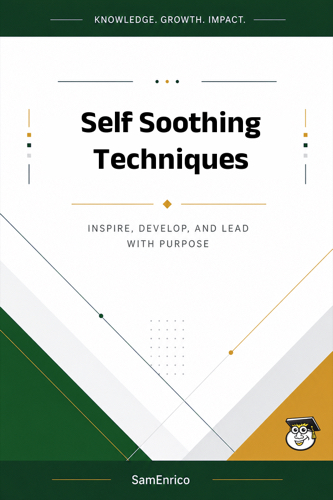
Self Soothing Techniques eBook
Develop healthy ways to comfort yourself during di
Develop healthy ways to comfort yourself during distress.
Formats
Free sample
Chapter 1: The Biology of the Storm--–- You are not broken. You are not weak. And you are definitely not “too sensitive.” What you are, right now, is a human animal whose ancient alarm system has detected a threat—and that alarm system does not know the difference between a saber-toothed tiger and a passive-aggressive email from your boss.Let that land for a moment.Every time you have ever told yourself to “just calm down” and failed, every time you have spiraled over something that seemed trivial in hindsight, every time your heart has raced while your mind screamed this doesn’t make sense—you have been witnessing the single most important truth about self-soothing: it is not a failure of willpower. It is a biological necessity.This chapter will rewire how you understand your own distress. By the time you finish reading, you will never again blame yourself for “overreacting.” You will know exactly what is happening inside your body when panic hits.
And you will have the first and most essential tool in your self-soothing arsenal: the knowledge that you are not fighting a character flaw. You are fighting a nervous system that evolved to keep you alive—and that same nervous system can be taught, gently and patiently, to recognize safety again.The Myth of “Just Calm Down”Imagine you are standing in a kitchen. Someone hands you a raw chicken breast and says, “Cook this.” You have no stove, no oven, no pan, no fire. You wave your hands over the raw meat, concentrating very hard. Nothing happens.
You try saying “cook, cook, cook” with increasing urgency. Still nothing. Finally, you give up, and the person shakes their head and says, “See? You just didn’t want it badly enough.”Ridiculous, right?And yet, this is exactly what we do to ourselves and each other when we say “just calm down” without providing the tools to actually lower physiological arousal. We hand people a task—regulate your nervous system—without giving them the biological equipment to accomplish it.
Then we blame them when they fail.The phrase “just calm down” is not merely unhelpful. According to the neuroscience we will explore in this chapter, it is actively harmful. Here is why: when you are already in a state of high distress, your brain’s capacity for language processing and logical reasoning is physically diminished. Telling a distressed person to “calm down” is like telling someone having an asthma attack to “just breathe normally.” They would if they could. They cannot because their body is in a different state.Dr.
Stephen Porges, the neuroscientist who developed the Polyvagal Theory, has shown that the nervous system operates in hierarchical states of safety, danger, and life threat. You cannot think your way from danger to safety any more than you can think your way from hypothermia to warm. You need external or internal interventions that signal safety to the body. That is what this entire book provides. But first, you need to understand what you are working with.Your Nervous System: The Ancient Alarm Let us take a brief tour of your autonomic nervous system (ANS).
This is the part of your nervous system that runs automatically—heartbeat, digestion, breathing, pupil dilation, sweating, and, crucially, your threat response. You do not have to remember to keep your heart beating. You do not have to decide to breathe. The ANS handles all of this in the background, freeing your conscious mind to think about other things.The ANS has two main branches, and understanding their relationship is the single most important piece of biology in this entire book.The Sympathetic Branch (Fight or Flight) : This is your accelerator pedal. When activated, it releases adrenaline and cortisol, increases heart rate and blood pressure, shunts blood away from digestion and toward large muscle groups, dilates your pupils, and sharpens your senses.
This is an excellent state to be in when you are running from a predator or preparing for a physical confrontation. It is a terrible state to be in when you are trying to fall asleep, have a calm conversation, or think clearly about a complex problem.The Parasympathetic Branch (Rest and Digest) : This is your brake pedal. It is responsible for lowering heart rate, reducing blood pressure, stimulating digestion, and promoting calm, connection, and rest. The vagus nerve—a large bundle of fibers running from your brainstem down through your neck, chest, and abdomen—is the primary highway for parasympathetic signals. When your vagus nerve is functioning well, you can recover from stress quickly.
When it is not, you get stuck in high alert.Here is what most people do not know: these two branches are designed to work in balance, like a seesaw. When one goes up, the other goes down. But they are not symmetrical in speed. The sympathetic branch (alarm) activates almost instantly—within milliseconds. The parasympathetic branch (calm) takes much longer to engage, sometimes several minutes of sustained safety signaling.
This asymmetry is why you can become terrified in an instant but take a long time to calm down. It is not a design flaw. It is a design feature for survival. An animal that took a long time to get scared would get eaten. An animal that took a long time to calm down simply rested more.
Evolution prioritized the alarm.The Four Threat Responses: Fight, Flight, Freeze, and Fawn You have probably heard of “fight or flight.” But modern neuroscience has expanded this model to include two additional responses that are equally important, especially for understanding chronic distress and trauma.Fight : This response is exactly what it sounds like. When you perceive a threat, your body prepares for confrontation. You may feel anger, irritability, clenched jaw, flushed face, a urge to push back, argue, or physically defend. Fight is not always violent—it can show up as sarcasm, criticism, interrupting, or “standing your ground” in an argument. The biological purpose: eliminate the threat through aggression.Flight : This is the urge to escape.
You may feel anxiety, panic, restlessness, a need to flee the room, leave the conversation, quit the job, end the relationship. Flight can show up as avoidance, procrastination, obsessive busyness, or the desperate need to “get out of here.” The biological purpose: remove yourself from the threat’s vicinity.Freeze : This response occurs when the threat is overwhelming and neither fighting nor fleeing is possible. Your body essentially hits the pause button. You may feel numb, spaced out, disconnected, heavy, or “stuck.” Your heart rate may actually drop. You might hold your breath.
Freeze is the deer in headlights—and it can look like dissociation, brain fog, procrastination (the stuck kind, not the avoidant kind), or feeling “paralyzed” by a decision. The biological purpose: become less visible to a predator that detects motion, or conserve energy until the threat passes.Fawn : This is the least well-known but extremely common response, especially among people who grew up in unpredictable or abusive environments. Fawn involves appeasing the threat through people-pleasing, compliance, or flattery. You may feel a desperate need to make everyone like you, say “yes” when you mean “no,” apologize excessively, or smooth…
This is the end of the free sample. Get the eBook to keep going. Buy now
About this book
Details
- Author
- Mclaurin Caprice
- Publisher
- SamEnrico
- Language
- English
- Genre
- Non-Fiction, Self-Help, Self Care
- Released
- 2026-06-11
- Pages (approx.)
- 134
- Available as
- eBook, Audiobook

Read better in the ZLOADR app
Your eBooks on your phone or tablet. Sign in with your SamEnrico account and start reading.
More by Mclaurin Caprice
 Pain Fear Extinction GuideMclaurin Caprice$11.99
 Solar Temple Saint Sernin Connection HandbookMclaurin Caprice$11.99
 Free Creator Q and A Stack GuideMclaurin Caprice$11.99
 Mindfulness for Imposter SyndromeMclaurin Caprice$11.99
 The Vanishing Diplomat: The Untold Story of the CIA’s Most Elusive OperativeMclaurin Caprice$11.99
 Frozen Footsteps: Ibn Battuta’s Arctic OdysseyMclaurin Caprice$11.99
 Understanding Cerebral Autosomal Dominant Arteriopathy With Subcortical Infarcts and LeukoencephalopathyMclaurin Caprice$17.99
 How to Become a Desk OfficerMclaurin Caprice$11.99
 Dubai Freelance Student VisaMclaurin Caprice$12.99
 ESG Performance Green Bond IssuersMclaurin Caprice$12.99ESG Performance Green Bond IssuersMclaurin Caprice$12.99
 Bookkeeping (Certified)Mclaurin Caprice$11.99
You may also like
 Hong Kong Handover 1997Dunn Johnnie$11.99
 Zumba For Postnatal Recovery CourseNeal Christian$11.99
 Zumba for BeginnersLadner Nikia$11.99
 YouTube Comment Mining GuideHumes Pandora$12.99
 Worry Box MeditationCarlin Rudy$11.99
 Workplace Stress MeditationNguyen Lynn$11.99
 Workplace Stress and Sleep RepairHawley Ivory$11.99
 Workplace Perfectionism CureDelaney Jeffry$11.99
 Workplace Injustice Anger GuideWallen Isabelle$11.99
 Work Addiction and Burnout LinkGreenwood Ester$11.99
 Women in Yoga and WellnessBeattie Galina$11.99
 Women in Stand Up ComedyChun Evangeline$11.99