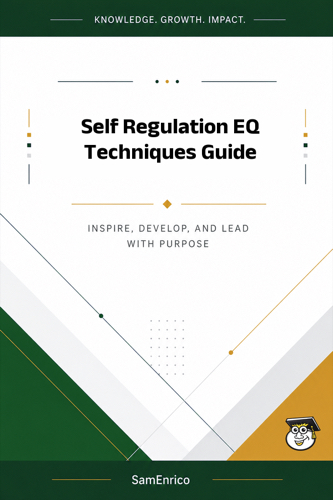
Self Regulation EQ Techniques Guide eBook
Develops impulse control and emotional pause butto
Develops impulse control and emotional pause buttons for high-stress moments.
Formats
Free sample
Chapter 1: The Seven-Second Window...--–- You are standing in your kitchen. It has been a long day. Your inbox is a graveyard of unanswered emails. Your boss made that comment in the meeting—the one that felt like a dismissal wrapped in a compliment. Your child just asked for help with homework for the fourth time, and you have not even started dinner.
Your partner walks in and says, casually, "Did you remember to call the plumber?"Something inside you snaps.You do not choose to snap. It chooses you. The words come out before you can stop them: "I can't do everything, you know. Maybe you could handle one thing for once." The silence that follows is heavy. Your partner's face changes.
Your child looks up, startled. And you feel it immediately—the shame, the regret, the familiar thought: Why did I say that? That's not who I am.But it was who you were in that moment. And moments like these have a way of accumulating. The sharp word to your partner.
The impatient tone with your child. The angry email you send and regret before the "sent" animation finishes. The impulse purchase that arrives three days later and sits unopened. The comfort food that solves nothing. The scroll session that steals an hour of your life.You tell yourself you have a temper.
Or you are weak-willed. Or you are just "that kind of person." You tell yourself that some people are born calm and you were not. You tell yourself that the urge is too strong, that you cannot help it, that this is simply who you are.Every single one of those explanations is a lie.The lie has a name. It is called the 7-Second Lie, and it is the most destructive myth in emotional regulation. The lie says that your first impulse is your true self.
The lie says that once an urge rises, it will keep rising until you either act on it or suffer. The lie says that some people are naturally impulsive and there is nothing they can do about it.None of that is true.The science is clear: the physiological peak of any emotional urge lasts only seven to fifteen seconds. After that window, your prefrontal cortex—the braking system of your brain—can re-engage and override the impulse. You are not a hot-headed person. You are a person who has never learned what happens if you wait seven seconds.This chapter will dismantle the 7-Second Lie piece by piece.
You will learn why your brain creates urges in the first place. You will understand the difference between an impulse and an action. You will discover why counting to ten works—and why there is a better way. And you will be introduced to Urge Surfing, a technique that will change your relationship with every impulse you will ever have.By the end of this chapter, you will no longer believe that you are at the mercy of your first impulse. You will know, with scientific certainty, that every urge is a temporary weather pattern passing through the sky of your awareness.
You will have taken the first step toward building the most valuable skill of the twenty-first century: the ability to pause.The Architecture of an Urge Before you can learn to pause, you must understand what you are pausing. An urge is not a demon that possesses you. It is not proof of moral failure. It is not a character flaw. An urge is a biological event with a predictable beginning, middle, and end.Let us start with the brain.Deep within your skull, tucked behind your eyes and slightly inward, lies a small almond-shaped cluster of neurons called the amygdala.
Its job, distilled to its essence, is survival. The amygdala does not think. It does not reason. It does not care about your long-term goals, your reputation, or your relationships. It cares about one thing and one thing only: keeping you alive in the next three seconds.When the amygdala detects a potential threat, it sounds an alarm.
And here is the crucial point: the amygdala has a very broad definition of "threat." A slow driver is a threat. A critical email is a threat. A disappointed look from your partner is a threat. The memory of a past embarrassment is a threat. A hungry feeling is a threat.
A bored feeling is a threat. To your amygdala, anything that disrupts your equilibrium is a potential predator.When the alarm sounds, your body responds instantly. Your adrenal glands release cortisol and adrenaline. Your heart rate accelerates. Your breathing becomes shallow.
Blood rushes away from your digestive system and toward your large muscle groups. Your pupils dilate. Your hearing sharpens. Your non-essential systems—digestion, immune response, long-term planning—shut down to conserve energy for the emergency.This is the fight-or-flight response. It evolved over millions of years to help you escape saber-toothed tigers and hostile tribes.
It is ancient. It is powerful. And it is spectacularly ill-suited for modern life.Your amygdala cannot tell the difference between a saber-toothed tiger and a slow driver. It cannot distinguish between a physical threat to your life and a social threat to your ego. To your amygdala, being criticized in a meeting feels exactly like being chased by a predator.
The physiological response is identical. Your heart races either way. Your muscles tense either way. Your breathing becomes shallow either way.This is why you snap. This is why you say things you regret.
This is why you reach for the cookie, the credit card, the angry email, the glass of wine. Your amygdala has hijacked your brain, and your prefrontal cortex—the rational, planning, impulse-controlling part of your brain—has been temporarily sidelined.But here is the truth the 7-Second Lie hides from you: the hijack does not last.The physiological peak of the stress response—the moment when cortisol and adrenaline are at their highest, when your heart is racing fastest, when your breathing is most shallow—lasts between seven and fifteen seconds. That is it. After that window, the chemicals begin to metabolize. Your heart rate starts to slow.
Your breathing deepens. Your prefrontal cortex, which had been shouted down by the amygdala, begins to regain access to the conversation.Seven to fifteen seconds.That is the entire window of vulnerability. That is the length of time between the trigger and the moment when you can think clearly again. And yet, most people act within the first two to three seconds of that window. They do not wait because they believe the lie that the urge will keep intensifying.
They believe that if they do not act now, the feeling will grow unbearable.It will not. It cannot. The biology does not allow it.The Difference Between an Impulse and an Action One of the most important distinctions you will ever make is the difference between an impulse and an action. These two things are not the same. They are not even close to the same.
But most people live as if they are inseparable.An impulse is a sensation. It is a cluster of physical feelings—tightness…
This is the end of the free sample. Get the eBook to keep going. Buy now
About this book
Details
- Author
- Rawlings Jacinta
- Publisher
- SamEnrico
- Language
- English
- Genre
- Non-Fiction, Self-Help, Emotional Control
- Released
- 2026-06-05
- Pages (approx.)
- 149
- Available as
- eBook, Audiobook

Read better in the ZLOADR app
Your eBooks on your phone or tablet. Sign in with your SamEnrico account and start reading.
More by Rawlings Jacinta
 Child Loss And InfertilityRawlings Jacinta$11.99
 Conversation Starters for English LearnersRawlings Jacinta$11.99
 CrossFit Gymnastics SkillsRawlings Jacinta$11.99
 Napping for Postpartum RecoveryRawlings Jacinta$11.99
 Bipolar Psychosis GuideRawlings Jacinta$11.99
 Bipolar Creativity GuideRawlings Jacinta$11.99
 Apple Calendar RemindersRawlings Jacinta$11.99
 Past Paper StrategyRawlings Jacinta$11.99
 The Last Telegram: How a Single Wire Changed the Fate of WWIIRawlings Jacinta$11.99
 The Last Waltz: How a Forgotten Dance Saved a GenerationRawlings Jacinta$11.99
 Breaking the Canvas: The Visionary Works of Ralph Hotere and His Indigenous LegacyRawlings Jacinta$11.99
 Growing HarrisiaRawlings Jacinta$11.99