
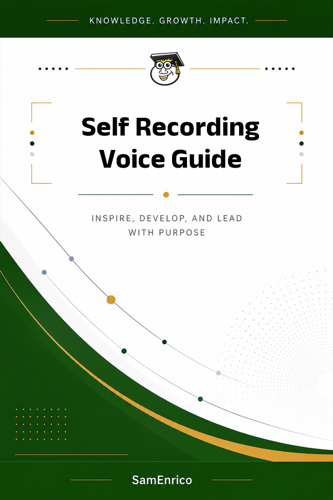
Non-FictionSelf-HelpSelf Voice
Self Recording Voice Guide eBook
Listen to your own recorded voice for self hypnosi
Listen to your own recorded voice for self hypnosis sessions.
Formats
Free sample
Chapter 1: The Voice You Fear...--–- Most people cannot stand the sound of their own recorded voice. They flinch. They laugh nervously. They delete the recording before the playback finishes. This reaction is so universal that psychologists have a name for it: voice confrontation.
And it is the single greatest obstacle—and simultaneously the single greatest opportunity—in the entire field of self-hypnosis.If you have ever recorded yourself speaking, only to cringe at the playback, you are in excellent company. The late novelist David Foster Wallace described hearing his own voice as "a kind of auditory waterboarding." The poet T.S. Eliot reportedly refused to listen to recordings of his own readings. Even professional voice actors often admit to a lingering discomfort with their own vocal sound. This is not a sign of weakness or insecurity.
It is a neurobiological fact of how human hearing works.The reason you sound different on recording than you do inside your own head comes down to a simple but profound anatomical distinction: bone conduction versus air conduction. When you speak, your vocal cords produce sound waves that travel through the air, into your ear canal, and vibrate your eardrum. That is air conduction. But simultaneously, those same sound waves vibrate your skull, your jawbone, and the cartilage of your throat. Those vibrations travel directly to your inner ear, bypassing the eardrum entirely.
That is bone conduction. And bone conduction adds depth, richness, and low-frequency resonance that air conduction alone cannot provide. The voice you hear inside your head is literally deeper and fuller than the voice anyone else hears—and than the voice that appears on a recording.When you hear your recorded voice for the first time, your brain is confronted with a mismatch. The auditory signal arriving through your ears does not match the internal prediction your brain has built over decades of hearing yourself through bone conduction. This mismatch triggers a mild startle response, often experienced as embarrassment, cringing, or even disgust.
Your brain briefly asks: "Who is that?" And then, a moment later, it realizes: "That is me." That moment of confusion is the voice confrontation response.Here is what almost no self-hypnosis book will tell you: that cringe response is not an obstacle to overcome. It is a doorway to enter.Why Your Own Voice Holds Unusual Power Every hypnotherapist knows about the "critical factor"—the psychological filter that sits between your conscious and subconscious mind. Its job is to protect you from accepting harmful or false suggestions. When a stranger tells you to relax, your critical factor asks: "Why should I trust you?" When a recording of a professional hypnotist speaks, your critical factor evaluates tone, accent, authority, and credibility. Even when the hypnotist is highly skilled, that filter remains active, reducing the effectiveness of every suggestion.But when you hear your own voice—after you have moved through the initial cringe response—something different happens.
Your critical factor has no question to ask. It does not need to evaluate authority because the voice is unmistakably you. It does not need to assess trustworthiness because you already trust yourself (or, if you do not, that is a separate therapeutic issue). The critical factor does not disappear, but it lowers its guard significantly. Suggestions delivered in your own voice encounter less resistance than those delivered by any external source, no matter how skilled.This is not mysticism.
This is the mere-exposure effect, one of the most replicated findings in social psychology. First demonstrated by Robert Zajonc in the 1960s, the mere-exposure effect shows that people develop a preference for stimuli simply because they are familiar with them. The more times you hear a sound, see a face, or encounter a melody, the more you tend to like it—or at least to trust it. Your own voice is the most familiar sound you have ever heard, even if you do not consciously recognize it at first. With repeated exposure, the discomfort fades, and what remains is an unparalleled channel of communication to your own subconscious.The Science of Self-Voice Recognition Neuroscience has confirmed what hypnotherapists have observed for decades.
Functional MRI studies of self-voice recognition reveal that hearing your own recorded voice activates a distinct network of brain regions, including the right superior temporal cortex, the insula, and the anterior cingulate cortex. These regions are involved in self-referential processing, emotional awareness, and conflict monitoring. When you hear a stranger's voice, this network remains largely quiet. When you hear your own voice, it lights up like a constellation.More importantly, the brain processes self-voice and other-voice on different temporal pathways. Self-voice recognition occurs in as little as 150 to 200 milliseconds—faster than conscious thought.
By the time you are aware of hearing your voice, your subconscious has already classified it as "safe" or "unsafe," "familiar" or "foreign," "authoritative" or "doubtful." This rapid processing means that the critical factor has less time to erect barriers. The suggestion arrives before the guard is fully raised.This is the central insight of this entire book: your recorded voice is not a poor substitute for a professional hypnotist. It is a superior tool for self-hypnosis, precisely because of the cringe response you initially feel. The discomfort is proof that your brain is paying attention, that it recognizes the voice as self, and that it is processing the sound on a deep, pre-conscious level.Why Generic Hypnosis Recordings Often Fail Commercial hypnosis recordings face an insurmountable problem: they are delivered by strangers. No matter how soothing the voice, no matter how effective the script, the listener's critical factor remains active throughout the session.
The subconscious mind knows, on some level, that this voice is not you. It does not share your history, your memories, your specific emotional triggers, or your unique linguistic patterns.Worse, generic recordings cannot adapt. A professional hypnotherapist in a live session can notice when a client is resisting, when a suggestion is landing poorly, or when a different approach is needed. A recording cannot. It plays the same words at the same speed in the same order, regardless of whether you are deeply relaxed or mildly annoyed.
This is not a flaw in the recording—it is an inherent limitation of the medium.Your own recorded voice solves both problems simultaneously. Because the voice is yours, the critical factor is lower from the first moment. Because you are the one writing the script, you can tailor every word to your specific goals, your specific resistance patterns, and your specific sensory preferences. And because you are the one listening, you can repeat the recording as many times as needed, at exactly the right moments (hypnagogia, just before sleep; hypnopompia, just after waking), without paying for additional sessions.The Seven-Day Desensitization Protocol Before you can use your voice for self-hypnosis, you must make peace with it. The following seven-day protocol is designed to move you from cringe to comfort, from discomfort to neutrality, and from neutrality to genuine therapeutic trust.
Do not skip this week. Do not rush through it. The time you invest here will determine the effectiveness of every recording you make afterward.Days 1 and 2: Raw Exposure Open…
This is the end of the free sample. Get the eBook to keep going. Buy now
About this book
Details
- Author
- Weaver Yolanda
- Publisher
- SamEnrico
- Language
- English
- Genre
- Non-Fiction, Self-Help, Self Voice
- Released
- 2026-06-06
- Pages (approx.)
- 144
- Available as
- eBook, Audiobook

Read better in the ZLOADR app
Your eBooks on your phone or tablet. Sign in with your SamEnrico account and start reading.
More by Weaver Yolanda
 Mountain Rescue Guide StressWeaver Yolanda$11.99
 Self Hypnosis for Fear of BirthdaysWeaver Yolanda$11.99
 Divorce Emotional First AidWeaver Yolanda$11.99
 The DBT for Anxiety GuideWeaver Yolanda$11.99
 Burke Ramsey Grand JuryWeaver Yolanda$11.99
 Alcohol Recovery for TherapistsWeaver Yolanda$11.99
 Newborn Immunization TrackerWeaver Yolanda$11.99
 The Lion’s Gambit: The Military Genius of Sundiata KeitaWeaver Yolanda$11.99
 The Battle of Tsingtao: Germany's Far Eastern Air War (1914)Weaver Yolanda$11.99
 How to Start a Hobby in Collecting MemorabiliaWeaver Yolanda$11.99
 How to Produce Security UniformsWeaver Yolanda$11.99
 How to Produce Flute PartsWeaver Yolanda$11.99
You may also like
 Hong Kong Handover 1997Dunn Johnnie$11.99
 Zumba For Postnatal Recovery CourseNeal Christian$11.99
 Zumba for BeginnersLadner Nikia$11.99
 YouTube Comment Mining GuideHumes Pandora$12.99
 Worry Box MeditationCarlin Rudy$11.99
 Workplace Stress MeditationNguyen Lynn$11.99
 Workplace Stress and Sleep RepairHawley Ivory$11.99
 Workplace Perfectionism CureDelaney Jeffry$11.99
 Workplace Injustice Anger GuideWallen Isabelle$11.99
 Work Addiction and Burnout LinkGreenwood Ester$11.99
 Women in Yoga and WellnessBeattie Galina$11.99
 Women in Stand Up ComedyChun Evangeline$11.99