
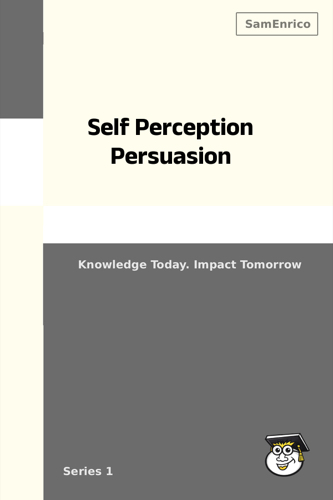
Non-FictionSelf-HelpSelf Perception
Self Perception Persuasion eBook
Lead people to infer their own attitudes from beha
Lead people to infer their own attitudes from behavior.
Formats
Free sample
Chapter 1: The Detective Within...--Most people walk through life believing they have a fixed, pre-existing self—a stable personality they are slowly “discovering.” This assumption feels so natural that we rarely question it. You might say, “I’ve always been shy,” or “I’m just not a morning person,” as if these statements were engraved on a stone tablet at your birth. But what if that entire framework was backwards? What if you don’t act because of who you are, but rather you figure out who you are by watching how you act?This is the radical proposition at the heart of this book. And it is not philosophy or positive thinking.
It is a rigorously tested scientific theory called Self-Perception Theory, developed by psychologist Daryl Bem in 1972. Bem’s insight was simple yet world-shaking: we often have no direct access to our own internal states. We cannot see our own confidence, our own motivation, or our own character the way we can see a tree or a table. Instead, we do something surprisingly clever. We observe our own behavior and the context in which it occurs, and then we infer what our attitude must have been to produce that behavior.
In other words, we treat ourselves as we treat others. We become detectives investigating the mystery of our own identity.Imagine you notice a friend volunteering at a homeless shelter every Saturday for three months. You would naturally infer, “She must care deeply about homelessness.” You wouldn’t assume she was doing it accidentally or under duress. Now imagine that you, yourself, have been volunteering every Saturday for three months. According to Bem, you would make the exact same inference about yourself.
You would look at your own behavior and conclude, “I must care about this cause.” The action comes first. The belief follows. This is the engine of self-persuasion, and most people have no idea it is running their lives.The Invisible Assumption That Holds You Back Before we go further, we need to name the enemy. The false belief that your identity is fixed and discoverable rather than flexible and constructed is what we will call the “Ghost in the Mirror.” It whispers to you constantly. “Find yourself first.” “You can’t fake authenticity.” “Change has to feel natural.” This ghost is not evil, but it is wrong.
And its wrongness has real consequences.When you believe your identity is fixed, you treat every action as evidence of a permanent trait rather than a temporary choice. You fail at a presentation and think, “I am bad at public speaking,” rather than, “I gave a bad presentation today.” You procrastinate on a project and think, “I am lazy,” rather than, “I delayed starting that specific task.” The fixed-identity belief turns every failure into a life sentence. It turns every success into a fluke, because deep down you believe the “real you” is the one that fails. This is the trap that keeps millions of people stuck in cycles of broken resolutions, imposter syndrome, and quiet desperation.Self-perception theory offers a way out. If identity is inferred from behavior, then you can change your identity by changing your behavior.
You do not need to “find” confidence. You need to act confident and then let your brain catch up. You do not need to “become” disciplined. You need to perform disciplined actions and then let your brain infer the label. This is not fake it till you make it in the shallow sense of pretending.
This is using the brain’s own wiring to rewrite its self-image from the outside in.The Foot-in-the-Door: How Tiny Actions Change Everything One of the most powerful demonstrations of self-perception theory comes from a classic sales technique known as the “foot-in-the-door.” The idea is simple: if you can get someone to agree to a small, easy request, they become significantly more likely to agree to a much larger request later. In the original study, researchers went door-to-door asking homeowners to sign a petition supporting safe driving. Almost everyone agreed because it was trivial. Then, two weeks later, the same researchers asked those homeowners to install a large, ugly “Drive Carefully” sign in their front yards. Among people who had not been asked to sign the petition, only 20% agreed to the sign.
Among those who had signed the petition, 76% agreed.What happened? The homeowners observed themselves signing a petition about safe driving. They then inferred, “I must be someone who cares about safety.” When the larger request came, they acted in alignment with that inferred identity. They did not experience the small request as manipulation. They experienced it as evidence about who they were.Now apply this to your own life.
The foot-in-the-door is not just a sales technique. It is the operating system of personal change. Every time you ask yourself to do a tiny, easy behavior—make your bed, write one sentence, drink one glass of water, do one push-up—you are creating data. That data is a behavior. Your brain observes that behavior and automatically infers an attitude: “I am someone who makes my bed.
I am someone who writes. I am someone who cares about my health.” Once that inference is made, larger behaviors feel natural rather than heroic.This is why the most successful habit-change methods in the world focus on ridiculously small actions. James Clear’s “Atomic Habits,” BJ Fogg’s “Tiny Habits,” and the entire literature of behavior design all point to the same conclusion: start so small that you cannot fail. But most explanations stop at the practical level—small actions are easier to sustain. The deeper truth, the one this book reveals, is that small actions are powerful because they change your identity.
You are not building a habit. You are building a case file. Each tiny action is a piece of evidence entered into the record of who you are.The Private Detective: Logging Your Behavior Without Judgment Here is where most self-help advice goes wrong. They tell you to track your habits, but they add a layer of judgment. Put a gold star on the calendar.
Give yourself a reward. Celebrate every success. This sounds encouraging, but as we will see in Chapter 4, it can backfire catastrophically. When you add rewards, your brain stops inferring “I do this because I value it” and starts inferring “I do this to get the reward.” The intrinsic motivation leaks out.Instead, this book teaches a different approach: pure observation. You become a detective, not a judge.
A detective collects evidence without deciding whether the evidence is “good” or “bad.” A judge renders a verdict. When you judge your own behavior, you trigger shame, defensiveness, and the very fixed-identity thinking we are trying to escape. When you simply observe, you allow self-perception to work its quiet magic.Here is a simple protocol. Get a notebook or open a digital document. Each day, write down three actions you took.
Do not rate them. Do not say “I did well” or “I failed.” Just write the action. For example: “Made my bed.” “Walked for ten minutes.” “Closed my laptop at 9 PM.” That is it. At the end of…
This is the end of the free sample. Get the eBook to keep going. Buy now
About this book
Details
- Author
- Trapp Antonietta
- Publisher
- SamEnrico
- Language
- English
- Genre
- Non-Fiction, Self-Help, Self Perception
- Released
- 2026-06-06
- Pages (approx.)
- 143
- Available as
- eBook, Audiobook

Read better in the ZLOADR app
Your eBooks on your phone or tablet. Sign in with your SamEnrico account and start reading.
More by Trapp Antonietta
 Self Talk for Medical StudentsTrapp Antonietta$11.99
 Sugar Addiction and Fatty LiverTrapp Antonietta$11.99
 South African Brigade Delville WoodTrapp Antonietta$11.99
 Triglyceride Reduction GuideTrapp Antonietta$11.99
 Lithium Mood StabilizerTrapp Antonietta$11.99
 Gadget Upgrade AddictionTrapp Antonietta$11.99
 Arctic Bear EncountersTrapp Antonietta$11.99
 Pelé vs. Maradona: The Clash of Football Titans That United a PlanetTrapp Antonietta$11.99
 The Red Army Dancers: How Ballet Became a Cold War WeaponTrapp Antonietta$11.99
 Service Providers Guide to Exterior Drain Pipe InstallationTrapp Antonietta$11.99
 A Collector's Handbook to the Ford LTDTrapp Antonietta$11.99
 Emergency Contacts China GuideTrapp Antonietta$12.99
You may also like
 Hong Kong Handover 1997Dunn Johnnie$11.99
 Zumba For Postnatal Recovery CourseNeal Christian$11.99
 Zumba for BeginnersLadner Nikia$11.99
 YouTube Comment Mining GuideHumes Pandora$12.99
 Worry Box MeditationCarlin Rudy$11.99
 Workplace Stress MeditationNguyen Lynn$11.99
 Workplace Stress and Sleep RepairHawley Ivory$11.99
 Workplace Perfectionism CureDelaney Jeffry$11.99
 Workplace Injustice Anger GuideWallen Isabelle$11.99
 Work Addiction and Burnout LinkGreenwood Ester$11.99
 Women in Yoga and WellnessBeattie Galina$11.99
 Women in Stand Up ComedyChun Evangeline$11.99