
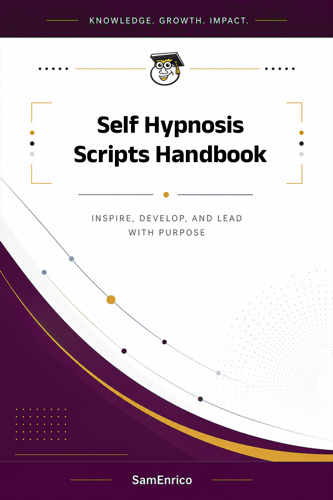
Non-FictionSelf-HelpHypnosisScripts
Self Hypnosis Scripts Handbook eBook
Write and use personalized hypnotic scripts for ha
by Rust Alva
Write and use personalized hypnotic scripts for habit change, confidence, and pain management.
Formats
Free sample
Chapter 1: The Unseen Autopilot...--–- Close your eyes for a moment. No, really—try it. In the darkness behind your lids, notice what happens. Your breath might slow. Your shoulders might drop a fraction of an inch.
Your thoughts might wander, then settle. You have just entered a light trance state. Not because you were trying to hypnotize yourself, but because your brain is wired to do exactly this dozens of times every single day. The problem is not learning how to enter hypnosis. The problem is learning to recognize that you are already there, constantly, and to harness what you find when you arrive.The Most Misunderstood Tool You Already Own Self-hypnosis suffers from a public relations disaster.
Mention the word "hypnosis" in casual conversation, and most people will conjure one of three images: a swinging pocket watch, a stage comedian making a volunteer cluck like a chicken, or a sinister villain controlling innocent minds. These images are not just inaccurate—they are actively harmful. They prevent millions of people from accessing one of the most powerful, scientifically validated, and readily available tools for personal transformation.The truth, supported by decades of clinical research and thousands of peer-reviewed studies, is almost boring in its simplicity. Hypnosis is not a mystical state. It is not sleep.
It is not unconsciousness. It is not mind control. Hypnosis is a naturally occurring state of focused attention with reduced peripheral awareness, characterized by an enhanced capacity for response to suggestion. That definition comes from the American Psychological Association, and it contains nothing supernatural. You have experienced this state hundreds of times: when you became so absorbed in a novel that you stopped hearing the traffic outside, when you drove ten miles on a familiar highway with no memory of the turns you took, when you sat in a movie theater and forgot entirely about the uncomfortable seat because the story had completely captured you.That state—intense focus, diminished awareness of distractions, heightened suggestibility—is the same neurological territory that self-hypnosis navigates.
The only difference is intentionality. In everyday life, trance happens to you. In self-hypnosis, you learn to invite it, direct it, and deploy it for specific purposes like habit change, confidence building, and pain management.This chapter exists to accomplish three things. First, to demolish the myths that have kept you from using this tool. Second, to give you a simple, repeatable method for entering self-hypnosis that will work for you today.
And third, to prove to you—not through promises but through direct experience—that you are already capable of everything this book will teach. By the time you finish this chapter, you will have completed your first successful self-hypnosis session. Not a theoretical exercise. Not a guided visualization that leaves you wondering if anything happened. An actual, measurable trance state that you induced yourself.The Four Myths That Keep You Stuck Before we build anything new, we must clear away the wreckage of what you think you know.
These four myths are the most common barriers to successful self-hypnosis, and each one has been thoroughly debunked by both clinical research and the direct experience of millions of practitioners.Myth One: Hypnosis Is Mind Control This is the fear that stops most people before they begin. The image of the hypnotist as puppet master, pulling strings while the subject drools obediently, is pure fiction. Here is what actually happens in a therapeutic hypnosis session: the subject remains fully aware, fully in control, and fully capable of rejecting any suggestion that conflicts with their values or safety. The stage hypnotist's power does not come from some magical ability to override free will. It comes from selection—choosing volunteers who are highly suggestible, willing to perform, and comfortable with social pressure—and from the implicit contract of entertainment.
No one on that stage is doing anything they do not consent to do.In self-hypnosis, you are both the hypnotist and the subject. The idea that you could somehow force yourself to do something against your will is logically absurd. You cannot hypnotize yourself into robbing a bank, cheating on your spouse, or revealing secrets you wish to keep, because your subconscious mind has its own internal security system—the critical factor—that rejects suggestions incompatible with your core values. We will explore this security system in depth in Chapter 2. For now, understand this: you are always in charge.
Hypnosis does not give anyone else the keys to your mind. It gives you better access to your own.Myth Two: Hypnosis Is Sleep Many people believe that hypnosis involves losing consciousness, and they measure their success by whether they "remember" the session. This misunderstanding comes from the word "hypnosis" itself, which derives from the Greek hypnos, meaning sleep. The coinage was a historical accident. Franz Mesmer and the early mesmerists believed they were working with magnetic fluids.
James Braid, who coined the term in the 1840s, initially thought the state resembled sleep but later realized his error and tried—unsuccessfully—to change the name to "monoideism" (single-thought state).Brain imaging studies have settled this question definitively. During hypnosis, the brain does not show the slow-wave activity characteristic of sleep. Instead, it shows patterns associated with focused attention, reduced default mode network activity (the "wandering mind" system), and increased connectivity between the prefrontal cortex and the insula. In plain language: hypnosis is a state of heightened, concentrated awareness, not diminished awareness. You may feel deeply relaxed, and your eyes will often close, but you are not asleep.
You are more awake than usual, but in a different way—narrowed in focus, open to suggestion, and curiously alert.The practical implication is enormous. You do not need to worry about "falling asleep" during self-hypnosis. If you do fall asleep, you were simply tired, and that is fine—sleep is restorative in its own right. But do not mistake sleep for failure. The goal of self-hypnosis is not unconsciousness.
The goal is focused awareness with reduced peripheral distraction.Myth Three: Only Weak-Minded People Can Be Hypnotized This myth is the mirror image of the mind-control fear. If hypnosis were a form of weakness, then being "good" at hypnosis would be embarrassing. In reality, the opposite is true. The ability to enter trance easily correlates positively with absorption—a psychological trait that involves the capacity to become deeply immersed in experiences. High absorption is associated with creativity, empathy, and the ability to lose oneself in art, music, or nature.
It is not a weakness. It is a form of cognitive flexibility.Moreover, the vast majority of people—estimates range from 80 to 95 percent—can be hypnotized to some degree. The remaining small percentage are not "strong-minded." They are usually highly analytical individuals whose critical factor is so vigilant that it blocks even useful suggestions. For these individuals, self-hypnosis is still possible, but it requires different approaches, including the Ericksonian methods covered in Chapter 11 and the troubleshooting techniques in Chapter 10. The point is this: if you can become absorbed in a good movie, lose track of time while reading, or find yourself daydreaming in the shower, you can be hypnotized.
You already have the ability. You just have not learned to direct it intentionally.Myth Four: You Will Do Something Embarrassing…
This is the end of the free sample. Get the eBook to keep going. Buy now
About this book
Details
- Author
- Rust Alva
- Publisher
- SamEnrico
- Language
- English
- Genre
- Non-Fiction, Self-Help, Hypnosis, Scripts
- Released
- 2026-06-10
- Pages (approx.)
- 144
- Available as
- eBook, Audiobook

Read better in the ZLOADR app
Your eBooks on your phone or tablet. Sign in with your SamEnrico account and start reading.
More by Rust Alva
 Spin Class Race Day Simulation GuideRust Alva$11.99
 Stalking Peer Support Counselor CasesRust Alva$11.99
 Breath Counting for AnxietyRust Alva$11.99
 Discord Community Status HierarchyRust Alva$11.99
 Whispers of the Wild: The Untold Story of Jane Goodall’s Secret WarRust Alva$11.99
 The Vanishing Hiker of the AdirondacksRust Alva$11.99
 Understanding DwarfismRust Alva$17.99
 AI Task Management GuideRust Alva$12.99
 Alamy Stock Phone GuideRust Alva$12.99
 How to Become a ControllerRust Alva$11.99
 Clinical Nurse EducatorRust Alva$11.99
You may also like
 Hong Kong Handover 1997Dunn Johnnie$11.99
 Zumba For Postnatal Recovery CourseNeal Christian$11.99
 Zumba for BeginnersLadner Nikia$11.99
 YouTube Comment Mining GuideHumes Pandora$12.99
 Worry Box MeditationCarlin Rudy$11.99
 Workplace Stress MeditationNguyen Lynn$11.99
 Workplace Stress and Sleep RepairHawley Ivory$11.99
 Workplace Perfectionism CureDelaney Jeffry$11.99
 Workplace Injustice Anger GuideWallen Isabelle$11.99
 Work Addiction and Burnout LinkGreenwood Ester$11.99
 Women in Yoga and WellnessBeattie Galina$11.99
 Women in Stand Up ComedyChun Evangeline$11.99