
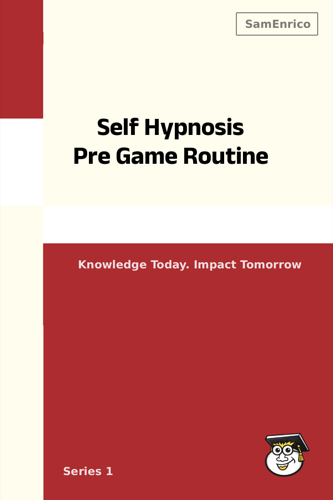
Non-FictionSelf-Help / Pre Performance
Self Hypnosis Pre Game Routine eBook
Establishes a standardized hypnosis warm-up before
by Grant Myrtle
Establishes a standardized hypnosis warm-up before any athletic competition.
Formats
Free sample
Chapter 1: The Warm-Up Lie--–- The stadium hums with 47,000 voices. The lights are blinding. You’ve done this drill ten thousand times in silence—in your driveway, in the empty gym, on the practice field at 6:00 AM when the only witness was the janitor. Your body knows exactly what to do. Your muscles remember every micro-adjustment.
And yet, standing here now, under the weight of expectation, something has gone wrong. Your throat tightens. Your hands feel like they belong to someone else. The ball in your grip suddenly seems alien. You miss.
Not because you lack skill. Not because you didn’t train. But because you walked onto the field with a warm body and a cold brain.This is the most agonizing paradox in all of sports. The athlete who performs flawlessly in practice—shot after shot, rep after rep, lap after lap—collapses under the lights. Coaches call it a lack of mental toughness.
Announcers call it choking. Sport psychologists have a more precise name: the yips. But here’s what almost everyone gets wrong. The yips are not a mystery. They are not a character flaw.
They are not evidence that you lack heart or grit or the will to win. The yips are the predictable, almost mechanical result of an unwarmed-up brain.For decades, athletes have accepted a dangerous lie. The lie is this: physical warm-up is enough. Stretch your hamstrings. Jog two laps.
Take a few practice swings. Do some dynamic lunges. And then—somehow, magically—your mind is supposed to be ready. But the mind does not warm up by accident. The mind does not transition from traffic jams, work deadlines, relationship stress, and the chaos of daily life into a state of effortless, instinctive flow simply because you broke a sweat.Think about what you ask of your brain in those final moments before competition.
In the locker room, you might be checking your phone—texts from family, emails from work, social media notifications. You walk onto the field or court while your brain is still processing the argument you had this morning, the bill you forgot to pay, the thing your coach said last week that still stings. And then, in an instant, you demand that this same brain—cluttered, distracted, half-engaged—execute at the highest level.It’s not fair to your brain. And it’s not effective.This book exists because of a simple but radical idea: the brain requires a deliberate, structured, teachable warm-up, just as much as any muscle group in your body. You would never sprint a hundred meters without first jogging, stretching, and activating your glutes.
You would never bench press your maximum weight without warming up your shoulders and elbows. And yet you step into competition every day with a completely unwarmed-up cognitive engine, and then you wonder why you freeze, why you hesitate, why your body seems to betray you.The answer is not more practice drills. The answer is not yelling at yourself to focus harder. The answer is not the generic advice to “just relax” or “trust your training.” The answer is a systematic pre-game hypnosis routine—a cognitive warm-up that shifts your brain from what I call “life mode” into “flow mode.”Let me define those terms precisely.Life mode is the brain’s default state when you are navigating the ordinary demands of existence. In life mode, your brain is vigilant, analytical, and future-oriented.
It scans for threats. It replays past mistakes. It runs a constant inner monologue: Did I lock the car? What time do I need to leave? Why did she say that?
Life mode is governed by the default mode network—a set of brain regions that activate when you are not focused on a specific task. The default mode network is essential for planning, self-reflection, and social cognition. But it is absolutely lethal for athletic performance.Because here’s the truth: you cannot be in life mode and in flow mode at the same time.Flow mode is the opposite state. In flow, the inner monologue goes silent. The sense of self disappears.
Time distorts. The ball seems larger and slower. Your body moves without conscious instruction. Athletes describe it as being “in the zone” or “playing out of my mind.” Neuroimaging studies show that flow is associated with reduced activity in the prefrontal cortex—the part of the brain responsible for self-analysis, doubt, and conscious decision-making—and increased activity in the motor cortex and sensory-motor regions. In flow, you stop thinking about the movement and simply become the movement.Here is the problem that no one talks about.
The transition from life mode to flow mode is not automatic. It is not something that happens just because you want it to. It is a trainable skill—a skill that most athletes have never been taught.The research on this is clear and irrefutable. In study after study, elite athletes report that their worst performances are preceded by a specific mental state: conscious over-analysis, self-criticism, and distraction. Their best performances are preceded by the opposite: a quiet mind, physical relaxation, and absorbed focus.
The difference between the two is not talent. It is not hours of practice. It is the presence or absence of a deliberate cognitive warm-up.And yet, when you look at how athletes actually prepare before a game, the picture is grim. Most do some form of physical warm-up—stretching, jogging, light drills. A smaller number listen to music to “get in the zone.” Almost none have a structured mental warm-up.
Even among professional athletes, the pre-game mental routine often consists of little more than a coach shouting “stay focused” or a teammate saying “you’ve got this.” That is not a routine. That is a wish.A real cognitive warm-up has specific, measurable components. It begins with relaxation—not the vague notion of “calming down,” but a systematic reduction of muscular tension and autonomic arousal. It proceeds to imagery—not daydreaming, but deliberate, multi-sensory mental rehearsal that activates the same neural circuits as physical practice. It includes arousal regulation—the ability to turn your energy up or down depending on the demands of your sport.
It ends with a trigger—a physical anchor that instantly recalls the entire state.This is the structure of the self-hypnosis pre-game routine. And it is not mystical. It is not new age. It is not something you need to believe in for it to work. It is a neurological fact.
Hypnosis—real hypnosis, not the stage show version—is simply a state of highly focused attention combined with deep relaxation. It is the same state you enter when you lose yourself in a great movie, or when you drive for twenty minutes and realize you don’t remember the last few exits. You have been in hypnosis thousands of times. You just didn’t call it that.But let me clear up a crucial confusion before we go any further. Because the word “hypnosis” carries a lot of baggage.
There are two completely different phenomena that both get called hypnosis, and mixing them up has ruined countless athletes’ attempts to use mental training.The first is what…
This is the end of the free sample. Get the eBook to keep going. Buy now
About this book
Details
- Author
- Grant Myrtle
- Publisher
- SamEnrico
- Language
- English
- Genre
- Non-Fiction, Self-Help / Pre Performance
- Released
- 2026-06-09
- Pages (approx.)
- 143
- Available as
- eBook, Audiobook

Read better in the ZLOADR app
Your eBooks on your phone or tablet. Sign in with your SamEnrico account and start reading.
More by Grant Myrtle
 Senior Friendship Self WorthGrant Myrtle$11.99
 Slack and Teams Distraction ControlGrant Myrtle$11.99
 OnlyFans Subscription AddictionGrant Myrtle$11.99
 The Ghost of Medellín: Pablo Escobar’s European Hit SquadGrant Myrtle$11.99
 Global Team Building Retreat PlannerGrant Myrtle$12.99
 How to Produce Advertising EquipmentGrant Myrtle$11.99
 Sales Assistant ManagerGrant Myrtle$11.99
 How to Start a Hobby in AntiquitiesGrant Myrtle$11.99
You may also like
 Hong Kong Handover 1997Dunn Johnnie$11.99
 Zumba For Postnatal Recovery CourseNeal Christian$11.99
 Zumba for BeginnersLadner Nikia$11.99
 YouTube Comment Mining GuideHumes Pandora$12.99
 Worry Box MeditationCarlin Rudy$11.99
 Workplace Stress MeditationNguyen Lynn$11.99
 Workplace Stress and Sleep RepairHawley Ivory$11.99
 Workplace Perfectionism CureDelaney Jeffry$11.99
 Workplace Injustice Anger GuideWallen Isabelle$11.99
 Work Addiction and Burnout LinkGreenwood Ester$11.99
 Women in Yoga and WellnessBeattie Galina$11.99
 Women in Stand Up ComedyChun Evangeline$11.99