
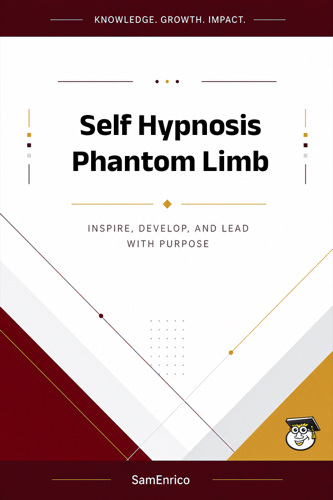
Non-FictionSelf-HelpAmputation
Self Hypnosis Phantom Limb eBook
Unclench missing limb cramping using mental imager
Unclench missing limb cramping using mental imagery release.
Formats
Free sample
Chapter 1: The Ghost Who Clenches--–- You are reading this because a hand that does not exist is making a fist so tight you would swear you can feel your own fingernails biting into your palm. You have tried to open it. You have commanded it to relax. You have ignored it, begged it, bargained with it, and possibly even screamed at it. Nothing worked.
Or worse—the more you tried to force it open, the tighter it clenched. You are not crazy. You are not weak. And you are not broken. You are experiencing one of the most baffling, exhausting, and poorly understood phenomena in all of medicine: the clenched phantom limb.This chapter is called The Ghost Who Clenches because that ghost is not your enemy.
It is not a hallucination. It is not a psychiatric symptom. It is a neurological signal that has been frozen in time—a message from your brain that got stuck somewhere between the wound and the will. Before we fix anything, we have to understand what we are dealing with. And the first thing you need to know is this: your brain is not trying to hurt you.
It is trying to protect you from a limb that no longer exists, using instructions that were written before the amputation.Let us start with a simple truth that most doctors never tell you: phantom limbs are not rare. They are the rule. Approximately 90 to 98 percent of amputees report phantom sensations within the first six months after amputation. Of those, nearly three-quarters describe pain, and the most common type of pain is a cramping, clenching, squeezing sensation. You are not alone.
You are part of a vast, silent majority of people whose brains are holding onto a map that no longer matches the territory.This chapter will give you three things. First, a complete explanation of why your phantom limb clenches and why it will not obey your commands to relax. Second, your first self-hypnosis exercise—a simple, two-minute inventory that will begin the process of separating you from the pain. Third, a roadmap for the rest of this book. By the time you finish this chapter, you will understand why every previous attempt to "just relax" failed, and why a different approach—one based on mental imagery and self-hypnosis—will succeed where willpower could not.The Cortical Homunculus: Your Brain’s Body Map To understand the ghost who clenches, you have to understand how your brain sees your body.
Not how your eyes see it. How your brain maps it. Neuroscientists call this map the cortical homunculus—Latin for "little man." It is a distorted, grotesque, and utterly brilliant representation of every body part, stretched across the surface of your brain like a city map pinned to a wall.Here is what the homunculus looks like: enormous lips, huge hands, a giant tongue, and tiny arms, legs, and trunk. The size of each body part on the map has nothing to do with the physical size of that part. It has everything to do with how many nerve endings and how much fine motor control that part requires.
Your lips are huge on the homunculus because they need to distinguish between a kiss and a burn. Your hands are enormous because they need to feel the difference between silk and sandpaper and because they can perform hundreds of precise movements per minute. Your back, by contrast, is tiny on the map because you rarely need to feel a single mosquito bite with surgical precision.This map is not just a passive drawing. It is alive. Every time you move, every time you feel something, every time you even think about moving, your homunculus lights up like a pinball machine.
Neurons fire in precise patterns that correspond to specific body parts. When you raise your right hand, a specific cluster of neurons in your left motor cortex fires. When you stub your toe, a different cluster in your sensory cortex fires. This is how you know where your body is in space without looking. This is proprioception—the sixth sense that most people do not even know they have.Now here is the part that changes everything.
That map is not permanent. It is plastic. It rewires itself constantly based on what you do, what you feel, and what you stop doing. If you play piano for twenty years, the hand area of your homunculus expands dramatically. If you lose a finger, the neighboring fingers slowly invade the abandoned territory on the map.
If you stop using a limb because it is in a cast for six weeks, the brain begins to prune away the neurons that used to control it. Use it or lose it is not just a motivational slogan. It is a neurological fact.So what happens when a limb is amputated? You might guess that the brain simply deletes that part of the homunculus. Out of sight, out of mind.
That is not what happens. The brain does not delete anything. It cannot. It has no mechanism for deleting a body part from its map. Instead, the map becomes what neuroscientists call "silent but active." The neurons that used to control the hand are still there.
They still fire. But they have no limb to send signals to, and no new sensory information is coming back. They are shouting into a void.This is the first piece of the puzzle. Your phantom limb exists because your brain still has a hand-shaped hole in its map. That hole is not empty.
It is filled with the last instructions the brain received from that limb before it was gone.Learned Paralysis: Why Your Hand Is Stuck Now we come to the most important concept in this entire book: learned paralysis. This is the reason your phantom limb is clenched and not relaxed. This is why you cannot just "think it open." And this is the key that will unlock everything else.Here is how learned paralysis works. Imagine you break your wrist. For six weeks, it is in a cast.
You cannot move your hand. You cannot wiggle your fingers. You cannot make a fist or open your palm. Your brain, ever efficient, notices that no movement signals are getting through and no sensory feedback is coming back. So it does something smart: it stops trying.
The neurons that used to command your hand to move go quiet. Not dead—just dormant. They are waiting for the cast to come off.When the cast finally comes off, your hand is stiff, weak, and clumsy. You have to retrain it. Physical therapy works because every time you successfully move a finger, the dormant neurons wake up and reconnect.
Within weeks, the map is restored.But what happens if the limb never comes out of the cast? What happens if the limb is amputated while it was still immobilized? Or what if the limb was in chronic pain before amputation—arthritic, burned, crushed, or frozen in a clenched position for months or years before the surgery?Here is the answer. The brain learns the position of the limb as its "default." If the limb was clenched before…
This is the end of the free sample. Get the eBook to keep going. Buy now
About this book
Details
- Author
- Hatch Maurice
- Publisher
- SamEnrico
- Language
- English
- Genre
- Non-Fiction, Self-Help, Amputation
- Released
- 2026-06-06
- Pages (approx.)
- 129
- Available as
- eBook, Audiobook

Read better in the ZLOADR app
Your eBooks on your phone or tablet. Sign in with your SamEnrico account and start reading.
More by Hatch Maurice
 Elderly Dysthymia GuideHatch Maurice$11.99
 Congress Member Lame Duck PeriodHatch Maurice$11.99
 Behavioral Indicators of Kidnap PlanningHatch Maurice$11.99
 Digital Comparison and Teen AnxietyHatch Maurice$11.99
 The Last Dance of the Ballerina: How a Single Performance Changed the WorldHatch Maurice$11.99
 The Frozen Frontier: La Perouse and the Lost Pacific ExpeditionHatch Maurice$11.99
 Understanding Congenital Mitral StenosisHatch Maurice$17.99
 Dubai Student Bank AccountHatch Maurice$12.99
 IoT Supply Chain MonitoringHatch Maurice$12.99
 Sales and Marketing RepresentativeHatch Maurice$11.99
 How to Become a Cell PlastererHatch Maurice$11.99
You may also like
 Hong Kong Handover 1997Dunn Johnnie$11.99
 Zumba For Postnatal Recovery CourseNeal Christian$11.99
 Zumba for BeginnersLadner Nikia$11.99
 YouTube Comment Mining GuideHumes Pandora$12.99
 Worry Box MeditationCarlin Rudy$11.99
 Workplace Stress MeditationNguyen Lynn$11.99
 Workplace Stress and Sleep RepairHawley Ivory$11.99
 Workplace Perfectionism CureDelaney Jeffry$11.99
 Workplace Injustice Anger GuideWallen Isabelle$11.99
 Work Addiction and Burnout LinkGreenwood Ester$11.99
 Women in Yoga and WellnessBeattie Galina$11.99
 Women in Stand Up ComedyChun Evangeline$11.99