
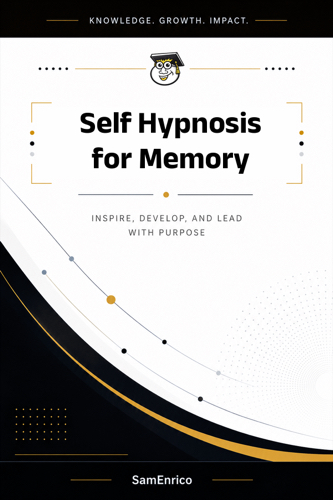
Self Hypnosis for Memory eBook
Improves recall and learning.
by Barton Dewey
Improves recall and learning.
Formats
Free sample
Chapter 1: The Locked Cabinet--–- The woman sitting across from me in the coffee shop had studied for the bar exam for six months. She had flash cards, color-coded outlines, and a spreadsheet tracking her progress. She had slept four hours a night for the last three weeks. And she had just failed the test for the second time."I know I knew the material," she said, her voice cracking. "When I left the exam, I could feel it in my head.
But during the test… nothing. Just white noise."She was not alone. Every year, millions of students, professionals, and lifelong learners walk into rooms where they need to perform, and their brains do the one thing they fear most: they go silent. The information is there. They know it is there.
They can almost feel the shape of it, the weight of it, the memory of having studied it. But when they reach for it, their hands close around empty air.This book is not about studying harder. It is not about more flash cards, more highlighters, or more late nights. This book is about something far more useful: teaching you to open the cabinet where every memory you have ever made is already sitting, perfectly preserved, waiting for you to find the right key.The Great Lie You Have Been Told You have been taught that forgetting is a natural, inevitable decay of information. Like fruit rotting on a counter.
Like ink fading in the sun. You have been told that your brain has limited storage, that old memories overwrite new ones, that age, stress, and genetics determine how much you can remember.Every single one of those statements is false.The truth—supported by decades of clinical hypnosis research, neuroimaging studies, and forensic evidence—is that your brain never loses data. Ever. Every conversation you have ever had, every page you have ever read, every face you have ever seen is still stored in your subconscious mind. The problem is not storage.
The problem is access.Consider the evidence. In criminal investigations, forensic hypnosis has enabled witnesses to recall license plate numbers they did not consciously notice. In clinical settings, patients under deep hypnosis have described, in perfect detail, the contents of a room they visited once as children. In operating rooms, patients anesthetized into unconsciousness have later recalled, under hypnosis, exact words spoken by surgeons during their procedures.These are not magic tricks. They are proof of a fundamental biological reality: your subconscious mind is recording everything, all the time, in perfect fidelity.
The conscious mind—the part of you that reads words on a page and worries about forgetting them—is simply not very good at finding what it has stored.This book fixes that.The Subconscious Hard Drive: Why Nothing Is Really Gone To understand how self-hypnosis transforms memory, you must first understand the architecture of your own mind. Think of your brain as having two distinct but connected systems: the conscious mind and the subconscious mind.Your conscious mind is the part you experience as "you." It is the voice in your head reading these words. It handles logic, analysis, short-term decisions, and the awareness of the present moment. It is also incredibly limited. The conscious mind can hold approximately seven pieces of information at once.
It processes data slowly. It tires easily. And it filters out roughly 99 percent of the sensory information your brain receives every second, deeming that information "irrelevant."Your subconscious mind is the opposite. It has no known storage limit. It records every sensory input—sight, sound, smell, touch, taste—in permanent, high-definition detail.
It never sleeps. It never gets tired. It never judges information as irrelevant. It simply absorbs and stores everything, forever.This is not metaphor. This is neurobiology.
The hippocampus, the structure in your brain responsible for memory formation, does not selectively delete data. It compresses and stores everything. What we call "forgetting" is actually a failure of the conscious mind to send the right retrieval signal to the subconscious. The file exists. You just lost the address.In every clinical study of hypnotic memory recall, subjects consistently retrieve information they believed they had forgotten.
Not vague impressions. Specific, verifiable details. The implication is inescapable: you have never truly forgotten anything. You have only lost the ability to find it.The Critical Factor: The Gatekeeper You Never Knew Existed If your subconscious never forgets, why do you struggle to remember? The answer lies in a neurological mechanism called the critical factor.The critical factor is a filtering system located in the anterior cingulate cortex and the prefrontal cortex.
Its job is to evaluate incoming information and decide what is important enough to pass from the conscious mind to the subconscious for long-term storage. It is the gatekeeper of your memory.The critical factor operates on a simple rule: only information that is emotionally charged, repeated many times, or flagged as "survival-relevant" gets through. Everything else is discarded. This worked beautifully for your ancestors, who needed to remember the location of water and the growl of a predator but did not need to remember the texture of every leaf they passed. It works terribly for modern humans who need to remember organic chemistry, foreign languages, and the names of thirty new colleagues at a networking event.Here is the crucial insight: the critical factor does not care about your intentions.
It does not care that you want to remember. It only cares about emotion, repetition, and survival value. If you study a textbook for three hours in a neutral, bored, or anxious state, your critical factor will tag that information as "not important" and block its entry into long-term memory. You will read the same paragraph ten times, feel like you understand it, and wake up the next day remembering almost nothing.Self-hypnosis bypasses the critical factor. When you enter a hypnotic state, the filtering activity of the anterior cingulate cortex decreases significantly.
The gatekeeper goes to sleep. For those precious minutes of trance, your subconscious mind accepts information directly, without filtering, without judgment, without requiring emotion or repetition. It simply records whatever you give it, in permanent detail.This is why a single hypnotic study session can outperform four normal study sessions. Not because you are smarter in hypnosis, but because the gatekeeper is no longer blocking the door.The 10 Percent Myth: Why the Wrong Model Ruins Memory You have heard the statistic: humans use only 10 percent of their brains. This is false.
Neuroimaging shows that virtually every region of the brain is active across a typical day. But the myth persists because it feels true. It feels like there should be untapped potential sitting somewhere inside your skull, waiting to be unlocked.Here is the corrected model, and it is far more useful: you use 100 percent of your brain, but you only have access to approximately 10 percent of your stored memories at any given time. The other 90 percent are sitting in your subconscious, perfectly intact, waiting for the right retrieval cue.Think of it this way. Your computer has a hard drive that contains every file you have ever saved.
But your desktop only shows a small folder of recent documents. To find the older files, you need to know…
This is the end of the free sample. Get the eBook to keep going. Buy now
About this book
Details
- Author
- Barton Dewey
- Publisher
- SamEnrico
- Language
- English
- Genre
- Non-Fiction, Self-Help, Memory
- Released
- 2026-06-05
- Pages (approx.)
- 140
- Available as
- eBook, Audiobook

Read better in the ZLOADR app
Your eBooks on your phone or tablet. Sign in with your SamEnrico account and start reading.
More by Barton Dewey
 Chromium Picolinate Safety GuideBarton Dewey$11.99
 Investment Withdrawal StrategyBarton Dewey$11.99
 Guilt as Adaptive EmotionBarton Dewey$11.99
 Criticism Receiving GuideBarton Dewey$11.99
 Birth Control And Cervical CancerBarton Dewey$11.99
 Senior Self Esteem AffirmationsBarton Dewey$11.99
 Difficult Conversations about MoneyBarton Dewey$11.99
 The Kiwi Pioneers: How New Zealand Shaped the Modern WorldBarton Dewey$11.99
 The Admiral's Anthem: Yi Sun-sin's Naval Symphony of DefianceBarton Dewey$11.99
 How to Produce Craft Wood and ShapesBarton Dewey$11.99
 Education Technology B2B SalesBarton Dewey$12.99
 Ruin Fear ProtocolBarton Dewey$12.99
You may also like
 Hong Kong Handover 1997Dunn Johnnie$11.99
 Zumba For Postnatal Recovery CourseNeal Christian$11.99
 Zumba for BeginnersLadner Nikia$11.99
 YouTube Comment Mining GuideHumes Pandora$12.99
 Worry Box MeditationCarlin Rudy$11.99
 Workplace Stress MeditationNguyen Lynn$11.99
 Workplace Stress and Sleep RepairHawley Ivory$11.99
 Workplace Perfectionism CureDelaney Jeffry$11.99
 Workplace Injustice Anger GuideWallen Isabelle$11.99
 Work Addiction and Burnout LinkGreenwood Ester$11.99
 Women in Yoga and WellnessBeattie Galina$11.99
 Women in Stand Up ComedyChun Evangeline$11.99