
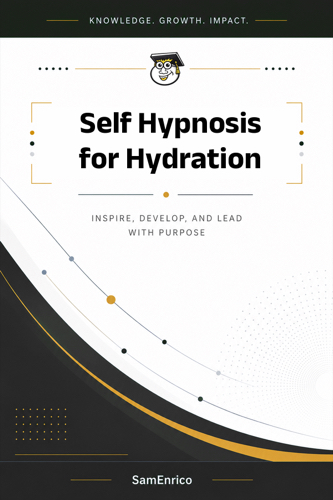
Self Hypnosis for Hydration eBook
Program thirst cues for optimal fluid intake.
by Becker Ellen
Program thirst cues for optimal fluid intake.
Formats
Free sample
Chapter 1: The Dehydration Deception--–- Every morning, millions of people wake up with a dull headache, dry mouth, and a vague sense of fatigue that they attribute to poor sleep. They reach for coffee, then a glass of water, then breakfast. By 2:00 PM, the brain fog rolls in like a tide. They drink more water—sometimes a lot more—but the fog persists. By evening, they are irritable, bloated, or constipated.
They assume this is normal. It is not. It is the silent signature of a body whose most fundamental communication system has been jammed by good intentions, bad advice, and a culture obsessed with external solutions to internal problems.This is the Dehydration Deception: the widespread belief that you know when you are thirsty, that your body will tell you when it needs water, and that drinking the recommended amount will solve the problem. All three beliefs are dangerously incomplete. Your body does have a natural thirst cue—a sophisticated cybernetic feedback loop involving your hypothalamus, your bloodstream, and your conscious awareness.
But for the majority of adults in the modern world, that cue has been suppressed, overwritten, or simply ignored for so long that it has stopped speaking altogether. You are not broken. You are not lazy. You are not forgetful. Your brain has simply learned that thirst signals are irrelevant because you have taught it—through years of overriding, scheduling, and substituting—that external commands matter more than internal ones.This book exists to undo that learning.
It will not tell you to drink more water. It will not give you a schedule or a formula. It will not ask you to set reminders on your phone. Instead, it will teach you to restore the one thing that has been lost: the ability to feel thirsty at exactly the right time, drink exactly the right amount, and feel completely satisfied. This is not magic.
It is cybernetics. It is hypnosis. It is the brain's own learning machinery turned back toward its original purpose: keeping you alive and hydrated without a single conscious thought.The Myth of the Eight Glasses Let us begin by dismantling the most persistent piece of hydration advice in history: the recommendation to drink eight 8-ounce glasses of water per day. This "8x8 rule" has been repeated so often that it has achieved the status of biological fact. It appears on government websites, in doctor's offices, and on countless wellness blogs.
There is only one problem: it was never based on any scientific evidence.The origin of the 8x8 rule is a matter of nutritional lore. Some trace it to a 1945 recommendation from the U.S. Food and Nutrition Board, which stated that a reasonable allowance for water for adults was 2.5 liters per day. What the Board also said—and what was almost always omitted from public messaging—was that most of this water is contained in prepared foods. In other words, you were never meant to drink eight glasses of plain water.
You were meant to eat your water through fruits, vegetables, soups, and other hydrating foods. Some trace it to a 1974 book titled Nutrition for Good Health by Dr. Frederick Stare, which suggested that adults drink six to eight glasses of water per day without mentioning that the author had financial ties to the beverage industry. Regardless of its origin, the rule persists not because it is true, but because it is simple. Humans love simple rules.
Simple rules feel safe. Simple rules require no thinking.But here is the problem with simple rules applied to complex biological systems: they jam the very feedback loops those systems depend on. When you drink because the clock says 10:00 AM, you are not responding to a biological need. You are responding to a conditioned stimulus. Your hypothalamus—the small but mighty region of your brain responsible for fluid balance—has not detected rising plasma osmolality (the concentration of your blood).
Your kidneys have not signaled the release of vasopressin, the antidiuretic hormone that tells your body to hold onto water. Your cells are not parched. You are simply following a rule. And every time you follow that rule, you tell your brain that external commands are more important than internal signals. Over time, your brain believes you.
It stops sending thirst signals because you have demonstrated, repeatedly, that you do not need them. You have outsourced hydration to a clock.This is not a failure of your body. It is a failure of the advice. Your body is a self-regulating machine of extraordinary precision. It can maintain your fluid balance within a fraction of a percent across dramatic changes in temperature, activity, and food intake.
But it cannot do this if you ignore its signals or override them with arbitrary schedules. The 8x8 rule is not helping you. It is training your brain to be deaf.The Cybernetic Loop: How Your Body Actually Manages Water To understand what has gone wrong, you must first understand how thirst is supposed to work. The system is called a negative feedback loop—the same kind of loop that controls your room's thermostat, your car's cruise control, and the global economy. It has four components: a sensor, a set point, a comparator, and an effector.Your sensor is a cluster of cells in your hypothalamus called osmoreceptors.
These cells detect the concentration of your blood plasma. When you are well-hydrated, your blood is relatively dilute, and the osmoreceptors fire at a low baseline rate. When you lose water—through sweating, breathing, urination, or simply not drinking—your blood becomes more concentrated. The osmoreceptors detect this change and increase their firing rate.Your set point is the optimal blood concentration your body tries to maintain. For most adults, this is approximately 285 to 295 milliosmoles per kilogram.
This is not a fixed number; it shifts slightly based on age, fitness level, and environmental conditions. But it is remarkably stable.Your comparator is the neural circuit that compares the current blood concentration to the set point. When the current value rises above the set point, the comparator generates an error signal. That error signal is thirst.Your effector is you. You drink water.
When you drink, your blood concentration drops back toward the set point, the error signal decreases, and thirst fades. The loop is closed.This is elegant, efficient, and entirely automatic. You do not need to think about it. You do not need to calculate anything. You do not need a water bottle with time stamps on the side.
Your body handles all of it, moment by moment, day by day, year by year.So why are you reading this book? Because for most adults, this loop has been disrupted. Not broken—disrupted. The osmoreceptors still work. The comparator still functions.
The set point is still there. But the signal is being ignored, overwritten, or distorted by three specific suppressors that we will explore in detail in Chapter 2. The result is not that you never feel thirst. The result is that you feel thirst at the wrong times, or not at all, or you mistake it for hunger, fatigue, or anxiety.Cellular Thirst vs. Mouth Dryness: The Critical Distinction You Have…
This is the end of the free sample. Get the eBook to keep going. Buy now
About this book
Details
- Author
- Becker Ellen
- Publisher
- SamEnrico
- Language
- English
- Genre
- Non-Fiction, Self-Help, Hydration
- Released
- 2026-06-06
- Pages (approx.)
- 140
- Available as
- eBook, Audiobook

Read better in the ZLOADR app
Your eBooks on your phone or tablet. Sign in with your SamEnrico account and start reading.
More by Becker Ellen
 Self Hypnosis for Fear of IntimacyBecker Ellen$11.99
 Military Psychologist Combat StressBecker Ellen$11.99
 Stress Eating Coping GuideBecker Ellen$11.99
 The Emotion Name SkillBecker Ellen$11.99
 Ethiopia Never ColonizedBecker Ellen$11.99
 Alcohol Recovery for NursesBecker Ellen$11.99
 Microbiome Master GuideBecker Ellen$11.99
 The Magpies and the Mavericks: How a Fashion Icon Built a Rugby EmpireBecker Ellen$11.99
 Windwalker's Lament: The Ballad of the Navajo Hero TwinBecker Ellen$11.99
 Scottish Deerhound: Gentle SighthoundBecker Ellen$11.99
 How to Start a Hobby in Collecting Sports CardsBecker Ellen$11.99
 How to Produce Seasonings and SpicesBecker Ellen$11.99
You may also like
 Hong Kong Handover 1997Dunn Johnnie$11.99
 Zumba For Postnatal Recovery CourseNeal Christian$11.99
 Zumba for BeginnersLadner Nikia$11.99
 YouTube Comment Mining GuideHumes Pandora$12.99
 Worry Box MeditationCarlin Rudy$11.99
 Workplace Stress MeditationNguyen Lynn$11.99
 Workplace Stress and Sleep RepairHawley Ivory$11.99
 Workplace Perfectionism CureDelaney Jeffry$11.99
 Workplace Injustice Anger GuideWallen Isabelle$11.99
 Work Addiction and Burnout LinkGreenwood Ester$11.99
 Women in Yoga and WellnessBeattie Galina$11.99
 Women in Stand Up ComedyChun Evangeline$11.99