
Non-FictionSelf-HelpCreative Blocks
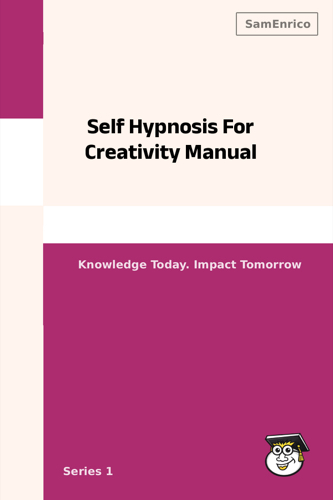
Self Hypnosis For Creativity Manual eBook
Accesses trance to bypass critical mind and access
Accesses trance to bypass critical mind and access creative subconscious.
Formats
Free sample
Chapter 1: The Effort Trap--–- You sit down at your desk. The cursor blinks. The canvas waits. The first page of the score stares back with empty staff lines. You want to create something original, something meaningful, something that feels like you.
So you try. You concentrate. You apply pressure. You tell yourself, “Come on, think. You’ve done this before.
Just focus.”And nothing happens. Or worse, something mediocre happens—the same idea you had yesterday, the same chord progression, the same composition, the same tired metaphor. You delete it. You paint over it. You crumple the page.
Then the voice arrives: “Maybe you’ve lost it. Maybe you never had it. Maybe real creators don’t struggle like this.”That voice is lying to you. But it’s lying in a very sophisticated way, using your own brain chemistry against you. This chapter dismantles the single most destructive myth about creativity: the belief that trying harder leads to better ideas.
In fact, the opposite is true. Effort—the kind of focused, analytical, willpower-driven effort that works beautifully for memorizing facts or solving math problems—is chemically incompatible with the brain state required for original insight.You are about to learn why your best ideas arrive in the shower, during a walk, or just as you’re falling asleep. You will understand why “sleep on it” is not a cliché but a neurological instruction. And you will discover the critical distinction that transforms frustrated creators into fluent ones: the difference between practice effort (deliberate, structured, disciplined) and creative surrender (the willing release of control that allows the subconscious to speak).By the end of this chapter, you will never blame yourself for a creative block again. You will understand the enemy.
And you will be ready to bypass it.The Anatomy of a Creative Block Let us name the enemy. That voice inside your head that says “that’s not good enough,” “someone else already did it,” “wait until you have a better idea,” “you’re not really a writer/painter/musician/innovator”—that voice has many names. Psychologists call it the critical faculty. Neuroscientists might call it the left hemisphere’s veto network. But for our purposes throughout this book, we will call it by one consistent name: the Inner Critic.The Inner Critic is not your enemy in the way a virus is your enemy.
It is not a foreign invader. It is a natural, necessary, and even valuable part of your cognitive architecture. Its job is to keep you safe. When you were a child, the Inner Critic helped you avoid danger: don’t touch the hot stove, don’t run into the street, don’t trust that stranger. The problem is that the Inner Critic cannot distinguish between physical danger and creative risk.
To your brain, the vulnerability of sharing an unfinished poem looks remarkably like the vulnerability of standing on a cliff edge. The Inner Critic responds the same way to both: stop, retreat, stay safe, don’t do anything that might invite judgment.This is not a character flaw. This is evolutionary biology.The Post-Natal Suggestion Machine Every human being is born without an Inner Critic. Infants do not judge their own babbling. Toddlers do not critique their own finger-painting.
The Inner Critic is constructed over time through a process we will call Post-Natal Suggestion—the accumulation of social conditioning, parental feedback, school grading systems, peer comparison, and cultural messaging about what “good” creativity looks like.Consider the average childhood creative experience. You draw a picture. An adult says, “That’s lovely, but the sky is not purple, the sky is blue.” You write a story. A teacher marks it with red pen: “Run-on sentence. Weak conclusion.” You sing a song.
A sibling laughs. None of these moments are traumatic in isolation. But accumulated over thousands of interactions, they build a neural superhighway: creativity equals judgment. By the time you reach adulthood, the Inner Critic has been trained so thoroughly that it activates automatically the moment you attempt any creative act.Here is the cruel irony: the Inner Critic believes it is helping you. It is trying to prevent embarrassment, rejection, and failure.
It does not understand that creative failure is not the same as physical danger. It does not understand that a bad drawing never killed anyone. It only knows that your past experiences have linked creativity with criticism, and it is doing its job by making you stop.The first step to bypassing the Inner Critic is understanding that it is not malicious. It is merely over-trained. And over-trained circuits can be re-trained.Why “Try Harder” Is Chemical Suicide for Creativity Let us look under the hood.
Your brain operates in several distinct electrical modes, measured by frequency in hertz. For our purposes, we need to understand three of them:Beta (14–30 Hz): This is your awake, alert, analytical, critical state. When you are solving a math problem, editing an email, following a recipe, or arguing a point, your brain is predominantly in Beta. The left hemisphere’s language and logic centers are highly active. This state is excellent for execution, but terrible for generation.
Why? Because Beta is the home of the Inner Critic. In high Beta, your brain is actively pattern-matching, comparing current input to past memory, and flagging anything that deviates. Deviation is dangerous. New ideas deviate by definition.
Therefore, in Beta, new ideas feel wrong.Alpha (8–13 Hz): This is relaxed alertness. Eyes closed, daydreaming, the moments just after waking or before sleep. In Alpha, the brain’s default mode network becomes active—the same network that generates spontaneous thoughts, mind-wandering, and creative associations. The Inner Critic quiets down because the left hemisphere’s analytical grip loosens. This is why you get ideas in the shower: warm water, repetitive motion, low sensory load—all encourage Alpha.Theta (4–7 Hz): This is deep relaxation, light trance, the hypnagogic state between wake and sleep.
In Theta, the boundaries between conscious and subconscious dissolve. Visual imagery becomes vivid. Insights feel like downloads. The Inner Critic is almost entirely offline. This is the state accessed by master meditators, experienced hypnosis subjects, and anyone who has woken in the middle of the night with a complete solution to a problem they couldn’t solve for days.Here is the critical insight: you cannot force your brain into Alpha or Theta by trying harder.
Trying harder increases Beta. You have experienced this. The more you tell yourself “I must focus on this creative problem,” the more your jaw tightens, your shoulders rise, and your mind races. That is Beta activation. You are literally pushing yourself away from the creative state with every ounce of effort.This is not a metaphor.
Functional MRI studies of creative problem-solving show that when participants are instructed to “try harder” on a creative task, the prefrontal cortex (executive control, critical evaluation) lights up, and the default mode network (spontaneous association) dims. The harder they try, the worse they perform. Effort kills creativity.The Paradox of Practice: Two Kinds of Effort At this point, a thoughtful reader might object: “But wait. You’re telling me to stop trying. Yet this book contains structured exercises…
This is the end of the free sample. Get the eBook to keep going. Buy now
About this book
Details
- Author
- Jeffery Jenine
- Publisher
- SamEnrico
- Language
- English
- Genre
- Non-Fiction, Self-Help, Creative Blocks
- Released
- 2026-06-11
- Pages (approx.)
- 156
- Available as
- eBook, Audiobook

Read better in the ZLOADR app
Your eBooks on your phone or tablet. Sign in with your SamEnrico account and start reading.
More by Jeffery Jenine
 Meditation for Diverticulitis PainJeffery Jenine$11.99
 Boundary Setting for Retirement CommunitiesJeffery Jenine$11.99
 Spider Dream Fear ProcessingJeffery Jenine$11.99
 Francis and the Robbers Story GuideJeffery Jenine$11.99
 Harvard Extension vs LSE AccreditationJeffery Jenine$12.99
 The Last Debt: How a Forgotten Empire Bankrupted the WorldJeffery Jenine$11.99
 The Velvet Underground’s Lost Tapes: How Motown Almost Changed Rock ForeverJeffery Jenine$11.99
 IT Service Delivery ManagerJeffery Jenine$11.99
 How to Start a Parts of Trousers for Women and Girls Business (Beginners Guide)Jeffery Jenine$11.99Harvard Extension vs LSE AccreditationJeffery Jenine$12.99
 House Sitting Referral SystemJeffery Jenine$12.99
 Understanding Epilepsy Mental Deterioration Finnish TypeJeffery Jenine$17.99
You may also like
 Hong Kong Handover 1997Dunn Johnnie$11.99
 Zumba For Postnatal Recovery CourseNeal Christian$11.99
 Zumba for BeginnersLadner Nikia$11.99
 YouTube Comment Mining GuideHumes Pandora$12.99
 Worry Box MeditationCarlin Rudy$11.99
 Workplace Stress MeditationNguyen Lynn$11.99
 Workplace Stress and Sleep RepairHawley Ivory$11.99
 Workplace Perfectionism CureDelaney Jeffry$11.99
 Workplace Injustice Anger GuideWallen Isabelle$11.99
 Work Addiction and Burnout LinkGreenwood Ester$11.99
 Women in Yoga and WellnessBeattie Galina$11.99
 Women in Stand Up ComedyChun Evangeline$11.99