
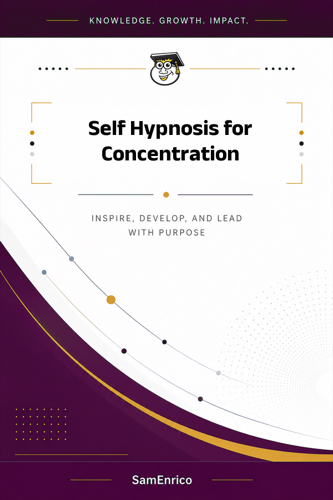
Self Hypnosis for Concentration eBook
Induces focused trance states for deep work and st
by Wiley Damian
Induces focused trance states for deep work and study.
Formats
Free sample
Chapter 1: The Effort Paradox--–- Every morning, Sarah sat down at her desk with a steaming mug of coffee and a ruthless to-do list. She wanted to focus. She needed to focus. Her job as a data analyst required hours of uninterrupted concentration, and her upcoming certification exam demanded even more. So she did what most people do when they cannot focus: she tried harder.
She clenched her jaw, narrowed her eyes, and silently commanded her brain to pay attention. Within fifteen minutes, her shoulders were tight, her breathing was shallow, and she had checked her phone three times, opened five irrelevant browser tabs, and mentally composed a grocery list. By noon, she was exhausted, frustrated, and convinced that she lacked some fundamental discipline that successful people possessed.Sarah is not lazy. She is not undisciplined. And she is certainly not alone.
Millions of students, professionals, and creatives fall into the same trap every day. They believe that concentration is a battle of willpower against distraction. They think that if they just try harder, grit their teeth, and power through, they will eventually win. But neuroscience tells a different story. The effort paradox—the counterintuitive truth that trying harder to focus actually makes concentration harder—is one of the most consistent findings in cognitive psychology.
When you strain to concentrate, you activate the sympathetic nervous system, the same stress response that prepares your body to fight a predator or flee from danger. Your heart rate increases. Your muscles tense. Your pupils dilate. And your prefrontal cortex, the very part of your brain responsible for sustained attention, begins to shut down under the pressure.This chapter dismantles the myth that concentration requires effortful struggle.
It introduces the foundational concept of self-hypnosis for focus: not as a mystical practice involving pocket watches and swinging pendulums, but as a scientifically grounded method for shifting from forced attention to effortless absorption. You will learn why the reticular activating system (RAS) acts as a gatekeeper for your awareness, how hypnotic trance differs from sleep or zoning out, and why the most productive people in history—from Nikola Tesla to Maya Angelou—entered flow states that felt less like work and more like surrender. By the end of this chapter, you will understand why your current approach to concentration is failing and how a radical shift in strategy will transform your relationship with deep work.The Myth of Willpower For centuries, philosophers and educators promoted the idea of willpower as a muscle. The more you exercised it, the stronger it became. If you could not focus, the logic went, you simply lacked moral fortitude.
This perspective permeated into modern productivity culture, giving rise to slogans like "no excuses," "grind harder," and "discipline equals freedom." While these mantras sound inspiring, they rest on a flawed understanding of how attention actually works.The willpower-as-muscle model was partially validated by early psychology research, most famously the 1990s studies by Roy Baumeister suggesting that willpower depletes like a finite resource. Later research, however, failed to replicate these findings consistently. More recent meta-analyses have shown that the depletion effect is smaller than originally claimed and may depend heavily on individual beliefs about willpower. People who believe that willpower is unlimited perform just as well on later tasks as they did on earlier ones. The limiting factor is not some mystical reservoir of self-control but rather your beliefs about whether effort is sustainable.More importantly, the entire framework misidentifies the problem.
When you struggle to focus, you are not running out of willpower. You are fighting against the natural architecture of your brain. The conscious mind can hold only a handful of pieces of information at once—roughly four to seven items, according to most cognitive load studies. Everything else is handled by the subconscious, which processes approximately eleven million bits of information per second compared to the conscious mind's mere fifty bits. Trying to force concentration through conscious effort is like trying to manually control every heartbeat and breath.
It is inefficient, exhausting, and ultimately unsustainable.Consider what happens when you learn to drive a manual transmission car. At first, every movement is conscious: clutch in, shift to first, slowly release clutch while applying gas. You stall. You lurch. You feel overwhelmed.
After a few weeks, you shift gears without thinking. Your subconscious has taken over. The same process occurs in any skill, from typing to playing the piano to reading complex material. Concentration works the same way. When you achieve true focus, you are not actively forcing your attention to stay on the task.
You are allowing your subconscious to enter a state of absorption where distraction simply does not arise.The effort paradox explains why students who cram for exams often perform worse than those who study in relaxed, spaced sessions. It explains why programmers who take breaks solve problems faster than those who stare at the screen for hours. It explains why creative breakthroughs rarely happen during intense struggle but rather during walks, showers, or moments of mind-wandering. Your brain is not a machine that responds to brute force. It is a complex organ that thrives on the right conditions, not on coercion.The Reticular Activating System: Your Brain's Gatekeeper To understand why self-hypnosis works for concentration, you need to meet the reticular activating system, or RAS.
This bundle of neurons sits at the brainstem, roughly where your spine meets your skull. Despite its small size—about the width of your pinky finger—the RAS performs one of the most critical functions in your nervous system. It filters every piece of sensory information entering your brain and decides what deserves conscious attention.Your senses are bombarded with millions of bits of data every second. The light hitting your retina, the pressure of your clothes on your skin, the hum of your refrigerator, the background conversation in the next room, the subtle ache in your left knee. If you consciously processed even a fraction of this information, you would be paralyzed by overwhelm.
The RAS solves this problem by acting as a gatekeeper. It monitors all incoming data and elevates only the information that seems relevant to your survival, goals, or current interests.Here is where the RAS becomes revolutionary for concentration: you can program it. The RAS responds to two primary inputs: threat and intention. If a lion walks into your office, your RAS will instantly elevate that information to consciousness because it signals a survival threat. More subtly, the RAS also responds to what you repeatedly tell your subconscious is important.
When you decide that a textbook, a spreadsheet, or a codebase matters, and when you reinforce that decision through hypnotic suggestion, the RAS begins to filter the world differently. It downgrades the salience of your phone notifications, the chatter in the coffee shop, and the urge to check email. It upgrades the salience of the task in front of you.This explains why you can suddenly hear your name mentioned across a crowded room when you were not consciously listening to the conversation. Your RAS was monitoring the ambient noise, and it recognized your name as personally relevant. It also explains why parents sleep through thunderstorms but…
This is the end of the free sample. Get the eBook to keep going. Buy now
About this book
Details
- Author
- Wiley Damian
- Publisher
- SamEnrico
- Language
- English
- Genre
- Non-Fiction, Self-Help, Focus
- Released
- 2026-06-10
- Pages (approx.)
- 149
- Available as
- eBook, Audiobook

Read better in the ZLOADR app
Your eBooks on your phone or tablet. Sign in with your SamEnrico account and start reading.
More by Wiley Damian
 Menopause Pelvic Health GuideWiley Damian$11.99
 Right of First RefusalWiley Damian$11.99
 Pet Loss Quarantine SpecialWiley Damian$11.99
 Rolling Hills SimplicityWiley Damian$11.99
 The IBS Self Advocate GuideWiley Damian$11.99
 The Criminal Defense Lawyer StressWiley Damian$11.99
 Time Blocking For Tax SeasonWiley Damian$11.99
 Yes PleaseWiley Damian$11.99
 Love Letters from the Eastern Front: The Secret Romance of a Nurse and a SoldierWiley Damian$11.99
 Long’s Wrath: The Serpent and the Frost GiantWiley Damian$11.99
 The Wise King and the Golden Age: Alfred the Great’s LegacyWiley Damian$11.99
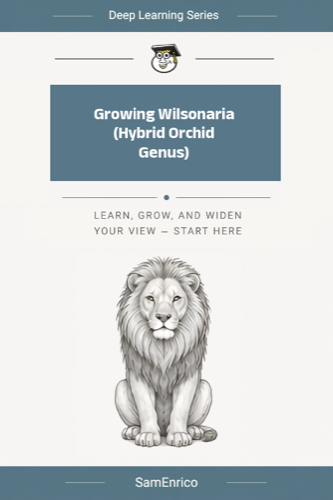 Growing Wilsonaria (Hybrid Orchid Genus)Wiley Damian$11.99
You may also like
 The Self Hypnosis for FocusCorley Mickie$11.99
 Phone Down While Driving GuideHatcher Lincoln$11.99
 Nostril Breath Attention GuideWeed Akilah$11.99
 Flow Recovery After BreaksReaves Vanita$11.99
 Distraction Proof Remote WorkGist Herta$11.99
 The Two Hour Focus BlockKunkel Maxima$11.99
 The Deep Work Remote GuideMcrae Keitha$11.99
 The Beginner's Candle GazingHull Sherron$11.99
 Remote Work Distraction ManagementMena Marylin$11.99
 Overcoming Listening Barriers and DistractionsGilliam Josue$11.99
 Flow Distraction EliminationRead Tamie$11.99
 Distraction Log ReviewEly Minerva$11.99