
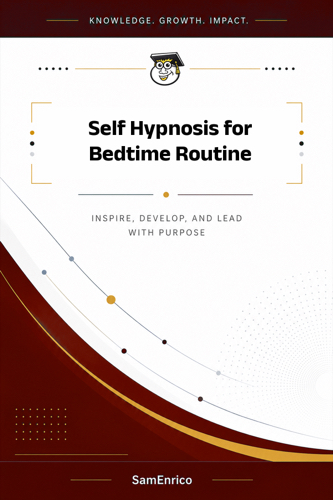
Self Hypnosis for Bedtime Routine eBook
Automatic wind down sequence.
by Mullins Lori
Automatic wind down sequence.
Formats
Free sample
Chapter 1: The 2 AM Lie--It is 2:00 AM, and you are wide awake.The sheets are tangled around your legs. Your pillow has somehow become both too flat and too lumpy. The room is dark, the house is quiet, and your brain is screaming. Not words, exactly—more like static. A low-voltage hum of everything you did wrong today, everything you have to do tomorrow, and a vague, shapeless dread that you cannot name but cannot shake.You have tried everything.
You have counted breaths. You have replayed soothing music in your head. You have begged whatever cosmic force governs sleep to please, please, just this once, let you drift off. You have even tried the old trick of pretending to be asleep—slowing your breathing, keeping your eyes still—hoping your brain would take the hint and follow along.None of it worked.And now there is a new thought, the worst one yet, sliding into your mind like a cold knife: What if this is just how I am now? What if I have forgotten how to sleep?If that thought has ever crossed your mind—at 2 AM or any other hour—I need you to hear something very clearly.
That thought is a liar. You have not forgotten how to sleep. You have not broken yourself. You are not a lost cause for rest.You have fallen into a trap. And it is not your fault.The trap has a name, though you have probably never heard it.
Sleep scientists call it psychophysiological insomnia, but I am going to call it something simpler: the 2 AM lie. The lie says that sleep is something you must achieve through effort. The truth—the one that will set you free—is that sleep is something you must allow by surrendering effort.This entire book exists to teach you that surrender. Not through vague advice like "just relax" (the most useless sentence in the English language). Through a specific, science-backed, step-by-step system of self-hypnosis that rewires your brain to treat bedtime as a reflex, not a battle.But before we get to the how, we have to understand the why.
We have to understand why your brain—which wants you to sleep, which needs you to sleep—keeps betraying you the moment your head hits the pillow.The Paradox of Effort: Why Trying Harder Makes Everything Worse Let me ask you a question. Have you ever tried to remember a name—a celebrity's name, a coworker's name, someone you have known for years—and the harder you tried, the more the name retreated into the fog? And then, the moment you stopped trying, while you were loading the dishwasher or staring out a window, the name suddenly popped into your head?That is the paradox of effort in action. Your brain does not respond well to being forced. When you apply conscious willpower to a task that requires unconscious processing, you jam the machinery.Sleep is the ultimate unconscious process.
You cannot will yourself to digest food. You cannot will yourself to grow hair. And you cannot will yourself to fall asleep. These are autonomic functions, governed by the parasympathetic nervous system—the branch of your nervous system responsible for rest, digestion, and repair.Here is the neuroscience that matters: the prefrontal cortex—the part of your brain right behind your forehead that handles planning, problem-solving, and goal-setting—must deactivate for sleep to occur. It needs to step back and let the older, more primitive parts of your brain take over.When you lie in bed thinking, I need to fall asleep right now because I have a big meeting at 8 AM and if I don't sleep I will fail and my life will fall apart, your prefrontal cortex is not deactivating.
It is throwing a rave. It is firing on all cylinders, processing threats, calculating consequences, and keeping you hyper-alert.You are essentially trying to push a door open that only opens when you stop pushing.This is not a character flaw. This is not a lack of discipline. This is neurology. And the first step to fixing it is to stop blaming yourself for something your brain was never designed to do.The Hyperarousal Trap: How Your Bed Became a Battlefield There is a second layer to this trap, and it is even more insidious than the paradox of effort.
It is called conditioned arousal, and it works like this.Every night, you go to bed. Every night, you struggle to sleep. Every night, you feel frustrated, anxious, and increasingly desperate. Your brain is a prediction machine—it learns from patterns. After enough nights of this, your brain starts to predict that bed equals struggle.
The moment you lie down, even before you have a chance to try to sleep, your body begins to prepare for battle.Your heart rate increases slightly. Your cortisol (the stress hormone) edges upward. Your muscles hold a little more tension. Your attention narrows, scanning for threats—because your brain has classified "bedtime" as a threat.This is the same mechanism that creates phobias. A person who has a panic attack in an elevator may start having panic attacks just thinking about an elevator.
The elevator itself becomes the trigger. Your bed has become your elevator.I want you to take a moment and feel into this. Think about the moment your head touches the pillow. Does your body relax? Or does it subtly, almost imperceptibly, brace itself?
Do you feel a small wave of resignation, or dread, or even anger?If you answered yes to any of those, you are in the hyperarousal trap. And again, it is not your fault. You did not choose this. It is a learned response, and what has been learned can be unlearned.The Self-Assessment: Is This You?Let us get specific. Below is a brief self-assessment.
Answer yes or no to each question. There is no scoring threshold—this is simply to help you see your own patterns more clearly.When you get into bed, do you feel a sense of dread or resignation rather than relaxation?Do you find yourself thinking about sleep during the day—worrying about the coming night, calculating how many hours you might get?Do you sleep better in a hotel, on a couch, or anywhere other than your own bed?Do you perform rituals before bed that feel more like anxiety management than genuine relaxation (checking the clock repeatedly, adjusting pillows obsessively, getting up to pee "just in case")?Do you fall asleep easily in front of the TV or in a recliner, but the moment you move to your bed, you wake up?If you answered yes to three or more of these, you are almost certainly dealing with conditioned arousal—the 2 AM lie in action. The good news is that this condition has a near-100% success rate when treated with the right combination of CBT-I (cognitive behavioral therapy for insomnia) and self-hypnosis. And that is exactly what this book delivers.What an "Automatic Wind Down" Actually Looks Like Now that we have named the enemy, let me show you what freedom looks like.Imagine for a moment that you have gone through the 21-day protocol in this book. It is…
This is the end of the free sample. Get the eBook to keep going. Buy now
About this book
Details
- Author
- Mullins Lori
- Publisher
- SamEnrico
- Language
- English
- Genre
- Non-Fiction, Self-Help, Bedtime
- Released
- 2026-06-05
- Pages (approx.)
- 127
- Available as
- eBook, Audiobook

Read better in the ZLOADR app
Your eBooks on your phone or tablet. Sign in with your SamEnrico account and start reading.
More by Mullins Lori
 OKR For Government GuideMullins Lori$11.99
 Gunshot Residue ReconstructionMullins Lori$11.99
 Estranged Family End Of LifeMullins Lori$11.99
 LBO Sensitivity Analysis WorkbookMullins Lori$11.99
 Nap for Headache ReliefMullins Lori$11.99
 Cycling Interval Pyramid WorkoutMullins Lori$11.99
 Empathy for Healthcare WorkersMullins Lori$11.99
 The Vanishing Billion: How a Shadowy Syndicate Stole the World’s Most Valuable ArtworkMullins Lori$11.99
 The Grand Designers: How Black Architects Shaped the World’s Greatest CitiesMullins Lori$11.99
 How to Produce Cuticle ScissorsMullins Lori$11.99
 A Collector's Handbook to the Veritas SaturnMullins Lori$11.99
 Medical Exam for PR GuideMullins Lori$12.99
You may also like
 Hong Kong Handover 1997Dunn Johnnie$11.99
 Zumba For Postnatal Recovery CourseNeal Christian$11.99
 Zumba for BeginnersLadner Nikia$11.99
 YouTube Comment Mining GuideHumes Pandora$12.99
 Worry Box MeditationCarlin Rudy$11.99
 Workplace Stress MeditationNguyen Lynn$11.99
 Workplace Stress and Sleep RepairHawley Ivory$11.99
 Workplace Perfectionism CureDelaney Jeffry$11.99
 Workplace Injustice Anger GuideWallen Isabelle$11.99
 Work Addiction and Burnout LinkGreenwood Ester$11.99
 Women in Yoga and WellnessBeattie Galina$11.99
 Women in Stand Up ComedyChun Evangeline$11.99