
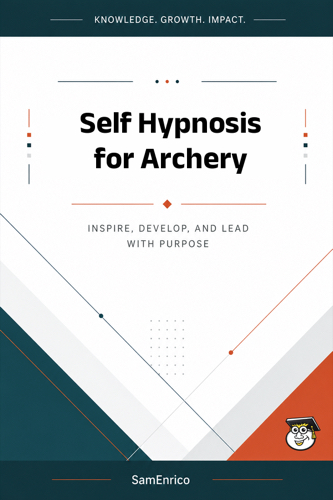
Self Hypnosis for Archery eBook
Steadies aim and releases cleanly through hypnotic
by Gaddis Ginny
Steadies aim and releases cleanly through hypnotic still-point induction.
Formats
Free sample
Chapter 1: The Vanished Arrow--–- You have felt it. That hollow, sinking moment when the arrow leaves the bow and you have absolutely no memory of telling your fingers to let go. The sight picture was perfect—the pin settled exactly where it belonged, the breath was steady, the back tension felt solid. And then, without warning, the string jumped forward as if possessed by some unseen hand. The arrow flew.
Where it went, you cannot say. The target might as well have been on another planet.This is not a failure of technique. You have spent hundreds of hours practicing your stance, your grip, your draw, your anchor point. You have watched countless instructional videos, read the forums, adjusted your peep sight, tuned your arrows, and experimented with three different release aids. And yet, the moment that matters most—the moment of release—remains a mystery to you.
Your conscious mind, so diligent in every other phase of the shot, simply vanishes when the arrow is supposed to fly.You are not alone. Every archer who has ever drawn a bow in earnest has experienced this phenomenon. Olympic gold medalists describe it. Competitive hunters whisper about it in camp. Traditional longbowmen have written poems about it.
The Japanese call it munen musō—"no thought, no image." Western sports psychologists call it "the yips." In archery circles, it has a more clinical, almost menacing name: target panic.But target panic is a misnomer. The word "panic" suggests fear, anxiety, a conscious emotional response that can be talked down with positive affirmations or breathing exercises. What you are experiencing is not panic. It is something far more insidious. It is a reflex—a hardwired, subconscious neural program that fires faster than your conscious mind can intervene.
By the time you realize something has gone wrong, the arrow is already in the backstop, or the dirt, or—if you are unlucky—somewhere in the next county.This book exists because the standard advice for target panic does not work. Coaches will tell you to "relax." They will tell you to "trust your shot process." They will tell you to shoot more blank bale and worry less about your score. All of this is well-intentioned, and none of it addresses the fundamental problem: you are trying to solve a subconscious reflex with conscious tools. That is like trying to debug a computer's operating system by pressing the keys harder. The problem is not in your fingers.
It is in the software that runs beneath your awareness.The Anatomy of a Lost Shot Let us walk through the exact sequence of what happens when the vanished arrow strikes.You are at full draw. The bow is steady—not perfectly still, because no human can hold a bow perfectly still, but steady enough that the pin is floating within the kill zone. Your back tension is engaged. You can feel the rhomboids and trapezius working together, holding the weight. Your breathing is controlled.
Everything feels good. And then, in the space between one heartbeat and the next, something changes.Your subconscious mind, which has been quietly monitoring thousands of sensory inputs throughout the shot process, detects a pattern. The sight pin has drifted across the center of the target. The wind has momentarily stilled. The muscle fatigue that was building in your back has reached a certain threshold.
All of these signals, processed in milliseconds, combine to form a single conclusion: The shot is ready.What happens next is not a decision. It is a reflex.The subconscious mind, bypassing your motor cortex entirely, sends a direct signal to the muscles of your hand or fingers. The release aid fires. The string slips from your fingers. The arrow is gone.
Only after the fact does your conscious mind register what has happened, and by then, it is too late to do anything except watch the arrow fly—often in a direction you did not intend.This is the Archer's Reflex. It is over-learned, which means it has been reinforced by thousands of repetitions. Every time you shoot, whether the arrow hits or misses, the reflex fires. And every time it fires, the neural pathway becomes stronger, faster, more resistant to conscious intervention.Here is the cruel irony: the reflex is not inherently bad. In fact, it is the same neural mechanism that allows elite archers to shoot with astonishing speed and accuracy.
The difference between a world champion and a frustrated weekend shooter is not whether the reflex fires. It is when the reflex fires.The elite archer has trained the reflex to fire at the precise moment when all mechanical and physiological conditions are optimal. The archer with target panic has trained the reflex to fire at the first hint of a good sight picture, long before the shot is truly ready. In both cases, the release feels automatic, almost unconscious. But one archer hits the X-ring, and the other punches the release and sends the arrow into the nine—or worse.Conscious Fear versus Subconscious Reflex Before we go any further, we must draw a sharp distinction between two very different problems that archers often confuse.Conscious fear is what most people think of when they hear the term "target panic." It manifests as visible, unmistakable signs: the bow bucks forward at the moment of release, the archer flinches or closes their eyes, the draw length collapses before the shot breaks, or the archer simply cannot bring themselves to aim at the target at all.
This is the archer who stands at full draw for ten seconds, fifteen seconds, twenty seconds, unable to let the arrow fly. Their heart pounds. Their palms sweat. They are acutely aware of the target and of their own fear.Conscious fear is driven by the amygdala, the brain's threat-detection center. The archer is afraid of missing, afraid of wounding an animal, afraid of embarrassing themselves in front of their peers.
This fear triggers the sympathetic nervous system—the fight-or-flight response. Muscles tense. Breathing becomes shallow. Fine motor control deteriorates. The archer knows exactly what is happening, and they hate it.Subconscious reflex, by contrast, leaves no visible trace.
The archer appears calm, steady, in control. Their form looks good. Their breathing seems normal. And then, without warning, the shot breaks—often earlier than intended, often with the pin still moving. The archer is not afraid.
They are not anxious. They are simply... absent. The shot happened to them, not by them.Most archers who struggle with target panic have a mixture of both problems. But the mixture is rarely fifty-fifty.
Typically, one pattern dominates. And that pattern determines which interventions will work and which will fail.The diagnostic questionnaire at the end of this chapter will help you identify your dominant pattern. For now, simply hold this distinction in mind: conscious fear is about too much awareness; subconscious reflex is about too little awareness. One is a floodlight. The other is a blackout.Why Willpower Cannot Solve This You have probably tried to fix this problem by trying harder.
You have told yourself, "Next time, I will hold steady. Next time, I will wait for the perfect sight picture.…
This is the end of the free sample. Get the eBook to keep going. Buy now
About this book
Details
- Author
- Gaddis Ginny
- Publisher
- SamEnrico
- Language
- English
- Genre
- Non-Fiction, Self-Help / Archery
- Released
- 2026-06-12
- Pages (approx.)
- 135
- Available as
- eBook, Audiobook

Read better in the ZLOADR app
Your eBooks on your phone or tablet. Sign in with your SamEnrico account and start reading.
More by Gaddis Ginny
 Managerial Interruption Filtering WorkbookGaddis Ginny$11.99
 Metta for Overcoming ResentmentGaddis Ginny$11.99
 TikTok Live Gift SpendingGaddis Ginny$11.99
 The Burke and Hare Murders: Scotland's Infamous Body SnatchersGaddis Ginny$11.99
 Sharepoint ArchitectGaddis Ginny$11.99
 A Beginners Guide to Kenp? (Volume 1)Gaddis Ginny$11.99
 De risking Mitigation WorkbookGaddis Ginny$12.99
 How to Produce an Air FryerGaddis Ginny$11.99