
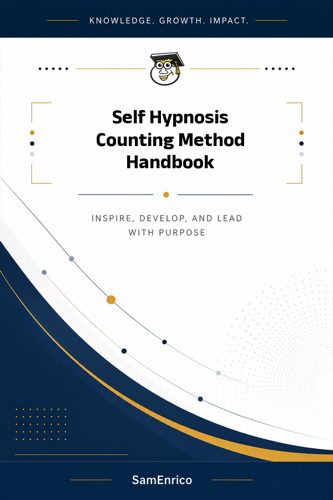
Self Hypnosis Counting Method Handbook eBook
Teaches descending count inductions from 100 to 1
by Allan Quinn
Teaches descending count inductions from 100 to 1 with pacing variations.
Formats
Free sample
Chapter 1: The Overthinker's Prison--–- Rebecca, a 42-year-old software architect, had tried everything. Meditation apps that made her feel inadequate. Breathing exercises that lasted exactly as long as her patience. Therapy that gave her insight but not relief. Her mind was a machine that never powered down—analyzing, predicting, catastrophizing.
At 3:00 AM, three days before a major presentation, she lay awake reviewing every mistake she had made in the past decade. Her therapist had mentioned something called "self-hypnosis" almost as an afterthought. Rebecca scoffed. She couldn't even meditate for ninety seconds without her brain hijacking the attempt. How was she supposed to hypnotize herself?Three weeks later, Rebecca delivered that presentation without notes, without tremor, and without the beta-blocker she had depended on for seven years.
She didn't use a mantra, a visualization, or a mindfulness bell. She used a single tool: a descending count from 100 to 1. Not because she believed in magic, but because she finally understood something her meditation teachers had never told her: the conscious mind cannot focus on two things at once. And counting backward is the perfect weapon against thinking.This chapter will teach you why counting works when nothing else has. You will learn the three psychological mechanisms that make descending numbers uniquely effective for self-hypnosis.
You will discover why forward counting keeps you alert while backward counting drops you into trance. And you will perform your first induction before you finish reading—not because you're special, but because the method is designed to work whether you believe in it or not.The Fundamental Problem: You Cannot "Stop Thinking"Every relaxation method makes the same impossible demand: quiet your mind. Meditation instructs you to observe your thoughts without attachment—a skill that takes years to develop. Breathing exercises ask you to focus on the breath, but your thoughts simply talk over it. Positive affirmations require you to believe something you don't yet believe.
The underlying assumption is that you have voluntary control over your internal monologue. You do not.This is not a character flaw. It is a feature of how your brain evolved. The human mind is a prediction engine, constantly generating scenarios to keep you safe. That voice in your head that rehearses conversations, anticipates criticism, and replays old embarrassments is not your enemy.
It is your survival mechanism. The problem is that the mechanism never turns off because there is no evolutionary advantage to a quiet mind. A quiet ancestor was a dead ancestor.Self-hypnosis solves this problem not by fighting the internal monologue, but by occupying it. You do not need to silence your thoughts. You need to give them a job.
Counting from 100 to 1 is that job.Mechanism One: The Numbering Buffer Working memory—the part of your consciousness that holds and manipulates information in real time—has a severely limited capacity. Cognitive psychologists estimate that the average person can hold only four to seven discrete items in working memory at once. This is why you cannot remember a ten-digit phone number without repeating it, and why someone reciting a list of instructions while you're trying to focus makes you feel overwhelmed.When you recite a descending numerical sequence—"100, 99, 98, 97..."—you are filling your working memory with a simple, repetitive, low-demand task. The numbers require just enough cognitive resources to occupy the conscious mind, but not enough to require concentration. Your internal monologue cannot generate anxiety-provoking thoughts at the same time that it is processing a descending count, because both activities compete for the same limited working memory capacity.This is called the Numbering Buffer.
It is not a metaphor. It is a measurable cognitive phenomenon. Functional MRI studies of people performing sequential counting tasks show reduced activity in the default mode network—the brain system responsible for self-referential thinking, rumination, and mind-wandering. When you count, you literally turn down the volume on the part of your brain that generates anxiety.But the direction of the count matters enormously.Mechanism Two: The Sinkhole Effect Forward counting—1, 2, 3, 4—creates anticipation. Each number points to a higher number ahead.
The sequence implies progression, movement toward a goal, increasing alertness. This is why coaches use forward counting for motivation ("I'll give you ten seconds to finish") and why military cadence counts upward. Forward counting activates the brain's approach motivation system, associated with dopamine release and heightened arousal.Descending counting—100, 99, 98, 97—does the opposite. Each number points to a smaller number ahead. The sequence implies reduction, letting go, moving away from waking alertness.
Descending counts activate the parasympathetic nervous system, specifically through the vagus nerve, which slows heart rate and lowers blood pressure.This is the Sinkhole Effect. Each number is not just a step down; it is a permission slip to release a little more tension, a little more vigilance, a little more conscious control. The brain interprets the descending sequence as a signal that the environment is safe enough to downregulate arousal. You are not climbing toward a summit. You are sinking into a warm bath.Critically, the sinkhole effect does not require you to visualize anything.
The numbers themselves carry this directional meaning because your brain has spent a lifetime associating "down" with "less" and "up" with "more." This is why you say "turn the volume down" and "ramp up" production. The spatial metaphor is hardwired.Mechanism Three: Rhythmic Pacing The final mechanism is the most overlooked and the most powerful. Counting at a consistent rhythm—especially when synchronized with your breath—creates a neurological state called frequency following response. The brain has a natural tendency to synchronize its electrical activity to external rhythms. This is why drumming induces trance states in every indigenous culture on Earth, and why repetitive chanting produces altered states in religious traditions.When you count at a steady pace, approximately one number per second, your brain's theta waves (4-8 Hz, associated with deep relaxation and hypnagogic states) begin to entrain to the rhythm.
When you slow the count to one number every three seconds, your brain shifts toward delta waves (1-4 Hz, associated with sleep and deep trance). When you accelerate the count to two numbers per second, your brain moves toward alpha waves (8-12 Hz, associated with relaxed alertness and creative flow).This is Rhythmic Pacing—the deliberate synchronization between number recitation and physiological rhythm. Throughout this book, you will learn three pacing modes: Standard (one number per exhale), Extended (multiple breaths per number), and Rapid (one number per second). Each mode produces a different trance profile. But for your first induction, you will use Standard Pacing because it is the most forgiving and the easiest to learn.Forward vs.
Backward: Why Direction Changes Everything Let me be precise about a distinction that most self-hypnosis books blur. Both forward and descending counting can produce relaxation. But they produce different kinds of relaxation, and they work for different people in different contexts.Descending counting (100 to 1) optimizes for:Physical relaxation (muscle release, heaviness, sinking)Sleep induction (reducing arousal, increasing drowsiness)Body-focused therapeutic suggestions (pain relief, physical healing, progressive relaxation)Individuals who experience anxiety as physical tension Ascending counting (1 to 100) optimizes for:Mental relaxation (quieting rumination, reducing mental chatter)Creative flow states (expanding awareness, reducing inhibition)Mind-focused therapeutic suggestions (confidence, focus, cognitive reframing)Individuals who…
This is the end of the free sample. Get the eBook to keep going. Buy now
About this book
Details
- Author
- Allan Quinn
- Publisher
- SamEnrico
- Language
- English
- Genre
- Non-Fiction, Self-Help, Counting Inductions
- Released
- 2026-06-09
- Pages (approx.)
- 157
- Available as
- eBook, Audiobook

Read better in the ZLOADR app
Your eBooks on your phone or tablet. Sign in with your SamEnrico account and start reading.
More by Allan Quinn
 Chunking for Mind MappingAllan Quinn$11.99
 Fitness Breathing BasicsAllan Quinn$11.99
 The Anger White Flag ProtocolAllan Quinn$11.99
 Commute Interruption Reclaim GuideAllan Quinn$11.99
 The Sky Splitter: When the Gods FellAllan Quinn$11.99
 Beyond the Stars: The Untold Story of Asia's Space PioneersAllan Quinn$11.99
 Front Office AssistantAllan Quinn$11.99
 No Estimates Kanban for BasecampAllan Quinn$12.99
 Best AI Art Midjourney StylesAllan Quinn$12.99
 Understanding Endometrial Stromal SarcomaAllan Quinn$17.99
 How to Start a Precious Stone Cutting Business (Beginners Guide)Allan Quinn$11.99