
Non-FictionSelf-HelpEarly Career
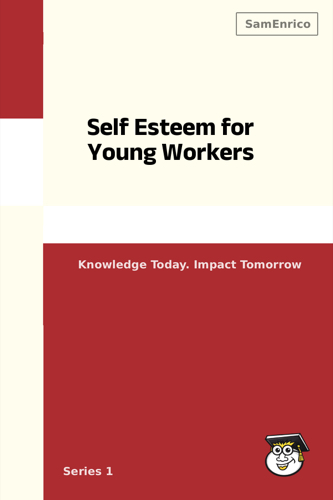
Self Esteem for Young Workers eBook
Build confidence in your first job using this prac
Build confidence in your first job using this practical early career workbook.
Formats
Free sample
Chapter 1: Your Feelings Don't Clock In--The first time a boss criticizes you, something happens in your body that feels like a small death.Your throat tightens. Your face flushes. The voice in your head—the one that sounded reasonable just minutes ago—starts screaming: You're going to be fired. Everyone thinks you're stupid. You should have stayed in school.
You're not cut out for this.If you are like most young workers, you have spent your entire life up to this point being told that your feelings matter. Your teachers asked how you felt about the assignment. Your parents validated your emotions. Your social media feed is a constant stream of people demanding that their feelings be seen, heard, and respected.Then you get a job. And suddenly, no one cares.The cash register does not care that you are having an anxious day.
The assembly line does not pause because you feel overwhelmed. The quarterly report does not include a section on your emotional state. Your boss, if they are honest, does not wake up wondering whether you feel confident enough to do your job.This is not cruelty. This is reality.And it is the single most important lesson you will learn about self-esteem in the workplace: Your feelings don't clock in.What does clock in? Your hands.
Your attention. Your consistency. Your ability to show up, do the task, learn from the mistake, and show up again tomorrow.This chapter is going to dismantle everything you thought you knew about confidence. It will hurt a little. That is normal.
But by the end, you will have something more valuable than a feeling of confidence. You will have a plan for earning it.The Participation Trophy Generation Let's be honest about how you were raised.If you are between sixteen and twenty-six years old, you grew up in an era of unprecedented emotional validation. Schools handed out participation trophies so no child would feel left out. Teachers were trained to praise effort over outcome. Parents were told that building self-esteem was the most important job of childhood, and that self-esteem came from telling children they were special, capable, and destined for greatness.This was not malicious.
It was well-intentioned. But it was also wrong.Psychologist Roy Baumeister, one of the world's leading researchers on self-esteem, reviewed hundreds of studies and found something surprising: High self-esteem does not cause good performance. Good performance causes high self-esteem. The causal arrow points the opposite direction from what most people assume.You do not feel confident and then succeed. You succeed (repeatedly, in small ways) and then confidence arrives as a byproduct.The participation trophy generation was trained to expect the opposite.
You were told that feeling good about yourself came first. That you needed to "believe in yourself" before you could achieve anything. That your feelings were the engine of your success.But here is the truth that no one told you: Feelings follow actions. Actions do not follow feelings.A young worker who waits to feel confident will wait forever. Confidence is not a light switch you flip on.
It is a receipt you earn after doing the thing you were afraid to do.The Painful But Liberating Truth Let me say this as clearly as possible: Your feelings do not matter to the cash register.That sounds harsh. I want you to sit with the harshness for a moment, because the harshness is where the freedom lives.If you work in retail, the customer does not care that you are shy. They care that you can find their size. If you work in food service, the hungry customer does not care that you are tired. They care that their order is correct.
If you work in an office, your manager does not care that you have imposter syndrome. They care that the spreadsheet is accurate and on time.This is not because the world is cruel. It is because the world runs on results.Cal Newport, a computer science professor turned productivity writer, made this argument forcefully in his book So Good They Can't Ignore You. Newport argues that "follow your passion" is terrible advice for most people. Passion, like confidence, is not something you discover before you start working.
Passion is something you build after you develop rare and valuable skills.The same logic applies to self-esteem. You do not discover self-esteem in your heart and then bring it to work. You build self-esteem at work, one small action at a time, and then you carry it home.This is liberating because it means you do not need to feel ready. You just need to act ready. And acting ready is something you can do right now, even if your hands are shaking and your voice is cracking.The Self-Esteem Trap Before we go further, we need to agree on what we are actually talking about.The word "self-esteem" has been used so loosely that it has almost lost its meaning.
Some people use it to mean "feeling good about yourself." Others use it to mean "not being depressed." Still others use it to mean "being confident in social situations."None of these definitions will help you at work.Here is the definition we will use throughout this book: Self-esteem is the evidence you have collected that you can trust yourself.Notice what this definition does not include. It does not include feelings. It does not include comparisons to other people. It does not include approval from your boss or your coworkers. It includes only one thing: evidence.Evidence is not a feeling.
Evidence is not an opinion. Evidence is a record of past behavior. When you promised yourself you would arrive five minutes early for five days in a row, and you did it, that is evidence. When you told yourself you would learn one new task per week, and you learned it, that is evidence. When you made a mistake, owned it, fixed it, and did not repeat it, that is evidence.Every piece of evidence is a brick.
Over time, bricks build a foundation. The foundation is self-esteem.This is why feelings-based self-esteem is so fragile. Feelings change. You wake up tired, and suddenly you do not feel confident. You get a piece of critical feedback, and suddenly you do not feel capable.
You compare yourself to a coworker who seems perfect, and suddenly you do not feel worthy.But evidence does not change. If you arrived on time yesterday, you arrived on time yesterday. That fact remains true regardless of how you feel this morning. If you learned the POS system last week, you learned the POS system last week. That skill remains in your possession regardless of whether your boss smiled at you today.Feelings-based self-esteem is a house built on sand.
Evidence-based self-esteem is a house built on stone.The Value Audit: Taking Stock of What You Actually Bring Most young workers have no idea what they actually contribute to their workplace. Ask them what they bring, and they will list vague personality traits: "I'm a hard worker." "I'm a nice person." "I'm a fast learner."These are not skills. These are aspirations dressed…
This is the end of the free sample. Get the eBook to keep going. Buy now
About this book
Details
- Author
- Waterman Deanne
- Publisher
- SamEnrico
- Language
- English
- Genre
- Non-Fiction, Self-Help, Early Career
- Released
- 2026-06-07
- Pages (approx.)
- 148
- Available as
- eBook, Audiobook

Read better in the ZLOADR app
Your eBooks on your phone or tablet. Sign in with your SamEnrico account and start reading.
More by Waterman Deanne
 Remote Work Insurance GuideWaterman Deanne$11.99
 Self Hypnosis for Menstrual CrampsWaterman Deanne$11.99
 Osborn Parnes CPS GuideWaterman Deanne$11.99
 Parental Anger at Foster ChildWaterman Deanne$11.99
 Mouth Covering SignalWaterman Deanne$11.99
 Small Talk for Sporting EventsWaterman Deanne$11.99
 User Testing and FeedbackWaterman Deanne$11.99
 The First Lady and the Monster: Argentina's Darkest SecretWaterman Deanne$11.99
 The Last Oracle of Delphi: When the Gods Spoke Through FireWaterman Deanne$11.99
 How to Produce Coffee FiltersWaterman Deanne$11.99
 Launching A Youtube Channel For Your Brand BreakthroughWaterman Deanne$12.99
 Italian Government ScholarshipsWaterman Deanne$12.99
You may also like
 Hong Kong Handover 1997Dunn Johnnie$11.99
 Zumba For Postnatal Recovery CourseNeal Christian$11.99
 Zumba for BeginnersLadner Nikia$11.99
 YouTube Comment Mining GuideHumes Pandora$12.99
 Worry Box MeditationCarlin Rudy$11.99
 Workplace Stress MeditationNguyen Lynn$11.99
 Workplace Stress and Sleep RepairHawley Ivory$11.99
 Workplace Perfectionism CureDelaney Jeffry$11.99
 Workplace Injustice Anger GuideWallen Isabelle$11.99
 Work Addiction and Burnout LinkGreenwood Ester$11.99
 Women in Yoga and WellnessBeattie Galina$11.99
 Women in Stand Up ComedyChun Evangeline$11.99