
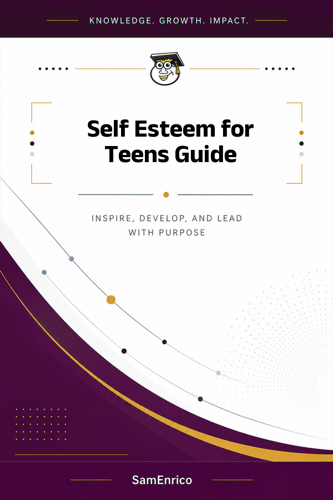
Self Esteem for Teens Guide eBook
Navigate puberty, peer pressure, and social media
by Cameron Hye
Navigate puberty, peer pressure, and social media comparison during adolescence.
Formats
Free sample
Chapter 1: Your Remodeling Brain--–- The first thing you need to know is that you are not falling apart. You are rebuilding. If you have ever felt like your emotions have a mind of their own, like you cry at a commercial one minute and snap at your best friend the next, like your body is doing things you didn't ask for and didn't expect, like you cannot focus on homework but can remember every embarrassing thing you said three years ago—you are not broken. You are not “too much.” You are not losing your mind. You are in the middle of the most radical biological renovation you will ever experience, and no one gave you the instruction manual.
This chapter is that manual.The word “puberty” probably makes you think of awkward school videos, parents clearing their throats, and a lot of euphemisms about “changes.” Forget all of that. We are going to call this what it actually is: Puberty 2.0. Not because it is the second version of anything, but because you are literally upgrading your hardware and your software at the same time. Your body is physically transforming. Your brain is rewiring itself.
And your sense of who you are—your identity, your values, your place in the world—is emerging from scratch. That is not a disaster. That is a renovation. And renovations are messy before they are beautiful.The Brain Under Construction Let us start with the part no one talks about: your brain. By the time you finish reading this chapter, you will understand why you feel the way you feel, and more importantly, you will stop blaming yourself for it.
Here is the science in plain language. Your brain has two major regions that matter for this conversation. The first is the limbic system, which is the emotional center. Think of it as the gas pedal. It feels everything intensely—excitement, fear, anger, joy, embarrassment, attraction, jealousy.
The second is the prefrontal cortex, which is the decision-making, impulse-control, planning-ahead part of your brain. Think of it as the brake pedal. It is the part that says, “Maybe do not text that,” “Let us think about this for a second,” and “That feeling will pass.”Here is the catch. Your limbic system (the gas pedal) is growing and strengthening rapidly during your teenage years. It is becoming more powerful than it has ever been or ever will be.
Your prefrontal cortex (the brake pedal) is also growing—but much more slowly. In fact, your prefrontal cortex will not be fully developed until you are around twenty-five years old. That means for the next several years, you are driving a car with a very powerful engine and very weak brakes. That is not a character flaw. That is biology.
Every single teenager in human history has gone through this. The ones who seem calm and put together are either very good at hiding it, have learned specific skills (which you will learn in this book), or are not being honest.This explains so much. It explains why you can know that you should not yell at your parent, but you yell anyway—your gas pedal floored it before your brakes could engage. It explains why a small comment from a friend can ruin your entire day—your limbic system feels rejection as if it were a physical injury (more on that in later chapters). It explains why you lie in bed at night replaying a conversation from three years ago and cringing—your brain is practicing social scenarios to keep you safe, even when that practice feels terrible.
It explains why you take risks that you know are dumb—your brain is literally wired to seek novelty and reward because it is trying to figure out the world. None of this is because you are weak or bad or lazy or dramatic. It is because you are under construction.Neural Pruning: Why You Feel Everything More There is another brain process happening right now that most adults do not even know about. It is called neural pruning. Imagine your brain as a garden.
When you were a child, your brain grew every possible pathway, like a garden full of weeds and flowers and grass and vines all growing in every direction. That was necessary for learning. You needed that chaos to absorb language, movement, social cues, and everything else. But now, as a teenager, your brain is doing something much more efficient: it is pruning. It is cutting away the connections you do not use and strengthening the ones you do use.
The old saying “neurons that fire together wire together” is real. Every time you practice guitar, the guitar pathways get stronger. Every time you scroll Tik Tok for three hours, the mindless-scrolling pathways get stronger. Every time you talk yourself out of something you are scared of, the avoidance pathways get stronger.This is incredible news. It means you have more power over your own brain than you think.
But it also explains why change feels hard. Your brain has spent years building certain pathways. Changing them is like hiking through a forest—it is easier to stay on the existing trail than to bushwhack a new one. But you can bushwhack. It just takes repeated effort.
That is what most of this book is about: helping you bushwhack new pathways toward self-esteem, confidence, and calm, instead of staying on the old trails toward anxiety, comparison, and self-doubt.Here is what neural pruning means for your daily life. The emotions you feel most often become stronger. If you spend a lot of time feeling anxious, your brain gets better at anxiety. If you spend a lot of time feeling angry, your brain gets better at anger. If you spend a lot of time feeling curious or calm or capable, your brain gets better at those states too.
This is not “positive thinking” nonsense. It is neuroplasticity—the scientific fact that your brain changes based on what you do repeatedly. The implication is both terrifying and liberating. Terrifying because if you are stuck in a cycle of negative emotions, your brain is literally wiring itself to stay there. Liberating because you can change it.
Not overnight. Not by wishing. But by small, consistent actions. That is what the rest of this book will teach you.Your Body Is Not a Report Card Now let us talk about the part you probably thought this chapter would be about: your body. The physical changes of puberty are impossible to ignore because they are happening to you, in your own skin, often in ways that feel humiliating or unfair.
Acne appears out of nowhere. Growth spurts make you feel like a puppet with tangled strings. Body hair shows up in places no one warned you about. Voices crack. Bodies change shape in ways that do not match what you see in magazines or on Instagram.
You might be developing earlier than everyone else, which makes you feel exposed. You might be developing later than everyone else, which makes you feel like a child. You might be developing in ways that do not match the gender you know…
This is the end of the free sample. Get the eBook to keep going. Buy now
About this book
Details
- Author
- Cameron Hye
- Publisher
- SamEnrico
- Language
- English
- Genre
- Non-Fiction, Self-Help
- Released
- 2026-06-10
- Pages (approx.)
- 141
- Available as
- eBook, Audiobook

Read better in the ZLOADR app
Your eBooks on your phone or tablet. Sign in with your SamEnrico account and start reading.
More by Cameron Hye
 Emotional Eating and TraumaCameron Hye$11.99
 Gary Oliva ConfessionCameron Hye$11.99
 Vaccine Exemption Laws GuideCameron Hye$11.99
 Self Hypnosis for Fear of ReincarnationCameron Hye$11.99
 James Monroe DoctrineCameron Hye$11.99
 The Ghanaian Founder Legal GuideCameron Hye$11.99
 Communication Strategies DeafnessCameron Hye$11.99
 The Maroon Navigators: The Untold Story of Africa's Master SeafarersCameron Hye$11.99
 How to Start a Cottonseed Growing Business (Beginners Guide)Cameron Hye$11.99
 How to Setup and Launch a Business DinnerCameron Hye$11.99
 How to Produce Foam InhibitorCameron Hye$11.99
 Climate Risk Insurance Claims Denial HandbookCameron Hye$12.99
You may also like
 Hong Kong Handover 1997Dunn Johnnie$11.99
 Zumba For Postnatal Recovery CourseNeal Christian$11.99
 Zumba for BeginnersLadner Nikia$11.99
 YouTube Comment Mining GuideHumes Pandora$12.99
 Worry Box MeditationCarlin Rudy$11.99
 Workplace Stress MeditationNguyen Lynn$11.99
 Workplace Stress and Sleep RepairHawley Ivory$11.99
 Workplace Perfectionism CureDelaney Jeffry$11.99
 Workplace Injustice Anger GuideWallen Isabelle$11.99
 Work Addiction and Burnout LinkGreenwood Ester$11.99
 Women in Yoga and WellnessBeattie Galina$11.99
 Women in Stand Up ComedyChun Evangeline$11.99