
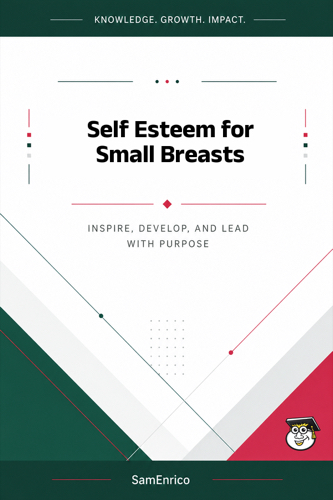
Self Esteem for Small Breasts eBook
Reject augmentation pressure and value your body w
Reject augmentation pressure and value your body without cleavage or size.
Formats
Free sample
Chapter 1: The Insecurity Factory...--Every year, four billion dollars change hands because millions of women look down at their own chests and see a problem that was never theirs to begin with.Let that number settle. Four billion. That is more than the GDP of more than a dozen countries. It is the kind of money that builds stadiums, funds presidential campaigns, or buys entire professional sports teams. And every single dollar of it comes from one simple, relentless transaction: a woman deciding that her body, as it is, is not enough.This chapter is not about convincing you that small breasts are beautiful.
It is not about listing celebrities who look great without curves. It is not about positive affirmations or learning to love what you see in the mirror. Those approaches have their place, but they arrive too late. They treat the symptom while the machinery of insecurity keeps running. Before you can learn to reject augmentation pressure, you need to understand where that pressure comes from.
Not vaguely. Not abstractly. Specifically. Chronologically. Ruthlessly.Welcome to the insecurity factory.
Let us walk through the assembly line together.The Fashion Cycle That Owns Your Body Here is a truth that sounds false until you see the receipts: breast size preferences have nothing to do with health, fertility, or universal attractiveness. They have everything to do with fashion cycles. And fashion cycles are not natural. They are invented, marketed, and discarded by industries that profit from your whiplash.In the 1920s, the ideal female body was flat. Flappers bound their breasts with bands of fabric to achieve a boyish, straight-up-and-down silhouette.
The word “small” was not an insult. It was the point. Women who had larger breasts wore minimizing garments not because they were ashamed but because the culture had decided, for that decade, that curves were out. Magazines celebrated the “flat-chested flapper” as modern, liberated, and fashionable.Then came the 1950s. Marilyn Monroe.
The hourglass. Sweater girls. Suddenly, breasts were not just acceptable—they were mandatory. The marketing machinery pivoted overnight. The same women who had been praised for being slim and flat were now told that their bodies were inadequate.
Enter the push-up bra. Enter the padded swimsuit. Enter the first wave of mass-market breast augmentation advertisements, which promised to “correct” what nature had “failed” to provide.The 1960s and 1970s? Thin was in again. Twiggy.
The waif. Small breasts returned to fashion, and women with larger chests complained of looking “matronly” or “heavy.” The 1980s brought power shoulders and athletic builds. The 1990s brought heroin chic. The 2000s brought the Victoria’s Secret bombshell, followed by the 2010s “fitness flat” look, followed by the 2020s return of exaggerated, augmented, “upper pole fullness” that looks nothing like natural breast tissue.Do you see the pattern? The ideal breast size has changed every ten to fifteen years.
Which means the ideal breast size is not an ideal at all. It is a trend. And trends are not truths. They are instructions designed to expire so that new instructions can be sold.This is the first and most important thing to understand: your body is not the problem. The problem is that you have been born into a culture that requires your insecurity to keep its economy running.
If everyone woke up tomorrow perfectly content with their natural breast size, the four-billion-dollar augmentation industry would collapse. So they cannot let that happen. They must manufacture dissatisfaction at the same rate that you might naturally develop self-acceptance. It is a race, and they have been running it for over a century.The Language of Lack: How Words Become Surgery Open any breast augmentation advertisement. Read the language carefully.
You will notice a pattern of words that do one specific thing: they frame small breasts as a problem in need of correction.“Augmentation.” From the Latin augere, meaning to increase or make greater. The word implies that something is currently insufficient. You do not augment a full glass. You do not augment a completed task. You augment what is lacking.
By calling the procedure “breast augmentation,” the industry has already won half the battle. They have defined small breasts as incomplete by default.“Enhancement.” Even softer, even more insidious. To enhance is to add value, to improve, to make better. But better than what? Better than your natural body.
The message is clear: your original body is the baseline, and the baseline is not good enough. Enhancement is not presented as optional decoration. It is presented as an upgrade, like moving from a standard hotel room to a suite. But your body is not a hotel room. You do not need to upgrade it to be comfortable.“Restoration.” This one appears more often than you might think, especially in marketing aimed at post-pregnancy or post-weight-loss patients.
The implication is that your breasts used to be something—fuller, higher, better—and now they have fallen from that state. Restoration promises to return you to a previous version of yourself. But that previous version was also judged. And before that, another version. There is no final destination where the judgment stops.“Correction.” The most blatant of all.
Correction implies an error. A mistake. Something that went wrong during development. But small breasts are not a developmental error. They are a normal human variation.
Approximately twenty to thirty percent of adult women have what the medical literature calls “hypoplasia” or “underdevelopment”—clinical terms for breasts that fall below some statistical average. Notice that we do not call tall people “overdeveloped” or people with size six feet “underdeveloped.” We only pathologize features that can be surgically altered for profit.The language is not accidental. It has been tested, focus-grouped, and optimized over decades. Every word is chosen to make you feel that your natural body is a draft version, and surgery is the final edit.The Four-Billion-Dollar Question Who spends four billion dollars a year on breast augmentation? The easy answer is women.
The more accurate answer is insecurity—packaged, marketed, and sold back to women at a massive markup.The breast implant industry is not a monolith. It is a web of manufacturers (Allergan, Mentor, Sientra), surgeons (who make between three thousand and twelve thousand dollars per procedure), marketers (who create the ads you see on Instagram and in women’s magazines), and financiers (who fund research into “better” implants that will require replacement every ten to fifteen years, guaranteeing repeat customers).This is not a conspiracy. It is capitalism. And capitalism does not need villains to operate. It only needs incentives.
The incentive here is simple: a woman who gets breast implants at twenty-five will likely need revision surgery by forty. That is fifteen more years of imaging, follow-ups, anxiety, and potentially explant surgery. Each step generates revenue. The industry is not designed to solve your insecurity. It is designed to monetize it indefinitely.Here is what the brochures do not tell you.
Breast implants are not lifetime devices. The FDA recommends monitoring for rupture every two to three years via MRI, which costs between one thousand and three thousand dollars per scan. Saline implants deflate. Silicone implants can rupture silently, leaking into surrounding…
This is the end of the free sample. Get the eBook to keep going. Buy now
About this book
Details
- Author
- Burley Julianna
- Publisher
- SamEnrico
- Language
- English
- Genre
- Non-Fiction, Self-Help
- Released
- 2026-06-08
- Pages (approx.)
- 102
- Available as
- eBook, Audiobook

Read better in the ZLOADR app
Your eBooks on your phone or tablet. Sign in with your SamEnrico account and start reading.
More by Burley Julianna
 Divorce Legal GriefBurley Julianna$11.99
 TIPP Skill Crisis SurvivalBurley Julianna$11.99
 Authority Influence MethodBurley Julianna$11.99
 Financial Freedom From TobaccoBurley Julianna$11.99
 Proptech Capital StrategyBurley Julianna$11.99
 Pauling Caltech YearsBurley Julianna$11.99
 Nightmares Every NightBurley Julianna$11.99
 Charlie Chaplin: The Tramp Who Conquered the WorldBurley Julianna$11.99
 The Code of the Cosmos: Archimedes and the Birth of Mathematical ReasonBurley Julianna$11.99
 How to Setup and Launch an Information Session/fairBurley Julianna$11.99
 How to Produce Food ColoringBurley Julianna$11.99
 VAT Deregistration Guide UKBurley Julianna$12.99
You may also like
 Hong Kong Handover 1997Dunn Johnnie$11.99
 Zumba For Postnatal Recovery CourseNeal Christian$11.99
 Zumba for BeginnersLadner Nikia$11.99
 YouTube Comment Mining GuideHumes Pandora$12.99
 Worry Box MeditationCarlin Rudy$11.99
 Workplace Stress MeditationNguyen Lynn$11.99
 Workplace Stress and Sleep RepairHawley Ivory$11.99
 Workplace Perfectionism CureDelaney Jeffry$11.99
 Workplace Injustice Anger GuideWallen Isabelle$11.99
 Work Addiction and Burnout LinkGreenwood Ester$11.99
 Women in Yoga and WellnessBeattie Galina$11.99
 Women in Stand Up ComedyChun Evangeline$11.99