
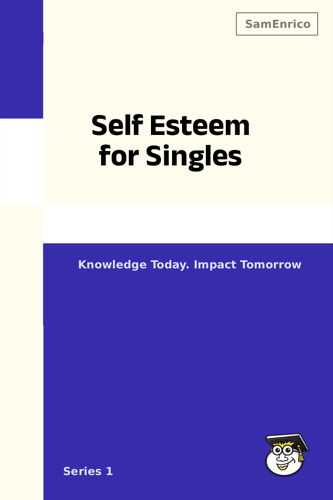
Non-FictionSelf-HelpDating Confidence
Self Esteem for Singles eBook
Maintain worth while dating and facing rejection o
by Seward Loma
Maintain worth while dating and facing rejection or dry spells.
Formats
Free sample
Chapter 1: The Status Trap--It begins with a notification.A ping, a buzz, a little red number on an icon. You pick up your phone, heart already accelerating in that specific way that feels suspiciously like hope but is actually something closer to desperation. Someone has matched with you. Someone has liked you. Someone has chosen you, or at least swiped right on you, which in the currency of modern dating feels like the same thing.
For a moment—one glorious, chemically saturated moment—you feel lighter. Validated. Visible. Worthy.Then, a few hours or days later, another notification, or rather the absence of one. They didn't respond to your message.
Or they unmatched you without explanation. Or the conversation trailed off into the graveyard of opened but unanswered texts. And that same chemical system that lit up with possibility now floods you with something else: shame, self-doubt, the quiet whisper that says maybe you weren't enough after all.This book is about why that ping has so much power over you. And more importantly, how to take that power back.The Unspoken Agreement You Didn't Know You Signed Let me tell you something that might feel uncomfortable: you have been trained to believe that being chosen by a romantic partner is the ultimate validation of your existence. This training started long before you downloaded your first dating app.
It began with fairy tales where the princess's story ended at the altar. It continued through every movie where the protagonist's happiness was measured by their romantic pairing. It was reinforced by family members who asked, "So, are you seeing anyone?" with the same hopeful tone they might use to ask about a terminal illness going into remission.And now it lives in your phone.The cultural narrative is so pervasive, so deeply embedded, that most of us don't even notice it anymore. We just feel it—as anxiety before a first date, as relief when someone texts back, as despair when a situationship ends ambiguously, as a low-grade sense of failure during dry spells that stretch into months. The message is always the same: your worth is contingent on your desirability.
If someone wants you, you matter. If no one wants you, you don't.This chapter is going to dismantle that message, piece by piece. But first, we need to understand how deeply it runs—and why your brain believes it even when your rational mind knows better.The Evolutionary Backstory: Why Rejection Literally Hurts There is a reason rejection feels like physical pain, and it is not because you are dramatic or weak. Neuroscientific research has shown that the same brain regions activated by physical pain—specifically the dorsal anterior cingulate cortex and the anterior insula—are also activated by social rejection. In one landmark study, participants who viewed photos of an ex-partner while recalling a breakup showed neural activity indistinguishable from someone experiencing a mild burn or a bruise.Evolutionarily, this makes perfect sense.
For the vast majority of human history, being ostracized from your tribe was a death sentence. No tribe meant no protection, no food sharing, no mating opportunities, no survival. Your brain evolved to interpret social rejection as an existential threat because, for your ancestors, it literally was. The same neural circuitry that kept early humans alive by making them desperate for belonging is now being activated by a stranger who stopped responding to your text message.Let me pause here to let that sink in. Your brain cannot reliably distinguish between being exiled from your hunter-gatherer tribe and being ghosted by someone you met on Hinge three days ago.
The response is the same: panic, vigilance, self-doubt, and a desperate urge to restore connection at almost any cost.This is not a character flaw. This is biology. But biology is not destiny. Understanding why you feel the way you do is the first step toward not being controlled by it.Two Kinds of Worth: The Distinction That Changes Everything Here is the single most important concept in this entire book, and I want you to return to it whenever you feel your self-esteem collapsing under the weight of dating disappointment.There are two kinds of worth.The first is felt worth. This is the stable, internally generated sense that you have value simply because you exist.
Not because of your job, your appearance, your relationship status, or how many people swiped right on you. Felt worth is not earned, achieved, or proven. It is recognized. It is the quiet knowing that you matter because you are a conscious, feeling, striving human being, and that is enough.The second is contingent worth. This is self-esteem that rises and falls based on external events.
A match gives you a spike of contingent worth. A date goes well—another spike. You get ghosted—a crash. You scroll through Instagram and see three engagement announcements in a row—another crash. Contingent worth is a roller coaster, and it is exhausting because you are constantly outsourcing your sense of value to things you cannot control.Most people live most of their lives in contingent worth.
They do not know there is another option. And the dating world, more than almost any other arena of modern life, is designed to keep you trapped there.Here is what I need you to understand: contingent worth is not evil. It is not a sin to feel good when someone likes you. The problem is not the presence of contingent worth; the problem is the absence of felt worth. When you have no stable foundation of internal value, every external event becomes an earthquake.
A match feels like salvation. A ghosting feels like annihilation. You are not looking for a partner; you are looking for proof that you are not worthless.That is an impossible burden to place on another human being. And it is an impossible way to live.The Feedback Loop: How Validation Becomes Addiction Now let us talk about your phone again, because your phone is not a neutral actor in this drama. Dating apps are designed by extremely smart people who understand exactly how your brain works, and they have engineered their products to exploit your vulnerability to contingent worth.The key concept here is intermittent reinforcement.
In psychological terms, intermittent reinforcement occurs when a reward is delivered unpredictably rather than consistently. Slot machines use intermittent reinforcement: you pull the lever, and sometimes you win, but you never know when. That unpredictability makes the behavior nearly impossible to extinguish because the possibility of a reward is always there, just around the corner.Dating apps use the same mechanism. You swipe, and sometimes you match. You message, and sometimes they respond.
You go on a date, and sometimes it leads to something. The rewards are unpredictable, which means your brain stays in a state of perpetual anticipation, dopamine spiking not only when you receive a reward but when you are anticipating a possible reward.This creates what I call the feedback loop:You feel a low-grade sense of anxiety or emptiness (the baseline)You check the app (the behavior)Maybe you get a match or a message (the potential reward)Your dopamine spikes and you feel…
This is the end of the free sample. Get the eBook to keep going. Buy now
About this book
Details
- Author
- Seward Loma
- Publisher
- SamEnrico
- Language
- English
- Genre
- Non-Fiction, Self-Help, Dating Confidence
- Released
- 2026-06-09
- Pages (approx.)
- 125
- Available as
- eBook, Audiobook

Read better in the ZLOADR app
Your eBooks on your phone or tablet. Sign in with your SamEnrico account and start reading.
More by Seward Loma
 LAPD Black Dahlia FilesSeward Loma$11.99
 Carla Fracci GiselleSeward Loma$11.99
 Flirting Nonverbal Cues GuideSeward Loma$11.99
 The Iron Will of Zheng He: The Siege of Malacca and the Birth of a Naval EmpireSeward Loma$11.99
 Instagram Aesthetic HomeSeward Loma$12.99
 MTS Software EngineerSeward Loma$11.99
 How to Produce BeetsSeward Loma$11.99
 10 Ways to Use Golden Syrup (Recipe Book)Seward Loma$11.99
You may also like
 Hong Kong Handover 1997Dunn Johnnie$11.99
 Zumba For Postnatal Recovery CourseNeal Christian$11.99
 Zumba for BeginnersLadner Nikia$11.99
 YouTube Comment Mining GuideHumes Pandora$12.99
 Worry Box MeditationCarlin Rudy$11.99
 Workplace Stress MeditationNguyen Lynn$11.99
 Workplace Stress and Sleep RepairHawley Ivory$11.99
 Workplace Perfectionism CureDelaney Jeffry$11.99
 Workplace Injustice Anger GuideWallen Isabelle$11.99
 Work Addiction and Burnout LinkGreenwood Ester$11.99
 Women in Yoga and WellnessBeattie Galina$11.99
 Women in Stand Up ComedyChun Evangeline$11.99