
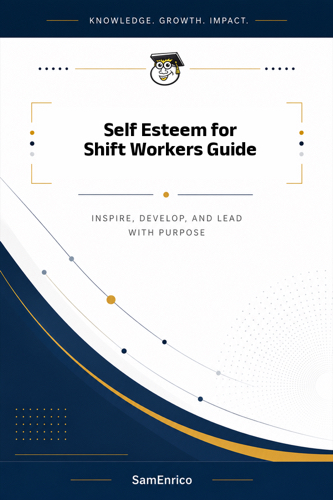
Self Esteem for Shift Workers Guide eBook
Maintain confidence when working non-traditional h
Maintain confidence when working non-traditional hours with less visibility.
Formats
Free sample
Chapter 1: The Unseen Scale--Every shift worker knows the moment. It comes quietly, often in the hours between midnight and dawn, when the rest of the world has withdrawn into sleep and you are left alone with the hum of machines, the glow of monitors, or the echo of empty hallways. The moment arrives not as a dramatic revelation but as a slow, sinking feeling that settles into your chest like cold water. You look around. No one else is there.
You think about what you have done tonight—the problems solved, the emergencies prevented, the quiet diligence of keeping things running—and you wonder if any of it matters.Not because the work itself is unimportant. You know it is important. You have seen what happens when things go wrong. You have cleaned up the messes left by inattention, caught the errors that would have become disasters, stabilized the situations that would have spiraled out of control. You know your work has value.
The question that haunts you is different. The question is whether anyone else knows.This is the Unseen Scale. It is the invisible metric by which shift workers are measured, judged, and too often dismissed. Unlike day workers, whose contributions are witnessed in real time, shift workers operate on a scale that no one watches. The scale tips when you prevent a problem, but because the problem never occurs, there is no evidence of your intervention.
The scale tips when you catch an error, but because the error is corrected before it spreads, there is no record of your catch. The scale tips when you hold things steady through the vulnerable hours, but because nothing dramatic happens, your steadiness is mistaken for the absence of danger rather than the active prevention of it.The Unseen Scale is not fair, but it is real. It is the reason shift workers everywhere struggle with self-esteem despite being competent, skilled, and often exceptional at their jobs. It is the reason you can finish a shift knowing you did good work and still feel hollow. It is the reason confidence erodes not in a single catastrophic failure but in the slow drip of a thousand unseen successes.This chapter is about understanding the Unseen Scale: how it works, why it harms you, and what you can do today to begin recalibrating it.
Because the truth is that the scale is not broken. It was never designed for shift workers in the first place. And when you understand that, you can stop measuring yourself by a tool that was built to make you invisible.The Architecture of Invisibility To understand why shift workers lose confidence, you must first understand how visibility works in most organizations. Visibility is not a natural phenomenon. It is an architectural feature of the workplace.
And like any architectural feature, it can be redesigned.In a traditional day-shift workplace, visibility is built into the schedule. When a day worker completes a task, there are witnesses. The witnesses may be managers, colleagues, subordinates, or even clients. But someone sees the work being done. That someone may offer a nod of acknowledgment, a thank-you, a comment in a meeting, or simply the silent awareness that the work happened.
These small moments of recognition are not random. They are structural. They happen because the schedule puts people together.The day worker does not have to ask for this recognition. It arrives spontaneously. A manager walking by sees a spreadsheet being completed.
A colleague overhears a difficult phone call being handled gracefully. A subordinate observes a problem being solved efficiently. These moments are not the result of self-promotion. They are the result of simple co-location. The day worker is present, so their work is witnessed.The shift worker, by definition, is not present when most other people are present.
This is not a choice. It is the job. But the consequence is that the shift worker's work is almost never witnessed spontaneously. There is no manager walking by at 2 AM. There are no colleagues overhearing a difficult call at 4 AM.
There are no subordinates observing a problem being solved at 5 AM. The shift worker works in a vacuum of witnesses.This vacuum has psychological consequences. The human brain is wired to treat unwitnessed events as less real than witnessed ones. This is not a flaw in shift workers. It is a feature of human cognition.
When an event is witnessed, the brain encodes it more deeply because social context signals importance. When an event is unwitnessed, the brain treats it as less significant, even when the event itself is highly significant.Consider a simple experiment. Imagine two scenarios. In the first, you solve a complex puzzle while a friend watches. In the second, you solve the same complex puzzle alone.
Which solution feels more real to you? For most people, the witnessed solution feels more substantial. The presence of a witness validates the effort. The unwitnessed solution, no matter how elegant, feels somehow less weighty.This is the architecture of invisibility. It is not that shift workers are doing less important work.
It is that their work is being processed by a brain that was designed to weight witnessed events more heavily. The result is a slow, steady erosion of confidence. Each unwitnessed success feels slightly less real than the last. Over months and years, the shift worker begins to doubt whether their work matters at all.The Three Faces of the Unseen Scale The Unseen Scale operates through three distinct mechanisms. Understanding each one is essential to dismantling them.First, the Problem That Never Happened.
This is the most common form of invisible work. A shift worker identifies a potential issue and resolves it before it becomes an actual problem. Because the problem never materializes, there is no record of it. The organization experiences a smooth morning, a trouble-free handover, a day without incident. No one knows that a crisis was averted because no crisis occurred.
The shift worker knows, but their knowledge is private. The organization's records show nothing.This mechanism is particularly damaging because the shift worker's success is measured by the absence of evidence. If you prevent a fire, there is no fire to point to. If you catch an error, there is no error to document. If you stabilize a patient before they crash, there is no crash to analyze.
Your success becomes invisible precisely because you succeeded.Second, the Handover That Erases You. This is the moment when shift work meets day work. The shift worker completes their shift and hands over to a day worker. The handover is efficient. The shift worker communicates what happened, what was resolved, what remains to be done.
Then they leave. The day worker takes over. Over the course of the day, the day worker implements the shift worker's solutions, builds on their work, and receives credit for outcomes that were set in motion hours earlier.This mechanism is not malicious. Day workers are not stealing credit. They simply cannot distinguish between problems they solved and problems that were already solved when they arrived.
From their perspective, they arrived to a stable situation and continued the work. From the organization's perspective, the day worker…
This is the end of the free sample. Get the eBook to keep going. Buy now
About this book
Details
- Author
- Tanner Tomiko
- Publisher
- SamEnrico
- Language
- English
- Genre
- Non-Fiction, Self-Help, Shift Work
- Released
- 2026-06-07
- Pages (approx.)
- 133
- Available as
- eBook, Audiobook

Read better in the ZLOADR app
Your eBooks on your phone or tablet. Sign in with your SamEnrico account and start reading.
More by Tanner Tomiko
 Teamster Pension Fund Looting After HoffaTanner Tomiko$11.99
 Burnout Prevention For Single ParentsTanner Tomiko$11.99
 Yemen War WhistleblowerTanner Tomiko$11.99
 Steemit Rewards Comparison TrapTanner Tomiko$11.99
 OKR Software GuideTanner Tomiko$11.99
 Inflation Financial StressTanner Tomiko$11.99
 Walking Program GuideTanner Tomiko$11.99
 The Poisonous Partnership: Canada's Deadly Victorian CoupleTanner Tomiko$11.99
 The Ghosts of Cambrai: The Birth of Blitzkrieg and the Haunted Tanks of 1917Tanner Tomiko$11.99
 How to Produce Rubber Processing MachineryTanner Tomiko$11.99
 Growing Brahea (Hesper Palm)Tanner Tomiko$11.99
 A Collector's Handbook to the Rover 105sTanner Tomiko$11.99
You may also like
 Self Esteem for Night Shift WorkersStaley Norberto$11.99
 Scheduling for Shift WorkersAshmore Fae$11.99
 Binge Eating For Shift Workers GuideStinnett Jordan$11.99
 Mindfulness for Beginner Shift WorkersStevenson Shari$11.99
 Meditation for Shift Work SleepMinton Vinnie$11.99
 Mindfulness for Night Shift WorkersPinkerton Digna$11.99
 The Shift Work Memory Recovery GuideNewman Hattie$11.99
 Shift Worker Sleep RescueJordan Douglas$11.99
 Shift Worker Sleep MeditationBroussard Maynard$11.99
 Shift Worker Sleep GuideMeyer Marco$11.99
 Shift Worker Memory GuideGriffiths Mariam$11.99
 Shift Work Memory GuideVines Coleen$11.99