
Non-FictionSelf-HelpRemote Work
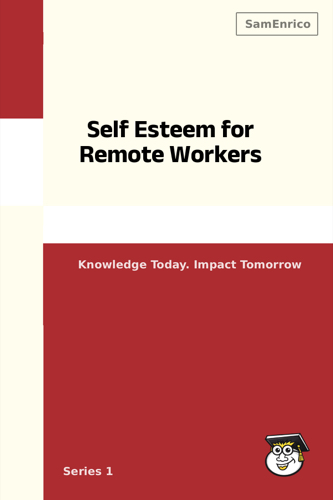
Self Esteem for Remote Workers eBook
Stay confident when working from home without dail
Stay confident when working from home without daily feedback using this practical guide.
Formats
Free sample
Chapter 1: The Quiet Crisis--–- The email had been sitting in my inbox for forty-seven minutes. I know the exact number because I had refreshed the page nineteen times. Each refresh, the same gray void where a reply should have been. My heart rate had climbed from a resting sixty-two to a nervous eighty-eight. My palms were damp.
And I was not waiting for news about a job offer, a medical diagnosis, or anything remotely urgent. I was waiting for a manager to say “looks good” on a routine status update.That was the moment I realized something had gone very wrong. Not with my work—the work was fine. Not with my manager—she was responsive and fair. Something had gone wrong with me.
I had become addicted to a drug called external validation, and the supply had run dry. In an office, that drug had been everywhere: the nod from a colleague, the quick “nice job” in the hallway, the spontaneous check-in from a leader who could see me working. I had not realized how dependent I was until I started working from home and the drip feed of reassurance stopped. What replaced it was silence. And silence, I discovered, is the most dangerous sound in remote work.This book is about that silence.
It is about what happens to your self-esteem when you work from home without the daily feedback that once propped you up. It is about the creeping doubt that arrives not because you are failing, but because you have no information at all. And it is about building a new kind of confidence—one that does not depend on anyone else’s applause, reply, or even acknowledgment.I wrote this book because I have watched too many brilliant, capable people crumble under the weight of nothing. No criticism. No complaints.
Just absence. And I have learned that the antidote is not to demand more feedback from your manager or to work harder until someone notices. The antidote is to build an internal system that generates confidence from the inside out. That is what these chapters will give you.But first, we must understand the enemy. We must name what is happening to you when you check Slack for the tenth time in an hour.
We must see the mechanism behind the quiet erosion of your professional self-worth. And we must begin the process of separating who you are from what you produce—a separation that remote work has made both necessary and possible.The First Crack Let me tell you about Sarah. (Not her real name, but her story is true.) Sarah was a senior marketing manager at a midsize tech company. She had been with the firm for six years, had received four promotions, and had never once received a negative performance review. In the office, she was known as calm, competent, unflappable.
Then the company went fully remote.For the first three months, Sarah thrived. She loved the quiet, the focus, the lack of commute. But around month four, something shifted. Her manager, who used to stop by her desk twice a day, now communicated almost entirely through Slack and weekly video calls. The casual affirmations disappeared.
The hallway conversations stopped. Sarah began to notice that she was checking her messages more often. She started to wonder if her work was still meeting expectations. No one had said anything negative—but no one had said anything positive either.By month six, Sarah was a wreck. She was staying online until 8 PM, hoping to catch her manager’s attention.
She was rewriting emails three times before sending them. She had started to believe that she was about to be fired, despite no evidence whatsoever. When she finally asked her manager for feedback, the manager looked confused. “You’re doing great,” she said. “Why wouldn’t you be?” Sarah burst into tears.Sarah was not weak.
She was not needy. She was a high-performing professional whose brain had been hijacked by a biological reflex she did not understand. And until someone explained to her what the feedback void was—until she learned to build internal sources of confidence—she would continue to suffer even as her manager assured her everything was fine.Sarah’s story is not unusual. In fact, it is so common among remote workers that it has its own name among organizational psychologists: evaluation deprivation. And understanding this concept is the first step toward reclaiming your confidence.Evaluation Deprivation: The Hidden Epidemic In the 1970s, psychologist David Rosenfeld conducted a series of experiments that should be required reading for anyone managing remote teams.
He asked participants to perform a task and then gave them one of three things: positive feedback, negative feedback, or no feedback at all. You might expect that negative feedback would be the most demoralizing. You would be wrong. The people who received no feedback reported the lowest self-evaluations, the highest anxiety, and the greatest sense of uncertainty about their abilities. Silence was worse than criticism.Why?
Because the human brain is not designed for ambiguity. From an evolutionary perspective, no signal is a dangerous signal. If you are part of a tribe and the tribe falls silent, it could mean you have been excluded. Exclusion from the tribe meant death for your ancestors. So your brain developed a simple rule: when in doubt, assume the worst.
Prepare for rejection. Scan for threats. This rule kept your ancestors alive on the savanna. It is ruining your remote work experience.Consider what happens in a typical remote workday. You send a thoughtful email to your manager.
No reply. You post a well-researched document in a shared channel. No reactions. You finish a task that would have earned a “good job” in the office. Silence.
Your brain, following its ancient script, does not think, “They are busy.” It thinks, “They are ignoring me because my work is inadequate.” This is not a rational assessment. It is a biological reflex. And the more silence accumulates, the stronger the reflex becomes.This is evaluation deprivation: the gap between your need for input and the reality of remote communication. The gap is not small. Research from Tsedal Neeley’s Remote Work Revolution found that remote employees receive approximately one-third the amount of informal feedback as their in-office counterparts.
That is not a minor difference. That is a starvation diet for the professional ego.But here is what most books and articles get wrong. They assume the solution is to ask for more feedback. And yes, we will discuss how to request structured input effectively in Chapter 7. But if your confidence depends on feedback—even feedback you request—you are still dependent.
The goal is not to become a better beggar for validation. The goal is to build a source of confidence that does not require anyone else to give you anything.Two Kinds of Feedback: Performance vs. Identity Before we go further, we must make a critical distinction. Not all feedback is created equal. In fact, confusing two very different types of feedback is one of the primary ways remote workers sabotage their own confidence.The first type is performance feedback.
This is specific, task-related, and actionable. Examples include: “Your introduction was clear, but the data table needs a summary row,”…
This is the end of the free sample. Get the eBook to keep going. Buy now
About this book
Details
- Author
- Burleson Reanna
- Publisher
- SamEnrico
- Language
- English
- Genre
- Non-Fiction, Self-Help, Remote Work
- Released
- 2026-06-08
- Pages (approx.)
- 138
- Available as
- eBook, Audiobook

Read better in the ZLOADR app
Your eBooks on your phone or tablet. Sign in with your SamEnrico account and start reading.
More by Burleson Reanna
 Remote Work Desk SetupBurleson Reanna$11.99
 Mexico Probation Period RulesBurleson Reanna$11.99
 Ellis Island Medal MomentBurleson Reanna$11.99
 Anger at Childs Job ChoiceBurleson Reanna$11.99
 Introvert Friendly BrainstormingBurleson Reanna$11.99
 Conversation Starters for Virtual CallsBurleson Reanna$11.99
 Design Thinking for ParentsBurleson Reanna$11.99
 The First Voice of the East: Japan's 18th-Century Storyteller RevolutionBurleson Reanna$11.99
 The Bloodstained Ledger: Canada's First Forensic ImpeachmentBurleson Reanna$11.99
 How to Produce Coffee and Tea SetsBurleson Reanna$11.99
 Launching A Youtube Channel For Your Brand BootcampBurleson Reanna$12.99
 Canadian Scholarship Africa GuideBurleson Reanna$12.99
You may also like
 Hong Kong Handover 1997Dunn Johnnie$11.99
 Zumba For Postnatal Recovery CourseNeal Christian$11.99
 Zumba for BeginnersLadner Nikia$11.99
 YouTube Comment Mining GuideHumes Pandora$12.99
 Worry Box MeditationCarlin Rudy$11.99
 Workplace Stress MeditationNguyen Lynn$11.99
 Workplace Stress and Sleep RepairHawley Ivory$11.99
 Workplace Perfectionism CureDelaney Jeffry$11.99
 Workplace Injustice Anger GuideWallen Isabelle$11.99
 Work Addiction and Burnout LinkGreenwood Ester$11.99
 Women in Yoga and WellnessBeattie Galina$11.99
 Women in Stand Up ComedyChun Evangeline$11.99