
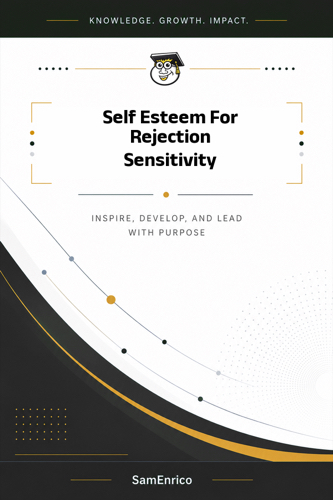
Non-FictionSelf-HelpRejection Sensitivity
Self Esteem For Rejection Sensitivity eBook
Reduce fear of partner rejection by building rejec
Reduce fear of partner rejection by building rejection proof self worth.
Formats
Free sample
Chapter 1: The Three Doors--–- You are standing in a hallway. There are three doors in front of you, and you have no idea which one to open. Behind one door is nothing at all—a false alarm, a sound you mistook for footsteps. Behind the second door is a temporary withdrawal, someone you love who has stepped back to breathe but intends to return. Behind the third door is an ending—a goodbye that will rearrange your life.
Your heart is pounding because you cannot tell which door is which, so you assume the worst behind every single one. This is what it feels like to live with rejection sensitivity.If you picked up this book, you already know this hallway. You have stood there hundreds of times: phone in hand, staring at a text message that says only "Okay." A partner who sighs and turns away in bed. A silence that stretches from one hour into three. A canceled plan.
A distracted "I love you" tossed over a shoulder. Every single one of these moments feels like the beginning of the end. Your body does not know the difference between a minor misunderstanding and an actual abandonment. Your nervous system treats a delayed reply the same way it would treat being left at the altar.This chapter will give you something you have never had before: a reliable way to tell which door to open. You will learn the single most important skill for anyone with rejection sensitivity—how to classify what is actually happening before you react to what you fear is happening.
By the end of this chapter, you will no longer treat every bump in the night like a home invasion. You will have a decision tree, a set of questions, and a new relationship with your own alarm system. And you will understand something that the rest of this book will build on: most of your worst moments of rejection fear are not rejections at all. They are false alarms. But the ones that are real—those require a completely different response.
The tragedy of rejection sensitivity is that you use the same panic response for everything. This chapter is where that stops.The Cost of Not Knowing Which Door to Open Let me describe a Tuesday. You send your partner a text at 10:15 AM. Nothing urgent—just a funny observation or a plan for the weekend. By 12:30 PM, they have not responded.
You check your phone seventeen times. By 1:00 PM, you have constructed a narrative. They are angry about something you said last night. They are pulling away because you have been too needy. They have decided to end things and are too cowardly to say it directly.
By 2:00 PM, you have drafted four follow-up texts, deleted all of them, and started crying at your desk. By 3:00 PM, they respond: "Sorry, crazy day. Love you." And just like that, the catastrophe dissolves. You were never in danger. You spent five hours in hell for nothing.Now let me describe a different Tuesday.
Your partner has been distant for two weeks. They come home late, eat in silence, fall asleep facing the wall. You ask if something is wrong. They say "I'm fine" in a tone that means the opposite. You chase.
You ask again. You try to fix. You offer to change. Nothing works. Eventually, they sit you down and say they need space—or worse, they say it is over.
That was a real withdrawal. And your response—the chasing, the pleading, the self-abandonment—made it worse, not better.Here is the painful truth that no one has ever told you: you cannot use the same strategy for both Tuesdays. The first Tuesday required you to calm your own nervous system and do nothing. The second Tuesday required you to change your behavior, lean back, and protect your own dignity. But because you cannot tell the difference, you either overreact to everything (exhausting yourself and your partner) or under-react to real problems (leaving yourself unprepared).
This chapter is your map. You are going to learn how to stand in that hallway and know, with reasonable accuracy, which door holds what.The Three Faces of Rejection Every experience of rejection fear falls into one of three categories. There is no fourth door. Memorize these three now, because the entire rest of this book is organized around them.Door Number One: The False Alarm. This is when no rejection has actually occurred.
Your partner sighed because they are tired, not because they are sick of you. They took forty-five minutes to reply because they were in a meeting, not because they are ghosting you. Their tone was flat because they have a headache, not because they have fallen out of love. In false alarms, the threat exists entirely inside your interpretation. The observable event is neutral or ambiguous.
Your brain has taken harmless data and constructed a horror movie. Most of your RSD episodes—perhaps seventy to eighty percent—are false alarms. You are not broken for having them. Your brain is doing exactly what evolution designed it to do: prioritize social safety above all else. But it is misfiring, and you need to learn how to override the misfire.Door Number Two: Real Withdrawal.
This is when your partner is genuinely pulling back, but the relationship is not ending. They need space. They are stressed about work. They are processing something unrelated to you. They are temporarily less available, less warm, less present.
This is painful, but it is not abandonment. It is a normal rhythm of intimate relationships. No two people are equally available every single day. Real withdrawal requires a specific response: non-pursuit, self-soothing, and patience. The wrong response—chasing, demanding, protesting—will turn temporary withdrawal into permanent distance.
Most people with rejection sensitivity make this error constantly. They feel the real withdrawal, panic, chase, and create the very abandonment they feared.Door Number Three: Relationship End. This is a breakup, a separation, a clear and permanent goodbye. This is the door you fear most, and it is also the rarest. In healthy relationships, true endings happen infrequently.
But when they do happen, they require a survival protocol, not a negotiation. You cannot talk someone back into loving you. You cannot perform your way into their arms. The end of a relationship is a grief event, not a problem to solve. Most people with RSD waste months trying to solve an ending—sending desperate texts, showing up unannounced, bargaining for another chance.
This chapter and the ones that follow will give you a different path.Here is the most important thing I will tell you in this entire chapter. You do not need to know which door you are facing with one hundred percent certainty. You need to know with enough certainty to choose a response. The rest of the book will help you refine your accuracy. For now, you just need the framework.Why Your Brain Treats All Three Doors the Same Let me explain the biology behind your panic, because understanding the machinery will help you stop blaming yourself for a system you did not design.Your brain has a region called…
This is the end of the free sample. Get the eBook to keep going. Buy now
About this book
Details
- Author
- Mcculloch Zachery
- Publisher
- SamEnrico
- Language
- English
- Genre
- Non-Fiction, Self-Help, Rejection Sensitivity
- Released
- 2026-06-09
- Pages (approx.)
- 142
- Available as
- eBook, Audiobook

Read better in the ZLOADR app
Your eBooks on your phone or tablet. Sign in with your SamEnrico account and start reading.
More by Mcculloch Zachery
 Legacy Myths DebunkedMcculloch Zachery$11.99
 Dreams After Addicted Parent GuideMcculloch Zachery$11.99
 Daily Fantasy Sports AddictionMcculloch Zachery$11.99
 The Sky Weaver and the Earth Dancer: A Navajo Creation LoveMcculloch Zachery$11.99
 The Silent Waves: How Ancient Pacific Islanders Predicted Earthquakes (1400-1500s)Mcculloch Zachery$11.99
 Nutrition Support ClinicianMcculloch Zachery$11.99
 A Beginners Guide to Casting (Volume 1)Mcculloch Zachery$11.99
 International Student Rwanda WorkbookMcculloch Zachery$12.99
 E-Commerce Personalization OutlookMcculloch Zachery$12.99
 Understanding Hemolytic Anemia Lethal Genital AnomaliesMcculloch Zachery$17.99
You may also like
 Hong Kong Handover 1997Dunn Johnnie$11.99
 Zumba For Postnatal Recovery CourseNeal Christian$11.99
 Zumba for BeginnersLadner Nikia$11.99
 YouTube Comment Mining GuideHumes Pandora$12.99
 Worry Box MeditationCarlin Rudy$11.99
 Workplace Stress MeditationNguyen Lynn$11.99
 Workplace Stress and Sleep RepairHawley Ivory$11.99
 Workplace Perfectionism CureDelaney Jeffry$11.99
 Workplace Injustice Anger GuideWallen Isabelle$11.99
 Work Addiction and Burnout LinkGreenwood Ester$11.99
 Women in Yoga and WellnessBeattie Galina$11.99
 Women in Stand Up ComedyChun Evangeline$11.99