
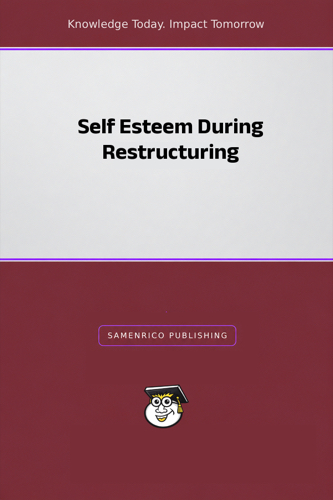
Self Esteem During Restructuring eBook
Stay confident when layoffs loom and role changes
Stay confident when layoffs loom and role changes create uncertainty.
Formats
Free sample
Chapter 1: The Borrowed Mirror--– You are not losing yourself. You are losing a reflection you were taught to mistake for yourself.Let me say that again, because it is the single most important sentence you will read in this entire book: You are not losing yourself. You are losing a reflection you were taught to mistake for yourself.If you picked up this book, chances are good that something has shifted in your professional life. Perhaps the rumors started three weeks ago—whispers of a “reorganization,” a “rightsizing,” a “strategic realignment.” Perhaps you have already sat through that meeting where the Power Point slides used gentle language to deliver brutal news. Perhaps your role has been changed, reduced, or eliminated entirely.
Or perhaps you are still employed but no longer recognize your job. Your responsibilities have been carved up and redistributed. Your team has been scattered. Your title remains the same, but the work beneath it has become unrecognizable.Whatever your specific situation, you are experiencing something that millions of professionals face every year, and almost none of them are prepared for: the collision between your identity and your employer’s spreadsheet. That collision is not merely stressful.
It is disorienting in ways that reach down into the very foundations of who you believe yourself to be. And the reason it feels so devastating is not because you are weak or overly attached to your job. It is because you have been looking into a borrowed mirror your entire career, and someone just took it away.This chapter is about understanding that mirror: where it came from, why you trusted it, and why losing it feels like losing yourself. More importantly, this chapter is about beginning the work of separating your true self from the reflections that have been loaned to you. By the time you finish reading, you will have a new way of understanding what restructuring actually does to a person.
You will have a practical tool for distinguishing between your role and your essence. And you will have a single sentence you can return to whenever the floor drops out from under you: My role changed. I did not.But first, we have to talk about how you got here. Because you did not arrive at this moment by accident. You arrived here by way of a culture that has been teaching you, since your very first job, to hang your sense of self on hooks that were never yours to keep.The Invisible Architecture of Work-Based Identity Let us be honest about something that most career advice books dance around: your job has probably become a central pillar of your identity.
Not just a source of income. Not just a place to spend your daylight hours. But a primary answer to the question “Who am I?”Think about the last time you met someone new at a party. Within the first three minutes, someone asked, “What do you do?” And you answered with your title, your company, perhaps a brief description of your responsibilities. That answer was not just small talk.
It was an identity statement. You were telling that stranger—and reminding yourself—where you belong in the social hierarchy, what kind of expertise you possess, how seriously you should be taken. Your job has been doing quiet identity work for you every single day, often without your conscious awareness.This is not your fault. We live in a culture that systematically encourages the fusion of self and work. From the moment we enter the workforce, we are rewarded for dedication, for loyalty, for going above and beyond.
We are given titles that confer status. We are assigned to teams that provide belonging. We are evaluated in performance reviews that feel like report cards on our very worth as human beings. Over time, the boundaries blur. You stop saying “I work as a marketing manager” and start saying “I am a marketing manager.” The verb shifts from action to identity.
And nobody warns you what happens when that identity is suddenly revoked.The problem with this fusion is not that caring about your work is wrong. Caring about your work is good. It is necessary for excellence, for creativity, for the kind of engagement that makes a career meaningful. The problem is that your employer does not share your fusion. To your employer, your role is a set of functions to be optimized, a line item in a budget to be adjusted, a resource to be allocated or eliminated based on quarterly forecasts and strategic priorities.
Your employer is not being evil. Your employer is being an employer. Organizations exist to achieve goals, not to provide their workers with stable identities. When those two purposes come into conflict, the organization will always choose its goals. And you will be left holding a mirror that has suddenly gone blank.This is the invisible architecture of work-based identity.
It is built over years, reinforced by promotions, praised by managers, envied by peers. And it collapses in an instant when the restructuring announcement arrives. The collapse feels catastrophic not because you have lost a job—though that is bad enough—but because you have lost the mirror that told you who you were in the world. You have been standing on a platform that was never bolted to the floor. You just did not know it.The Earthquake You Cannot See Let me give you a name for what you are experiencing.
Call it the invisible earthquake.Physical earthquakes announce themselves. The ground shakes. Buildings sway. Pictures fall off walls. There is no mistaking what is happening.
The invisible earthquake of restructuring is different. It happens entirely inside you, which makes it easy for other people to miss. Your colleagues may not notice that you have stopped sleeping. Your family may not understand why you seem distant or irritable. Your manager may be surprised when you stumble in a meeting, unaware that you spent the previous night spiraling through every mistake you have made in the last five years.But the invisible earthquake is real.
It is measurable. It has neurological, psychological, and physiological consequences that can last for months if left unaddressed.Here is what happens inside your brain when you learn that your role is changing or disappearing. Your amygdala—the ancient threat-detection system that has been keeping humans alive for hundreds of thousands of years—interprets the news as a survival threat. Not because you will literally starve, though financial fear is real. But because your brain has learned, over years of conditioning, that your job provides essential resources: social belonging, status, structure, purpose, and a coherent sense of self.
When those resources are threatened, the amygdala sounds the alarm. Cortisol and adrenaline flood your system. Your heart rate increases. Your digestion slows. Your prefrontal cortex—the rational, planning part of your brain—gets partially offline because your body believes it needs to fight or flee, not think clearly.This is why you cannot stop replaying the conversation with your manager.
This is why you wake up at 3 a.m. with your mind racing through worst-case scenarios. This is why you feel exhausted even though…
This is the end of the free sample. Get the eBook to keep going. Buy now
About this book
Details
- Author
- Westmoreland Oralia
- Publisher
- SamEnrico
- Language
- English
- Genre
- Non-Fiction, Self-Help
- Released
- 2026-06-09
- Pages (approx.)
- 134
- Available as
- eBook, Audiobook

Read better in the ZLOADR app
Your eBooks on your phone or tablet. Sign in with your SamEnrico account and start reading.
More by Westmoreland Oralia
 Peach Kucha PresentationWestmoreland Oralia$11.99
 Business Credit for Salons SpasWestmoreland Oralia$11.99
 Introvert Friendship GuideWestmoreland Oralia$11.99
 Castration as Spiritual PurificationWestmoreland Oralia$11.99
 Road Rage Success StoriesWestmoreland Oralia$11.99
 Growth Mindset for ParentsWestmoreland Oralia$11.99
 Forgiveness After Job LossWestmoreland Oralia$11.99
 The Wall Street Whisperer: Ivan Boesky and the Birth of Modern Insider TradingWestmoreland Oralia$11.99
 How to Start a Coated or Cored Wire Business (Beginners Guide)Westmoreland Oralia$11.99
 How to Produce Tripods and MonopodsWestmoreland Oralia$11.99
 A Collector's Handbook to the Jaguar E-type 4.2-litre 2+2Westmoreland Oralia$11.99
 Service Providers Guide to Basketball GoalsWestmoreland Oralia$11.99
You may also like
 Workplace Stress MeditationNguyen Lynn$11.99
 Volcano Monitoring ScientistCox Alexis$11.99
 The Tech Professional NetAguiar Nevada$11.99
 The Morning Metta RitualCanales Anya$11.99
 The Chunking Memory TechniqueClanton Hyacinth$11.99
 The Beginner Mistake FixAmmons Cassondra$11.99
 Surrendering to What IsGrimm Reatha$11.99
 Self Hypnosis for Fear of FireBillups Eli$11.99
 Road Rage for Professional DriversBrackett Janise$11.99
 Psychiatric Ward Nurse StressDunning Wyatt$11.99
 Observation vs Evaluation NVCTimmons Alda$11.99
 Networking for Nonprofit ProfessionalsPoole Jesse$11.99