
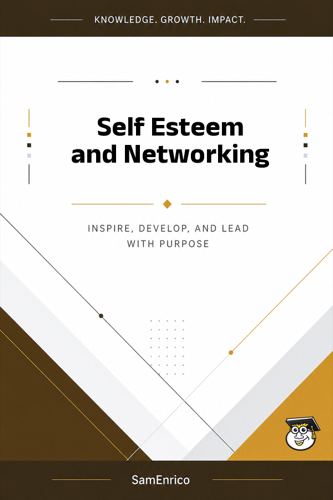
Non-FictionSelf-HelpNetworking Confidence
Self Esteem and Networking eBook
Build professional connections without anxiety usi
by Fitts Ines
Build professional connections without anxiety using this practical career guide.
Formats
Free sample
Chapter 1: The Bathroom Stall Strategy--–- I once spent twenty-seven minutes hiding in a bathroom stall at a professional conference. I was thirty-four years old, a senior director at a Fortune 500 company, and I had successfully managed teams of dozens of people. But I could not walk back into a room of strangers. I sat there, feet pulled up so no one would see my shoes, texting my wife: "Come pick me up. I can't do this."She replied: "You're a grown man hiding from business cards."She was right.
And she was wrong. She was right that the situation was absurd. She was wrong that the problem was cowardice. The problem was that every networking guide I had ever read was written by and for people who were not like me. Those guides assumed a brain that could walk into a room, scan for "targets," deliver an elevator pitch, and collect business cards like Pokémon.
That advice didn't just fail me. It actively made things worse.If you are reading this book, you have probably had your own bathroom stall moment. Maybe it was a conference, maybe a company happy hour, maybe a Zoom breakout room where you conveniently "lost connection." You know the feeling: the racing heart, the shallow breathing, the sudden certainty that everyone can see how nervous you are, the desperate calculation of the minimum time required to be polite before you can flee.Here is what I need you to understand before we go any further: Your discomfort is not a character flaw. It is data. And the data is telling you that traditional networking approaches don't fit your nervous system.
That is not your failure. It is the failure of the advice you were given.This chapter will do three things. First, it will normalize your experience by showing you how common networking anxiety really is. Second, it will give you a precise vocabulary for understanding what is actually happening in your body and brain when networking triggers you. Third, it will introduce a tool—the Personal Networking Audit—that will help you stop fighting your natural tendencies and start working with them.The Silent Majority: You Are Not Alone Let me tell you about a study that changed how I think about this problem.
Researchers at the University of Toronto asked over eight hundred professionals to describe their experience of networking. The results were striking. Nearly seventy percent described significant discomfort. Forty-two percent said they had actively avoided a professional event because of anxiety. And twenty-three percent—nearly one in four—reported that networking anxiety had directly harmed their career progression through missed opportunities or failed to advocate for themselves.Think about that.
One in four professionals has concrete evidence that their networking fear cost them something real—a promotion, a project, a connection that would have changed their trajectory.Here is what those numbers mean for you. When you are standing at the edge of a room, drink in hand, heart pounding, you are not alone. You are not broken. You are part of a massive silent majority who have been told to "just be confident" by people who have never experienced what you experience.The problem is not that you are unusually anxious. The problem is that the people writing networking advice are usually the ones who don't need it.
They are the natural schmoozers, the extroverts who get energy from crowds, the people for whom "working a room" is as natural as breathing. They write books for themselves, not for you.And then they sell those books to you, and you read them, and you try their techniques, and you fail, and you conclude that something is wrong with you.Nothing is wrong with you. The advice was wrong for you.The Three Faces of Networking Difficulty Here is where most networking guides make their first fatal mistake. They use words like "introvert," "shy," and "socially anxious" interchangeably, as if they were the same thing. They are not.
They are three completely different experiences that require three completely different strategies. If you have been trying the wrong strategy for your actual experience, no wonder you are exhausted.Let me break this down with precision.Introversion is about energy. Introverts are not necessarily afraid of people. They do not necessarily feel anxious in social situations. What introverts experience is a specific energy pattern: social interaction drains their batteries, and solitude recharges them.
An introvert can absolutely crush a networking event—and then need to lie down in a dark room for an hour afterward. The challenge for introverts is not performance. It is endurance and recovery.If you are an introvert, you have probably noticed that you are fine during the conversation but wiped out afterward. You might even enjoy the conversation while it is happening. The problem comes when you have to do three events in one week, or when the event is scheduled at the end of a long workday when your battery is already low.Shyness is about temperament.
Shy people experience hesitance in new situations or with unfamiliar people. Shyness is not fear of judgment—it is more like caution. The shy person might feel uncomfortable until they find their footing, but once they warm up, they are fine. Shyness is a starting condition, not a persistent state.If you are shy, you have probably noticed that you do fine once you know a few people in the room or once the conversation gets past the initial small talk. The first ten minutes are brutal.
The next two hours are fine.Social anxiety is about fear. Specifically, social anxiety is the fear of negative evaluation by others. The socially anxious person is not just drained or cautious. They are genuinely afraid that they will say something stupid, be judged as awkward, or be rejected. This fear is not rational in most professional settings—but it is not under rational control.
It is a conditioned response in the brain's threat-detection system.If you have social anxiety, you have probably noticed that your fear spikes before the event, during the event, and even after the event as you ruminate on everything you said. You might feel physical symptoms: racing heart, sweating, shortness of breath, even nausea. You might avoid events entirely, or you might attend but spend the whole time in a state of high alert.Here is the crucial point: these three experiences can overlap, but they are not the same. An introvert without social anxiety needs energy management strategies. A person with social anxiety who is also extroverted (yes, that exists) needs fear-management strategies.
A shy introvert with social anxiety needs all three.Throughout this book, when I use the word "anxiety," I am specifically referring to the fear of negative social evaluation. If you are an introvert without that fear, focus your attention on the energy management sections—the Personal Networking Audit in this chapter, the digital strategies in Chapter 11, and the boundary-setting in Chapter 10. If you have social anxiety, the scripts and pre-event routines throughout will be your primary tools.Why Your Brain Turns Networking into a Threat To understand why networking triggers such intense…
This is the end of the free sample. Get the eBook to keep going. Buy now
About this book
Details
- Author
- Fitts Ines
- Publisher
- SamEnrico
- Language
- English
- Genre
- Non-Fiction, Self-Help, Networking Confidence
- Released
- 2026-06-07
- Pages (approx.)
- 129
- Available as
- eBook, Audiobook

Read better in the ZLOADR app
Your eBooks on your phone or tablet. Sign in with your SamEnrico account and start reading.
More by Fitts Ines
 Improv Comedy for TeamsFitts Ines$11.99
 Guided Body Scan for BeginnersFitts Ines$11.99
 Self Hypnosis for Cluster HeadachesFitts Ines$11.99
 Bag Holding AnxietyFitts Ines$11.99
 Presentation Skills for BeginnersFitts Ines$11.99
 Parental Anger And BipolarFitts Ines$11.99
 The Silk Road Gambit: Han Dynasty's March to the WestFitts Ines$11.99
 The Forgotten General: The Wrongful Imprisonment of General Juan José TorresFitts Ines$11.99
 How to Produce Coke FuelFitts Ines$11.99
 University of Toronto AfricaFitts Ines$12.99
 Launching A Youtube Channel For Your Brand AuthorityFitts Ines$12.99
 African Bush Elephants: Everything You Need to Know About Savanna GiantsFitts Ines$11.99
You may also like
 Hong Kong Handover 1997Dunn Johnnie$11.99
 Zumba For Postnatal Recovery CourseNeal Christian$11.99
 Zumba for BeginnersLadner Nikia$11.99
 YouTube Comment Mining GuideHumes Pandora$12.99
 Worry Box MeditationCarlin Rudy$11.99
 Workplace Stress MeditationNguyen Lynn$11.99
 Workplace Stress and Sleep RepairHawley Ivory$11.99
 Workplace Perfectionism CureDelaney Jeffry$11.99
 Workplace Injustice Anger GuideWallen Isabelle$11.99
 Work Addiction and Burnout LinkGreenwood Ester$11.99
 Women in Yoga and WellnessBeattie Galina$11.99
 Women in Stand Up ComedyChun Evangeline$11.99