
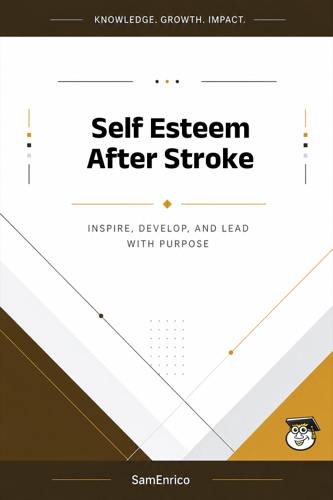
Non-FictionSelf-Help / Stroke Recovery
Self Esteem After Stroke eBook
Rebuilds identity and confidence following stroke-
by Wiese Jewell
Rebuilds identity and confidence following stroke-related disability.
Formats
Free sample
Chapter 1: The Stranger’s Face...--You are about to do something very difficult. You are going to look in a mirror—not the one on your bathroom wall, but the one inside your mind—and you are going to ask a question that has no easy answer: Who am I now?This is not a philosophical exercise. For a stroke survivor, it is a survival question. The person you were six months ago, or six weeks ago, or even six hours before the stroke—that person walked a certain way, spoke with a certain rhythm, knew without thinking which hand to reach with, and carried an invisible resume of competence: I am the one who drives. I am the one who fixes things.
I am the one who finishes sentences. I am the one people call when something breaks.Then the stroke came. And that person did not walk away. That person is still here—technically, biologically, legally. But that person cannot button a shirt.
Cannot find the word "refrigerator." Cannot trust their own balance. Cannot look at their reflection without seeing a face that seems to belong to someone else.This chapter is not about fixing you. It is about naming what has happened to you. Because you cannot rebuild a house while pretending the earthquake did not occur. And make no mistake: a stroke is an earthquake inside the architecture of the self.The Theft You Did Not See Coming Let us use the precise language for what you are experiencing.
It is not "low self-esteem" in the way that term is usually used. Low self-esteem, in the self-help industry, means you have an unflattering opinion of yourself. You think you are not smart enough, not attractive enough, not successful enough. The prescribed solution is to change your thoughts—to replace negative self-talk with positive affirmations, to visualize success, to "fake it until you make it."That advice is worse than useless for a stroke survivor. It is actively harmful.Because you are not suffering from a bad opinion of yourself.
You are suffering from a rupture in continuity—a break between the person your brain remembers being and the body it now inhabits. This is not a thought problem. This is an identity problem. And identity problems cannot be solved by repeating "I am strong and capable" while your weak arm lies motionless in your lap. Your brain is not stupid.
It registers the lie. And every time it registers the lie, your sense of self fractures a little more.The clinical term for what you are experiencing is ambiguous loss. Dr. Pauline Boss, who coined the term, studied families of missing soldiers and Alzheimer's patients—situations where a person is physically present but psychologically absent, or vice versa. Stroke creates a unique form of ambiguous loss: you are mourning the person you used to be, but that person is still sitting in the room with you.
You cannot hold a funeral for your former self because your former self is not dead. But you cannot go back to being that person either. You are stuck in the ambiguous space between.This is why you feel crazy. This is why you cry at odd moments. This is why you feel rage toward your own hand.
This is why you snap at the people who love you. You are not depressed in the clinical sense (though you may be, and that is treatable). You are disoriented in the existential sense. And existential disorientation requires a different kind of medicine.Why the Mirror Is Terrifying (And What to Do About It)For many stroke survivors, the bathroom mirror becomes an enemy. There are two reasons for this, and it is crucial to distinguish between them.Reason One: Neurological.
Depending on where your stroke occurred, you may have hemispatial neglect—a condition where your brain no longer processes one side of space. If you have left-side neglect, you may shave only the right side of your face. You may eat only the right side of your plate. And when you look in the mirror, you may literally not recognize the left half of your own face. This is not denial.
This is not avoidance. This is a wiring problem in your parietal lobe. Your brain is not receiving the data.Reason Two: Emotional. Even without neglect, facial droop, uneven expressions, or changes in muscle tone can make your reflection look like a stranger. You look for the familiar landmarks—the crinkle around your eyes when you smiled, the asymmetry that was yours—and they are gone.
In their place is a face that seems slack, or frozen, or wrong.These two reasons often combine. You cannot recognize your reflection because of neurology, and then you feel horror because of emotion. The horror makes the neglect worse, because anxiety narrows attention. You get stuck in a loop.The Mirror Protocol (from occupational therapy):Cover half the mirror. If you have left-side neglect, cover the left half.
If right-side neglect, cover the right half. Look only at the side your brain can process.Approach slowly. Do not surprise yourself. Walk toward the mirror at half speed, narrating out loud: "I am walking toward the mirror. I am three feet away.
I am two feet away."Name one unchanged feature. Say it out loud: "My left eye is still brown." "My right earlobe is still the same shape." "The freckle on my chin is still there." You are teaching your brain to find continuity, not difference.Look for no more than five seconds. Then turn away. The goal is not to "stare until you accept." The goal is to build tiny exposures that re-establish familiarity over weeks.This protocol will not cure neglect. But it will reduce the terror of the mirror, which is the first step toward recognizing yourself again.The Two-Column Journal: Separating Grief from Research The central exercise of this chapter is simple, low-energy, and designed for the cognitive fog that follows a stroke.
You will need a notebook or a piece of paper. Draw a vertical line down the middle. On the left side, write the heading: What I used to know about myself without thinking.Under this heading, list everything that used to be automatic. Do not judge the items. Do not rank them.
Just list. Examples from other survivors:"I could walk to the bathroom without planning the route.""I knew how to tie my shoes without looking.""I finished people's sentences.""I was the one who remembered birthdays.""I could drive to the grocery store without GPS.""I lifted my child with two arms.""I talked on the phone while chopping vegetables.""I knew the word for 'spoon' without searching for it."Write until you run out of items. This may take five minutes. It may take a week. There is no deadline.On the right side, write the heading: What I am re-learning about myself today.This is the research column.
Notice the verb: re-learning. Not "what I have lost." Not "what I can no longer do." Re-learning. Because the brain, even a damaged brain, is a learning machine. Neuroplasticity is not a buzzword; it…
This is the end of the free sample. Get the eBook to keep going. Buy now
About this book
Details
- Author
- Wiese Jewell
- Publisher
- SamEnrico
- Language
- English
- Genre
- Non-Fiction, Self-Help / Stroke Recovery
- Released
- 2026-06-06
- Pages (approx.)
- 135
- Available as
- eBook, Audiobook

Read better in the ZLOADR app
Your eBooks on your phone or tablet. Sign in with your SamEnrico account and start reading.
More by Wiese Jewell
 Vitamin K1 Blood Clotting GuideWiese Jewell$11.99
 LBO Modeling Excel TemplatesWiese Jewell$11.99
 Elmo Puppeteer Voice LifeWiese Jewell$11.99
 Pelvic During TrampolineWiese Jewell$11.99
 Hormonal Birth Control Side Effects GuideWiese Jewell$11.99
 Boomer Facebook UseWiese Jewell$11.99
 Creative Habits for ConsultantsWiese Jewell$11.99
 The Phantom of the Louvre: The Great Art Heist That Wasn’tWiese Jewell$11.99
 The Golden Scribes of Timbuktu: Guardians of Africa's Lost KnowledgeWiese Jewell$11.99
 How to Produce Paper ProductsWiese Jewell$11.99
 A Collector's Handbook to the Tvr TaimarWiese Jewell$11.99
 Hamsters: PET Hamster CareWiese Jewell$11.99
You may also like
 Hong Kong Handover 1997Dunn Johnnie$11.99
 Zumba For Postnatal Recovery CourseNeal Christian$11.99
 Zumba for BeginnersLadner Nikia$11.99
 YouTube Comment Mining GuideHumes Pandora$12.99
 Worry Box MeditationCarlin Rudy$11.99
 Workplace Stress MeditationNguyen Lynn$11.99
 Workplace Stress and Sleep RepairHawley Ivory$11.99
 Workplace Perfectionism CureDelaney Jeffry$11.99
 Workplace Injustice Anger GuideWallen Isabelle$11.99
 Work Addiction and Burnout LinkGreenwood Ester$11.99
 Women in Yoga and WellnessBeattie Galina$11.99
 Women in Stand Up ComedyChun Evangeline$11.99