
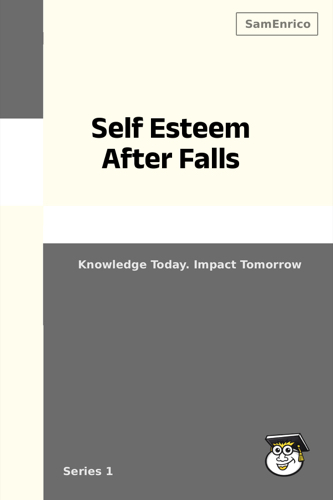
Non-FictionSelf-Help / Fall Prevention
Self Esteem After Falls eBook
Recovers confidence and reduces fear after injurio
by Bostick Hye
Recovers confidence and reduces fear after injurious falls.
Formats
Free sample
Chapter 1: The Second Fall...--–- The bruise on your hip will heal in six weeks. The one on your ego may take years. You did not expect that part. No one does.You planned for the physical recovery. You expected the ice pack, the compression bandage, the careful negotiation with stairs, the awkward explanation to neighbors about why you are moving more slowly.
You may have even anticipated the medical bills, the physical therapy referrals, the temporary dependence on a cane or walker or someone else’s arm. These are the visible consequences of a fall. They are the ones people ask about. They are the ones you can measure.But no one warned you about waking up at three in the morning, heart racing, because you shifted your weight in bed and felt, for one terrible second, the sensation of falling again. No one told you that you would stand in your own kitchen, staring at the floor as if it were a threat.
No one prepared you for the moment you would realize that the fall did not end when you hit the ground. It ended—or rather, it began—when you opened your eyes the next morning and saw a stranger in the mirror.That stranger is not older. That stranger is not more broken. That stranger is something far more disorienting: smaller.This is the silent epidemic of fall recovery. It is the psychological aftermath that no one discusses in the emergency room, the rehabilitation clinic, or the support group that focuses only on balance exercises and home safety checklists.
It is the erosion of self-esteem that happens not because you fell, but because you now believe something different about yourself. You believe you are fragile. You believe you are a burden. You believe that the person you were before the fall—the one who walked without thinking, who reached for high shelves without hesitation, who moved through the world with casual confidence—that person is gone, and you do not know how to get them back.This chapter is for the moment you realize you are afraid of your own body. It is for the shame that comes with that fear.
And it is for the question you have been too embarrassed to ask aloud: Is it normal to feel this way?The answer, which may surprise you, is yes. Not only is it normal—it is predictable, it is biological, and it is solvable.The Fall That No One Sees Let us distinguish between two very different events. The first is the physical fall: the loss of balance, the impact, the pain, the injury. This is the fall that leaves a mark on your medical chart. It is real, it is serious, and it deserves attention.
But it is not the fall that concerns this book.The second fall is psychological. It happens in the hours and days after the physical one. It is the moment you internalize the fall as evidence of who you are now. It is the voice that says, “If I fell once, I will fall again.” It is the creeping assumption that your body has betrayed you and cannot be trusted. It is the quiet collapse of self-worth that transforms a single accident into a permanent identity.I call this the Second Fall.
And it is far more damaging than the first.Consider the evidence. A person who has fallen once is significantly more likely to fall again—not primarily because of physical frailty, but because of fear. The fear of falling changes how you move. You shorten your stride. You stiffen your joints.
You walk more slowly, which paradoxically makes you less stable. You avoid turning your head to look around because the movement feels disorienting. You grip handrails with a force that actually throws off your center of gravity. In trying so hard not to fall, you become a fall waiting to happen.This is not speculation. It is the finding of decades of research on what geriatric specialists call “post-fall syndrome.” The fear itself becomes a risk factor.
And the fear is fueled by something deeper than instinct: it is fueled by a blow to your self-esteem that you may not even recognize as such.The Ego Bruise Let me ask you something honest. When you fell, what was the first thought that crossed your mind after the pain subsided? Not the practical thought—”I should call for help”—but the private one, the one you may not have said aloud.For many people, that thought sounds something like this: I am so stupid. Or I am so old. Or I am so weak.
Or, most devastating of all: This is how it starts.That thought is not a statement of fact. It is a judgment. And it lands not on your body but on your sense of self. You do not simply have a bruised hip. You have a bruised ego.
The difference is that the ego bruise does not show up on an X-ray, so you may be tempted to dismiss it as unimportant. But the ego bruise is the reason you hesitated at the top of the stairs this morning. It is the reason you avoided going to the mailbox yesterday. It is the reason you are reading this book instead of walking your dog.The ego bruise is the Second Fall.Here is what makes the Second Fall so insidious: it disguises itself as realism. It tells you that you are simply being cautious, that you are just acknowledging your limitations, that you are being wise to accept the new reality.
But caution and fear are not the same thing. Caution is a measured response to a genuine risk. Fear is a catastrophic overreaction that narrows your life until nothing is left but the small circle of floor you can reach without moving.The Second Fall is not wisdom. It is a cognitive distortion—an error in thinking that feels like truth because the emotion behind it is so strong.Why Your Brain Has Betrayed You To understand why the Second Fall happens, you need to understand a small but crucial piece of neuroscience. Deep in your brain, behind your eyes and slightly to the side, sits a pair of almond-shaped clusters of neurons called the amygdala.
Its job is simple: detect threats and sound the alarm.The amygdala does not think. It does not reason. It does not consider context or probability. It reacts. Millions of years of evolution have optimized it for speed, not accuracy.
When the amygdala detects a potential threat, it floods your body with stress hormones. Your heart rate increases. Your breathing becomes shallow. Your muscles tense. Your peripheral vision narrows.
This is the fight-or-flight response, and it is excellent for running from a predator. It is terrible for walking to the bathroom.Here is what happened when you fell. You were moving normally—walking, turning, reaching, stepping—and suddenly you were not. Your body experienced a sudden, unexpected loss of control. The amygdala, which had never classified “walking” as a threat before, made a rapid and irreversible decision: That movement is dangerous.Now, every time you approach a similar…
This is the end of the free sample. Get the eBook to keep going. Buy now
About this book
Details
- Author
- Bostick Hye
- Publisher
- SamEnrico
- Language
- English
- Genre
- Non-Fiction, Self-Help / Fall Prevention
- Released
- 2026-06-09
- Pages (approx.)
- 134
- Available as
- eBook, Audiobook

Read better in the ZLOADR app
Your eBooks on your phone or tablet. Sign in with your SamEnrico account and start reading.
More by Bostick Hye
 Call Protection and Make WholeBostick Hye$11.99
 Trace Minerals Deficiency HandbookBostick Hye$11.99
 Family Guy Voice MemoirBostick Hye$11.99
 Boomer Travel PreferencesBostick Hye$11.99Boomer Travel PreferencesBostick Hye$11.99
 Creative Habits for LawyersBostick Hye$11.99
 TED Talk Style GuideBostick Hye$11.99
 Pelvic Floor Workout LogBostick Hye$11.99
 The Wind in Their Sails: How the Dutch Conquered the SeasBostick Hye$11.99
 The Phantom of the Grand Hotel: The Unsolved 1929 Disappearance of Agnes DriscollBostick Hye$11.99
 How to Produce Counterfeit Electronic ComponentsBostick Hye$11.99
 Greenland Dogs: Arctic Sled DogBostick Hye$11.99
You may also like
 Hong Kong Handover 1997Dunn Johnnie$11.99
 Zumba For Postnatal Recovery CourseNeal Christian$11.99
 Zumba for BeginnersLadner Nikia$11.99
 YouTube Comment Mining GuideHumes Pandora$12.99
 Worry Box MeditationCarlin Rudy$11.99
 Workplace Stress MeditationNguyen Lynn$11.99
 Workplace Stress and Sleep RepairHawley Ivory$11.99
 Workplace Perfectionism CureDelaney Jeffry$11.99
 Workplace Injustice Anger GuideWallen Isabelle$11.99
 Work Addiction and Burnout LinkGreenwood Ester$11.99
 Women in Yoga and WellnessBeattie Galina$11.99
 Women in Stand Up ComedyChun Evangeline$11.99