
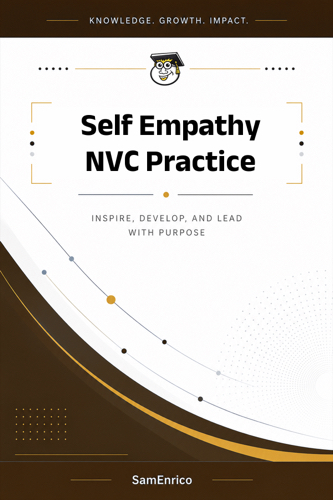
Non-FictionSelf-HelpSelf Compassion
Self Empathy NVC Practice eBook
Turn compassion inward by connecting with your own
Turn compassion inward by connecting with your own feelings and needs.
Formats
Free sample
Chapter 1: The Jackal on Your Shoulder--–- You wake up before your alarm. Not because you are rested, but because your mind is already running. Within thirty seconds—before you have even turned your head on the pillow—the voice begins. "You should have gone to bed earlier. You are going to be exhausted all day.
You always do this. Why can't you just get your act together?" By the time your feet touch the floor, you have already been scolded, judged, and found wanting. You have not yet spoken a single word to another human being, and already you have been verbally abused. The perpetrator and the victim are the same person: you.This is the Jackal on your shoulder. It is the internal voice that speaks the language of moralistic judgment, blame, diagnosis, and demand.
It calls you "lazy," "stupid," "too much," "not enough," "dramatic," "weak," or "broken." It tells you what you should have done, what you must do, what you deserve, and what you will never be. For most people, this voice is so constant, so familiar, that they mistake it for their own true thinking. They believe that this is simply what it means to have a conscience, to be self-aware, to hold oneself accountable. They are wrong.This chapter makes a diagnosis. It names the internal language that keeps millions of people trapped in cycles of shame, guilt, anxiety, and depression.
It draws on the work of Marshall Rosenberg, the founder of Nonviolent Communication (NVC), who distinguished between "life-alienating" communication (violent, judgmental, and disconnected from human needs) and "life-serving" communication (compassionate, honest, and connected to what is alive in us). The Jackal—Rosenberg's metaphor for the judging mind—speaks the language of life-alienation. And when that language is directed inward, it becomes a form of self-violence that is as destructive as any external attack.But here is the radical reframe that changes everything: The Jackal is not your enemy. The voice on your shoulder is not a demon to be exorcised, a monster to be slain, or a flaw to be eliminated. It is a desperate, tragic messenger.
It is trying desperately to alert you to an unmet need—using the only tools it has, which happen to be violence and shame. The content of its message ("You are failing," "You should have known better," "You are not safe") is a clumsy, tragic attempt to signal a legitimate need for learning, safety, belonging, or integrity. The delivery—the shouting, the cruelty, the shame, the timing—is the problem. The messenger itself is not the enemy. We do not silence the messenger.
We simply ask them to stop shouting.This distinction—between the content (the need signal) and the delivery (the Jackal attack)—is the single most important paradigm shift in this entire book. Get this right, and everything else will follow. Get this wrong, and you will spend years trying to kill a part of yourself that is only trying to help.The Language of Self-Violence: How You Learned to Bully Yourself Before Breakfast Before we can transform the Jackal, we must recognize its voice. The language of self-violence has specific, identifiable features. It is not simply "being hard on yourself" or "having high standards." It is a distinct linguistic structure that research in cognitive psychology and neuroscience has shown to be correlated with depression, anxiety, and reduced problem-solving capacity.Moralistic Judgments: These are words that label your entire self as good or bad, right or wrong, rather than describing specific actions or their effects.
"I am a bad parent." "I am a failure." "I am an idiot." Notice that these statements do not describe any observable behavior. They describe an identity. And once you have labeled yourself as "bad," there is no pathway to improvement—only shame and hiding.Demands and "Shoulds": The words should, must, ought, have to, supposed to and their negative counterparts (should not, must not) are the grammar of coercion. When you say "I should have exercised today," you are not describing a need for health or vitality. You are threatening yourself with punishment for a past failure.
"Should" is a time machine that takes you to a past you cannot change and beats you there.Diagnosis and Blame: This is the language of psychoanalysis turned against the self. "I am depressed." "I have anxiety." "I am codependent." "I am an addict." These statements may be clinically accurate, but when used as internal Jackal language, they function as life sentences. They imply a fixed, unchangeable identity rather than a temporary state connected to unmet needs. The Jackal also blames others: "They made me feel this way." "If they had just listened, I wouldn't be angry." This violates the NVC principle of Stimulus vs. Cause, which we will explore in depth in this chapter.Comparisons and Rankings: "I am behind." "Everyone else is ahead." "I am the worst one in the room." The Jackal loves hierarchies.
It measures your worth against an invisible yardstick and always finds you wanting. Comparative language triggers the brain's threat response, flooding the system with cortisol and shutting down the prefrontal cortex—the very part of the brain you need for creative problem-solving.The Grammar of Entitlement: "I deserve better than this." "I have earned a break." While these phrases may sound like self-advocacy, they often function as hidden demands on the universe. When the universe does not deliver what you "deserve," the Jackal uses the gap between expectation and reality as evidence of your victimhood.Take a moment to read through that list again. Notice which forms of Jackal language appear most frequently in your own internal monologue. For most people, "shoulds" and moralistic judgments are the most common.
They are also the most destructive.The Myth of the "Inner Critic": Why the Enemy Metaphor Fails The self-help world has spent decades telling you to "silence your inner critic," to "ignore the negative voice," to "kill the imposter syndrome." This advice is well-intentioned. It is also wrong. Here is why.When you try to silence a part of yourself, that part does not disappear. It goes underground. It becomes a shadow.
It finds sneakier, more destructive ways to express itself. The voice that you try to kill does not die; it goes to the gym, gets stronger, and waits for a moment of weakness. This is why people who have done years of "positive thinking" and "affirmations" often find themselves collapsing into even deeper self-hatred when they make a mistake. They have not transformed the Jackal. They have simply suppressed it.The metaphor of the "enemy" also creates an internal civil war.
You are now fighting against a part of yourself. That war is exhausting. It consumes the very energy you need for creativity, connection, and growth. And wars have only two outcomes: one side wins, or they both lose. Either way, a part of you is destroyed.
That is not healing. That is amputation.The alternative metaphor: the desperate, tragic messenger. Imagine a young child who has been locked out of the house in a thunderstorm. That child is terrified. They need shelter, safety, and warmth.
But they do not know how to ask calmly. They scream. They pound on the door. They throw rocks at…
This is the end of the free sample. Get the eBook to keep going. Buy now
About this book
Details
- Author
- Richie Gearldine
- Publisher
- SamEnrico
- Language
- English
- Genre
- Non-Fiction, Self-Help, Self Compassion
- Released
- 2026-06-10
- Pages (approx.)
- 143
- Available as
- eBook, Audiobook

Read better in the ZLOADR app
Your eBooks on your phone or tablet. Sign in with your SamEnrico account and start reading.
More by Richie Gearldine
 Harvard Extension School Grading SystemRichie Gearldine$11.99
 The Sauna Detox GuideRichie Gearldine$11.99
 Cold War Embassy EscapeRichie Gearldine$11.99
 The Siege of Chigirin: The Cossacks' Last Stand Against the TsarRichie Gearldine$11.99
 How to Produce Bicycle JerseysRichie Gearldine$11.99
 Discourse Analysis Proposal GuideRichie Gearldine$12.99
 SAP Functional AnalystRichie Gearldine$11.99
 How to Start a Non-alcoholic Beverages (commission Agent) Business (Beginners Guide)Richie Gearldine$11.99
You may also like
 Hong Kong Handover 1997Dunn Johnnie$11.99
 Zumba For Postnatal Recovery CourseNeal Christian$11.99
 Zumba for BeginnersLadner Nikia$11.99
 YouTube Comment Mining GuideHumes Pandora$12.99
 Worry Box MeditationCarlin Rudy$11.99
 Workplace Stress MeditationNguyen Lynn$11.99
 Workplace Stress and Sleep RepairHawley Ivory$11.99
 Workplace Perfectionism CureDelaney Jeffry$11.99
 Workplace Injustice Anger GuideWallen Isabelle$11.99
 Work Addiction and Burnout LinkGreenwood Ester$11.99
 Women in Yoga and WellnessBeattie Galina$11.99
 Women in Stand Up ComedyChun Evangeline$11.99