
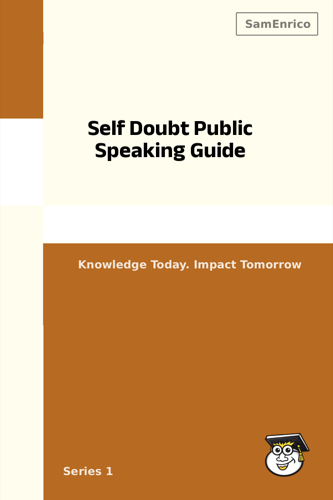
Non-FictionSelf-HelpPublic Speaking
Self Doubt Public Speaking Guide eBook
Overcomes fear that audiences will discover you do
by Dees Jaunita
Overcomes fear that audiences will discover you don't know what you're talking about.
Formats
Free sample
Chapter 1: The Fraud Alarm–- You are standing backstage. The hum of the crowd leaks through the heavy curtain. Your notes feel flimsy in your sweaty hands. You glance at them for the thirtieth time, and suddenly—a thought arrives, not as a whisper but as a conviction: What if someone in that room actually knows what they’re talking about? What if they ask a question I can’t answer?
What if they see right through me?Your heart rate doubles in two seconds. Your mouth goes dry. A voice inside—calm, certain, and utterly wrong—says: You don’t belong here. You’ve fooled everyone to get this far, but tonight is the night they find out.You consider faking a sore throat. You check your phone for an “urgent” message that isn’t there.
You fantasize about a fire alarm.If any of this feels familiar, you are not broken. You are not uniquely incompetent. And you are certainly not alone. You are experiencing what this book calls the Fraud Alarm—a primitive, overprotective neurological response that has nothing to do with your actual knowledge and everything to do with your brain’s desperate attempt to keep you safe from social danger.This chapter is about understanding that alarm. Not silencing it—because you cannot silence a fire alarm by smashing it with a hammer—but learning to read its message correctly.
By the time you finish this chapter, you will know why the fraud alarm rings loudest for competent people, why feeling like a fake is statistically unrelated to being one, and how to distinguish between the kind of self-doubt that makes you better and the kind that tries to make you mute.The Anatomy of a False Alarm Let us begin with a story about a woman who had every reason to feel confident. Her name was Maya Angelou. She had written eleven books by the time she was asked to speak at a major literary event. She had received a Pulitzer nomination. She had recited a poem at a presidential inauguration.
And yet, before every single speech, she reported the same internal experience: “I think, ‘Uh-oh, they’re going to find out now. I’ve run a game on everybody, and they’re about to discover me.’”Maya Angelou, one of the most celebrated voices in American letters, felt like a fraud before she opened her mouth.Howard Schultz, the former CEO of Starbucks who grew the company from eleven stores to more than fifteen thousand, once admitted that before every major shareholder presentation, he was convinced someone would stand up and expose him as someone who had just gotten lucky. Albert Einstein, near the end of his life, told a friend that he felt like “an involuntary swindler” whose work was not as original as people believed.These are not outliers. In a study of over 1,500 professionals across medicine, law, academia, and technology, researchers found that nearly seventy percent reported experiencing impostor phenomenon at some point in their careers. The rates were highest not among beginners, but among people who had been promoted within the last eighteen months—people who had objective evidence of their competence.Here is what you need to understand: The fraud alarm does not measure reality.
It measures perceived risk.Your brain evolved in an environment where social exclusion could mean death. Being rejected by your tribe—being “found out” as a non-contributor—was a literal survival threat. Your amygdala, the brain’s threat-detection center, has not updated its software for the age of Power Point presentations. When you stand in front of an audience, your ancient neural circuits scan for the same dangers your ancestors faced around a campfire. The fact that you are being watched by dozens or hundreds of faces triggers a cascade of stress hormones designed for physical danger, not rhetorical missteps.And here is the cruel irony: the more you care about doing a good job, the louder the alarm rings.
The fraud alarm is not a sign that you are unqualified. It is a sign that you are invested.The Cognitive Distortion That Fuels the Fire The fraud alarm does not operate alone. It brings friends—specifically, a set of cognitive distortions that turn a vague unease into a full-blown conviction that you are about to be unmasked.The most powerful of these distortions is called mind reading. Mind reading is the tendency to assume you know what other people are thinking, and more specifically, that they are thinking the worst about you. In public speaking, mind reading sounds like this: “They’re bored.” “They think I’m rambling.” “That person in the third row just crossed their arms—they definitely think I’m wrong.”The problem with mind reading is that you are terrible at it.
Research on emotional recognition shows that humans correctly identify what another person is feeling only about fifty percent of the time—roughly the same as random chance. When you add the stress of public speaking, your accuracy drops even further. That person who crossed their arms? They might have been cold. They might have been thinking about a fight with their spouse.
They might have been practicing a yoga breathing technique. But your fraud alarm told you they were judging you, and you believed it because the alarm feels like truth.A second distortion is selective abstraction—focusing on one piece of negative information while ignoring all the positive. You could deliver twelve minutes of a fifteen-minute talk with clarity and confidence, but the one moment you stumbled over a word becomes the only data point that matters. Your brain discards the evidence of competence and magnifies the evidence of imperfection.A third distortion is catastrophizing—imagining the worst possible outcome and treating it as inevitable. “If I forget this statistic, they will think I’m an amateur.
If they think I’m an amateur, I’ll lose credibility. If I lose credibility, I’ll never be invited to speak again. My career will be over.” Notice how quickly a forgotten number becomes a ruined life. Your fraud alarm is an expert catastrophizer.The antidote to these distortions is not positive thinking. Positive thinking—telling yourself “I’m great, I’m wonderful, they love me”—often backfires because your brain knows you’re lying.
The real antidote is cognitive reframing backed by evidence. And the first piece of evidence you need is the most counterintuitive finding in the psychology of competence.The Reverse Dunning-Kruger Effect You have probably heard of the Dunning-Kruger effect. It is the well-documented finding that incompetent people overestimate their abilities. A novice chess player thinks they are better than they are. A beginner guitarist confidently plays out of tune.
The unskilled lack the very expertise they need to recognize their own incompetence.But there is a mirror image to this phenomenon, and it is far more relevant to your public speaking fear. Psychologists call it impostor syndrome or the reverse Dunning-Kruger effect: competent people systematically underestimate their abilities. They assume that what comes easily to them comes easily to everyone. They mistake their hard-won knowledge for common sense.Here is how this works in…
This is the end of the free sample. Get the eBook to keep going. Buy now
About this book
Details
- Author
- Dees Jaunita
- Publisher
- SamEnrico
- Language
- English
- Genre
- Non-Fiction, Self-Help, Public Speaking
- Released
- 2026-06-09
- Pages (approx.)
- 138
- Available as
- eBook, Audiobook

Read better in the ZLOADR app
Your eBooks on your phone or tablet. Sign in with your SamEnrico account and start reading.
More by Dees Jaunita
 Second Generation Body ImageDees Jaunita$11.99
 Anger and IntimacyDees Jaunita$11.99
 The Interruption Scripting HandbookDees Jaunita$11.99
 Charlie Parker BirdDees Jaunita$11.99
 Whole30 Paleo Weight LossDees Jaunita$11.99
 Sleep Memory For Shift WorkersDees Jaunita$11.99
 REIT Income GuideDees Jaunita$11.99
 The Neon Underground: How a Secret Jazz Club Outlasted the MafiaDees Jaunita$11.99
 Whispers of the Marid: The Djinn of the AbyssDees Jaunita$11.99
 How to Produce Frosting and IcingDees Jaunita$11.99
 Understanding Fisher SyndromeDees Jaunita$11.99
 A Collector's Handbook to the Buick ElectraDees Jaunita$11.99
You may also like
 Hong Kong Handover 1997Dunn Johnnie$11.99
 Zumba For Postnatal Recovery CourseNeal Christian$11.99
 Zumba for BeginnersLadner Nikia$11.99
 YouTube Comment Mining GuideHumes Pandora$12.99
 Worry Box MeditationCarlin Rudy$11.99
 Workplace Stress MeditationNguyen Lynn$11.99
 Workplace Stress and Sleep RepairHawley Ivory$11.99
 Workplace Perfectionism CureDelaney Jeffry$11.99
 Workplace Injustice Anger GuideWallen Isabelle$11.99
 Work Addiction and Burnout LinkGreenwood Ester$11.99
 Women in Yoga and WellnessBeattie Galina$11.99
 Women in Stand Up ComedyChun Evangeline$11.99