
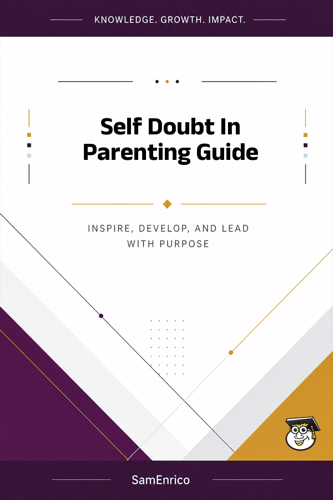
Self Doubt In Parenting Guide eBook
Helps parents trust their instincts despite consta
Helps parents trust their instincts despite constant fear of messing up kids.
Formats
Free sample
Chapter 1: The Algorithm of Fear--It is 2:17 in the morning. You are not sleeping. You are holding your phone three inches from your toddler's face, angling the screen toward a faint rash on their cheek that you swear was not there at bedtime. The child is peacefully asleep, breathing steadily, utterly unaware that you have just spent forty-five minutes spiraling through Web MD, Reddit parenting forums, and a mommy blog written by a woman whose child has never eaten a processed food in its entire life. You have now convinced yourself of three things: the rash is meningitis, the slight warmth on their forehead is early sepsis, and the fact that they rolled over in their sleep means they are having a febrile seizure.
Your heart is pounding. Your palms are sweaty. You have not peed in six hours. And somewhere, in the very back of your exhausted brain, a tiny voice whispers: This is insane. They are fine.
Go to sleep.But you do not go to sleep. Because the other voice—the loud one, the algorithmic one, the one fed by a billion dollars of behavioral psychology designed to keep you scared and scrolling—is screaming: But what if you are wrong? What if this is the one time you should have worried? What if every other parent would have known what to do?Welcome to modern parenting. Welcome to the era of the 2 AM scroll.
Welcome to the algorithm of fear.The Great Unmaking of Parental Confidence There is a cruel irony at the heart of the digital age. We were told that access to information would empower us. We were told that the sum total of human knowledge, available instantly in our pockets, would make us better, wiser, more capable parents. Silicon Valley sold us a dream: you will never be confused again, because the answer is always just a search away.Instead, that promise has become a nightmare. Because the answer is not just a search away.
The answers are a search away—plural, conflicting, overwhelming, and specifically curated to maximize your anxiety rather than minimize it.Before smartphones, parents operated within a small, manageable circle of information. They had their pediatrician, whom they called during office hours, not at 2 AM. They had their own mother or father, whose advice might be outdated but whose presence was calming. They had two or three close friends with children of similar ages. They had a few well-worn books—maybe Dr.
Spock, maybe What to Expect When You're Expecting—that sat on a shelf and gathered dust between readings. And they had their own two eyes. That was it. That was the whole ecosystem. And within that ecosystem, parental confidence was not guaranteed—parenting has never been easy—but it was possible.
Because there was no algorithm whispering that you were failing, that you were behind, that you were the only one who did not know the secret.Today, the average parent encounters more parenting opinions before breakfast than their own grandmother encountered in an entire year. Every diaper rash is a potential yeast infection. Every late milestone is potential autism. Every tantrum is potential oppositional defiant disorder. Every picky eating phase is potential ARFID.
Every night waking is potential sleep apnea. And every single one of these possibilities comes with a comment section full of strangers who seem absolutely certain that they would handle it better, that their children never did that, that you must be doing something wrong.The algorithm, you see, does not reward reassurance. It rewards fear. Fear generates clicks. Clicks generate ad revenue.
Ad revenue keeps the servers running. So the algorithm has learned, with terrifying precision, to show you the worst-case scenario first. You search for "toddler rash" and it shows you meningitis before it shows you the five benign explanations. You search for "baby not crawling at ten months" and it shows you neuromuscular disorders before it shows you the perfectly normal range of six to thirteen months. You search for "two-year-old tantrum" and it shows you articles about behavioral disorders before it shows you the simple truth that two-year-olds tantrum because they are two.The algorithm is not your enemy in the sense that it hates you.
It does not know you exist. It is your enemy in the sense that it is structurally incapable of caring whether you sleep. It only cares that you keep scrolling. And the most effective way to keep you scrolling is to keep you just scared enough to need one more article, one more opinion, one more data point before you can possibly make a decision.The Paradox of More Information Here is the paradox that undoes so many parents: more information does not lead to better decisions. It leads to delayed decisions, anxious decisions, or no decisions at all.Psychologists have a name for this phenomenon: analysis paralysis.
When presented with too many options or too much conflicting data, the human brain short-circuits. Instead of acting, we freeze. Instead of trusting our gut, we Google. Instead of noticing that our child is clearly fine—eating, playing, smiling, sleeping—we demand a second opinion, then a third, then a fourth, until we have consulted the entire internet and still feel no more certain than when we began. In fact, we feel less certain.
Because every new source introduces new doubts, new edge cases, new possibilities that we had not previously considered.Consider a simple example. Your three-year-old falls off a chair. They cry for thirty seconds, then get up and run away to play. In 1985, a parent would have checked for blood, given a hug, and moved on with their day. In 2025, that same parent pulls out their phone, searches "toddler fall head injury," reads seven conflicting articles about concussions, watches a You Tube video on how to check pupils, texts a photo of the child's head to two different group chats, and spends the next three hours waking the child up every thirty minutes "just to be safe." The child is fine.
The child was always fine. The child never had a concussion. But the parent is not fine. The parent has lost three hours of sleep, raised their cortisol levels, and reinforced a neural pathway that says danger is everywhere and you cannot trust your own judgment.This is not parenting. This is a trauma response dressed up as due diligence.
And it is becoming the default mode of raising children in the digital age.Dr. Spock's Radical Message In 1946, Dr. Benjamin Spock published The Common Sense Book of Baby and Child Care. It sold fifty million copies. It changed the course of parenting in the Western world.
And its most famous line—the one that has echoed through generations, the one that every parenting book since has had to contend with—was this: "Trust yourself. You know more than you think you do."Think about how radical that statement was when Spock wrote it. He was writing in an era of rigid, doctor-knows-best, behaviorist parenting. The prevailing wisdom was that parents were amateurs and experts were professionals, and amateurs should defer to professionals on everything. Spock said the opposite.
He said that you, the parent, are the expert on your own child. Not because you have a medical degree.…
This is the end of the free sample. Get the eBook to keep going. Buy now
About this book
Details
- Author
- Haskins Selma
- Publisher
- SamEnrico
- Language
- English
- Genre
- Non-Fiction, Self-Help, Parenting
- Released
- 2026-06-10
- Pages (approx.)
- 137
- Available as
- eBook, Audiobook

Read better in the ZLOADR app
Your eBooks on your phone or tablet. Sign in with your SamEnrico account and start reading.
More by Haskins Selma
 Second Generation Civic DutyHaskins Selma$11.99
 Sleep Memory For CaregiversHaskins Selma$11.99
 Anger and SexualityHaskins Selma$11.99
 Working Memory in Software DevelopmentHaskins Selma$11.99
 Managing Meeting Interruptions WorkbookHaskins Selma$11.99
 Primal Diet Weight Loss GuideHaskins Selma$11.99
 Bucket Strategy GuideHaskins Selma$11.99
 The Curse of the Red Sox: 86 Years of HeartbreakHaskins Selma$11.99
 Dashimi’s Will to Win: The Untold Story of Japan’s First Olympic Mindset CoachHaskins Selma$11.99
 How to Become a Marine Railway OperatorHaskins Selma$11.99
 ARIPO Examination Process GuideHaskins Selma$12.99
 A Collector's Handbook to the Buick Empire Series 80 DaHaskins Selma$11.99
You may also like
 Hong Kong Handover 1997Dunn Johnnie$11.99
 Zumba For Postnatal Recovery CourseNeal Christian$11.99
 Zumba for BeginnersLadner Nikia$11.99
 YouTube Comment Mining GuideHumes Pandora$12.99
 Worry Box MeditationCarlin Rudy$11.99
 Workplace Stress MeditationNguyen Lynn$11.99
 Workplace Stress and Sleep RepairHawley Ivory$11.99
 Workplace Perfectionism CureDelaney Jeffry$11.99
 Workplace Injustice Anger GuideWallen Isabelle$11.99
 Work Addiction and Burnout LinkGreenwood Ester$11.99
 Women in Yoga and WellnessBeattie Galina$11.99
 Women in Stand Up ComedyChun Evangeline$11.99